Which Boss pedal will make the biggest difference to your playing? Start with the function your setup is missing: responsive overdrive, heavier distortion, spacious reverb, a practice looper, or dependable tuning.
The BD-2 Blues Driver is a strong starting point for versatile drive, while the DS-1 offers straightforward rock distortion. The RV-6, RC-1, and TU-3 solve different problems rather than competing for the same job. These are category recommendations, not a universal sound-quality ranking.
Top Boss Pedals for Guitar
Boss BD-2 Blues Driver
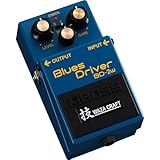
- Overdrive Effects Guitar Pedal with Tube Amplifier Simulation
- Switchable Custom Voice Mod
- Newly revised, all-analog discrete amplifier circuit
The Boss BD-2 Blues Driver covers lightly roughened clean sounds, crunchy rhythm guitar, and more saturated lead tones. Despite its name, it is not restricted to blues. Its broad gain range makes it useful for roots music, indie, classic rock, and other styles where picking dynamics matter.
Its main attraction is responsiveness. Pick gently or reduce your guitar’s volume, and the sound becomes cleaner; dig in, and the grit increases. The amount of cleanup depends on pickup output, gain settings, and the amplifier, so expect an interaction rather than an identical result in every rig.
For players comparing Boss overdrive pedals, the BD-2 generally sounds less mid-focused than the SD-1 Super OverDrive. That makes it a practical choice when you want an overdrive to provide much of the character rather than primarily tightening an already-distorted amp.
The three controls keep adjustments accessible:
- Level sets output volume and how hard the pedal pushes the next device.
- Tone adjusts brightness.
- Gain moves from mild breakup toward more substantial distortion.
Starting setting: Put Gain around 9 o’clock, Tone slightly below noon, and adjust Level until switching the pedal on does not create a distracting volume jump. Increase gain only after hearing that baseline.
The limitation is its upper-frequency bite. Higher gain and brighter tone settings can become grainy through an already-bright amplifier. Turning down Tone is often more useful than immediately changing the amp’s entire EQ.
Positioned in the mid-range of this selection, the standard BD-2 offers useful flexibility without requiring a premium edition.
Verdict: Buy it for expressive, general-purpose overdrive. Skip it if your main requirement is a tightly focused boost into an already-driven amp or a completely unchanged clean signal.
Boss DS-1 Distortion

- Legendary Distortion Heritage: Used by guitarists everywhere since...
- Pioneering Sound Design: First distortion pedal from BOSS defined a bold...
- Clear Hard-Edged Attack: Remains clear even at maximum distortion settings...

The Boss DS-1 Distortion is a straightforward route to a harder-edged guitar sound. Compared with the BD-2, its character is more obviously distorted and compressed, with a pronounced attack that suits rock riffs, power chords, and cutting lead parts.
It is particularly appropriate for a guitarist whose amplifier has a usable clean sound but lacks an appealing distortion channel. Its budget-friendly positioning also makes it approachable for someone exploring dedicated distortion without committing to a more elaborate high-gain pedal.
The controls are simple: Distortion determines saturation, Tone changes the frequency balance, and Level sets output. That simplicity makes the DS-1 easy to understand, but it does not mean every setting works equally well.
Amp voicing matters considerably. A bright clean amplifier can emphasize the pedal’s sharper edges, while an amp already approaching breakup may blend with it more smoothly. Pickup choice also changes the result: a bright bridge single-coil can demand a different Tone setting from a darker humbucker.
Starting setting: Try Distortion around 10 o’clock and Tone around 9–10 o’clock. Match Level to your bypassed sound before deciding whether you need more saturation or brightness.
Avoid assuming that noon is the neutral or ideal position for every knob. If the sound becomes thin or fizzy, reduce Tone and reassess before adding more gain. Listen to full chords as well as single notes; a setting that makes a lead line exciting may make rhythm parts less distinct.
Its chief limitation is restricted tone shaping. One Tone control cannot independently adjust bass, treble, and the middle frequencies.
Verdict: Buy it for accessible rock distortion with minimal controls. Skip it if you need detailed EQ, highly specialized metal sounds, or an overdrive that closely follows every small change in picking strength.
Boss RV-6 Reverb
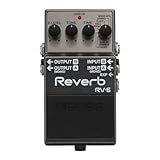
- Compact and Versatile Design: Compact and versatile reverb pedal with rich...
- Simple and Intuitive Controls: Dial in sophisticated, top-level reverb...
- Studio-Grade Sound Quality: Newly developed studio-grade algorithms powered...
The Boss RV-6 Reverb can add a small sense of space or become a central part of an atmospheric guitar sound. Its eight modes cover conventional reverbs alongside more expansive textures, making it useful for players who move between ordinary rhythm parts and ambient passages.
For everyday playing, Room or Plate can keep a dry amplifier from feeling unnaturally close. Use a restrained effect level and decay so notes remain clear. For spacious arrangements, Modulate adds movement, while Shimmer introduces an upper-octave texture that can turn sustained chords into a backdrop.
The controls balance accessibility and range. E.Level adjusts the amount of reverb, Tone shapes its brightness, and Time changes decay. The mode selector determines the underlying reverb character, so changing modes can be more productive than repeatedly adjusting the same three knobs.
Starting setting: Select Plate, keep E.Level around 9 o’clock, and place Tone and Time near noon. For an ambient variation, switch to Modulate and increase Time gradually without immediately raising the effect level.
Mono and stereo connections give it room to grow with a larger rig. Its expression-pedal connection can also control effect level, allowing more movement than the enclosure alone suggests. Check the manual’s connection instructions, particularly if you want wet-only operation.
The RV-6 occupies the premium end of this particular selection, but the useful distinction is its range of applications rather than price alone.
Its main limitation is performance recall. There are no onboard preset memories for instantly switching between a short room sound and a long ambient wash. Changing those settings during a song requires planning.
Verdict: Buy it for conventional reverb and atmospheric sounds in one compact enclosure. Skip it if stored presets, MIDI integration, or instant access to several programmed sounds are essential to your performance.
Boss RC-1 Loop Station

- User-Friendly Loop Station: Experience a new level of fun with our most...
- Creative Layering Capability: The RC-1 allows you to create musical...
- Comprehensive Looping Functions: Experience the fun of looping when you...
The Boss RC-1 Loop Station records a phrase and plays it repeatedly while you add another part. It is a practice tool rather than a conventional tone effect: its value comes from helping you work on timing, improvisation, harmony, and arrangements.
Record a chord progression, close the loop, and play a melody over it. You can then overdub additional material onto the same repeating passage. This makes the RC-1 especially useful for guitarists who want to hear how their parts fit together without opening recording software.
Its circular indicator is a practical feature. The illuminated segments show loop progress, giving you a visual reference for the beginning and end of the phrase. That is helpful when learning to make a clean transition between the final beat and the first beat.
The RC-1 specifications list up to 12 minutes of stereo recording time. The recorded phrase remains in memory after the power is turned off, so a useful practice backing does not have to disappear at the end of a session.
However, retention is not the same as an extensive phrase library. The RC-1 is built around one current loop, not a collection of independently selectable song memories.
Starting approach: Record four bars of simple chords with a steady pulse. Concentrate on closing the loop accurately before adding overdubs. A clean, well-timed foundation is more useful than several layers masking an uneven transition.
Stereo inputs and outputs accommodate stereo effects, and an optional external footswitch can make stopping or other supported operations more convenient.
Verdict: Buy it for focused, uncomplicated looping and practice. Skip it if you need built-in drum rhythms, multiple saved songs, USB file management, or separate tracks that can be brought in and out independently.
Boss TU-3 Chromatic Tuner

- Industry-Leading Stage Tuner: Tune your guitar or bass on stage with the...
- Durable Construction with High-Visibility Display: Housed in a tank-tough...
- Adjustable LED Meter: 21-segment LED meter with brightness control for...
The Boss TU-3 Chromatic Tuner addresses a more fundamental need than any overdrive or reverb: getting the guitar in tune quickly and quietly. It is a utility pedal, not a tone effect, but that does not make its contribution less important.
It suits rehearsals, gigs, and home pedalboards where stopping to attach a clip-on tuner is inconvenient. The illuminated display provides a clear tuning reference, and High Brightness mode helps when ambient light makes a normal display harder to read.
The TU-3 offers chromatic tuning alongside guitar and bass modes. Chromatic mode is particularly useful when you want the tuner to identify notes freely rather than follow a standard string sequence. Its specified tuning accuracy is ±1 cent.
Output choice matters. The main Output mutes the signal while tuning, allowing silent adjustments between songs. The Bypass output remains active, which is useful in some routing arrangements but does not provide the same silent-tuning behavior.
Starting setup: Place the TU-3 early in the signal chain, use its main Output, and tune with a clean, sustained note. If tracking seems inconsistent, mute unused strings and avoid striking the string excessively hard.
Its buffered bypass can help drive the signal through subsequent cables. However, a buffer is not an automatic cure for every pedalboard problem, and some pickup-sensitive vintage-style fuzz circuits may behave differently when placed after one.
The power-output socket adds convenience when used with a suitable supply and distribution cable. It passes along available power; it does not generate additional capacity.
Its limitation is straightforward: if you already have dependable muted tuning in your setup, another tuner may add little.
Verdict: Buy it when visible, foot-operated, silent tuning fills a genuine gap. Skip it when your existing tuner already handles those jobs comfortably.
Choosing the Right Boss Pedal for Your Rig
Match the Effect to Your Amp and Pickups
The best Boss pedals for guitar depend partly on what happens before and after them. A drive pedal feeding a clean amplifier provides much of the distortion itself. The same pedal feeding an already-driven amp may primarily change attack, sustain, and frequency balance.
Higher-output pickups push a pedal harder, so a setting that sounds lightly crunchy with one guitar can become considerably more saturated with another. Amplifier headroom matters too: increasing pedal output may produce more distortion rather than a louder solo.
Compare sounds at similar perceived volumes. A louder setting can initially seem fuller or more exciting even when its underlying tone is not better suited to the song.
If you are choosing the best pedals for a Boss Katana, first explore the amp’s existing effects. A separate pedal makes most sense when it provides easier foot control, a specific sound, or a function your current setup lacks.
Check Power, Routing, and Footswitch Requirements
Verify every selected model against its own manual before connecting power or accessories. Check voltage, polarity, current draw, and the required connector rather than assuming all compact pedals have identical needs.
The models here use 9-volt power arrangements, but their current requirements differ. A supply must provide adequate current for each output and sufficient total capacity for everything connected.
Routing also deserves attention. The BD-2 and DS-1 are mono pedals; the RV-6 and RC-1 offer stereo connections. Stereo capability only delivers a stereo result when the rest of the signal path supports it.
Check external-control compatibility before buying a footswitch or expression pedal. Similar-looking sockets do not guarantee interchangeable accessories.
These selections use buffered bypass, but that should not be generalized into a claim that every Boss product has the same bypass design. Consider the entire chain, including any fuzz pedal sensitive to what precedes it.
Other Boss Effects Worth Understanding
Different Drive Circuits Solve Different Problems
Overdrive, distortion, and fuzz overlap, but their intended roles differ. The SD-1’s mid emphasis and reduced low-end weight can tighten a driven amp. A common approach is low Drive with higher Level, rather than using it as a full-frequency clean boost.
The MT-2 Metal Zone offers more detailed shaping through its sweepable, parametric-style midrange EQ. Start with modest boosts and cuts: extreme settings can become harsh or hollow. Its flexible high-gain distortion is not synonymous with the HM-2-style chainsaw sound.
For fuzz, the FZ-1W provides Vintage and Modern modes. Vintage emphasizes expressive response and cleanup, while Modern offers a fuller, more focused voice with greater gain. It is a practical contemporary design, not a direct replacement for every sound associated with collectible FZ-2 models.
Delay and Chorus Add Different Kinds of Space
Delay produces distinct repeats, whereas reverb creates a more continuous impression of reflections. The DD-8 Digital Delay includes clean digital, analog-style, tape-style, and reverse sounds, with tempo entry through its pedal switch or a compatible external footswitch. Its compact controls trade immediacy for versatility.
The DM-2W Analog Delay instead serves players specifically seeking analog repeats and their changing texture.
Chorus adds movement through a modulated delayed signal. The CE-2W includes CE-2-derived chorus plus CE-1-derived chorus and vibrato modes, with mono input and stereo outputs. The DC-2W emphasizes dimension-style widening instead. Waza Craft features are worth considering when those particular modes matter—not simply because the label denotes a premium range.
FAQ
Are Boss pedals considered the best?
Boss pedals are widely established choices, but no brand is best for every guitarist. Effect character, control layout, routing, and budget matter more than a universal ranking. A compact pedal with straightforward controls may suit a working setup better than a more elaborate alternative with features you rarely use.
Which Boss pedal should a beginner buy first?
A beginner should buy a tuner first if dependable tuning is not already covered, then choose an effect the amplifier lacks. Avoid duplicating several built-in sounds immediately. One clearly useful pedal is easier to learn and can reveal more about your preferences than several overlapping purchases.
Are Boss Waza Craft pedals worth the extra cost?
Waza Craft pedals can justify their premium when their additional modes, particular voicings, or routing options solve a specific need. They are not automatically a better fit for every player. Compare the features you will actually use rather than assuming a higher price guarantees a more suitable sound.
Can Boss pedals work with any guitar amplifier?
Most guitar-focused Boss compact pedals can work with many guitar amplifiers, provided connections and signal levels are appropriate. The results still vary substantially. Distortion into a bright clean channel behaves differently from distortion into an already-saturated channel, while time-based effects may remain clearer in a suitable effects loop.
Conclusion
Build your pedalboard around missing functions rather than overlapping sounds. Reliable tuning, an appropriate gain texture, and well-chosen ambience can cover considerable musical ground. Add complexity only when it improves control or opens a sound you genuinely need; a focused setup is easier to understand, adjust, and enjoy.