What Makes an IEM Vocal-Focused
A vocal-focused IEM gives voices an audible, convincing place within the mix without letting bass or treble dominate them. That does not necessarily mean an aggressively boosted midrange.
Three qualities deserve separate attention:
- Vocal clarity: how easily you can follow words, harmonies, and phrasing.
- Vocal forwardness: how close or prominent the singer appears relative to instruments.
- Natural vocal timbre: whether voices retain believable weight, texture, and tonal character.
Frequency response influences all three, but brighter tuning is not automatically clearer or more natural. Excessive upper-midrange energy can make singing forceful, while prominent treble can exaggerate consonants. The best in-ear monitors for vocal-heavy music balance intelligibility with comfortable, believable reproduction.
Best Vocal-Forward IEMs
Kiwi Ears Astral

The Kiwi Ears Astral is a high-performance, seven-driver hybrid in-ear monitor engineered to deliver a powerful, highly engaging, and spacious acoustic presentation. Utilizing a sophisticated array consisting of a single ten-millimeter dynamic driver and six customized balanced armatures per ear, this monitor masterfully achieves an energetic V-shaped or warm U-shaped signature without sacrificing technical fidelity.
The defining asset of its performance is the authoritative, subwoofer-like low end. Equipped with a bioceramic diaphragm dynamic driver designed with an electrical roll-off at 300 Hz, the bass region produces an immense, visceral sub-bass rumble and a tactile mid-bass punch. This configuration isolates the low-end energy entirely from the rest of the spectrum. As a result, the bass notes maintain outstanding control, speed, and texture, providing heavy dynamic impact while preventing any bloating or bleed into the lower midrange.
Despite the heavy bass shelf, the midrange remains remarkably transparent and organic. Balanced armatures track a specific pinna curvature peak at 2.8 kHz, which expertly pushes the upper midrange forward to highlight vocal clarity and instrumental layering. While female vocals sound exceptionally sweet, airy, and prominent, certain deep male vocals can occasionally sound slightly recessed or thin due to a lean lower-midrange transition. Handling the high registers, a modified ultra-high-frequency dual-tweeter system extends the treble smoothly. It extracts intricate micro-details and cymbals shimmer with crystalline clarity, steering clear of harsh or metallic sibilance. Driven at 23 ohms, the monitor throws an expansive, three-dimensional holographic soundstage, offering the precise imaging required for tracking complex musical arrangements or competitive gaming layouts.
TANCHJIM Nora — A Candidate for Listening and Recording
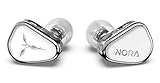
- 【Engineered for Professional Monitoring】NORA precisely separates each...
- 【Flagship DMT5 Driver Architecture】NORA is equipped with a driver based...
- 【Unique Acoustic Chamber Design】Inside the front acoustic cavity, NORA...
The TANCHJIM Nora is a wired in-ear monitor positioned around enhanced vocals and instruments, making it relevant for listeners who also record audio or livestream.
Its appeal is versatility: vocal intelligibility matters both when enjoying an acoustic performance and when checking spoken or sung audio. However, “vocal enhanced” does not establish whether voices sound naturally balanced or simply more prominent. Listeners sensitive to upper-midrange emphasis should distinguish those qualities before buying.
For recording, check the connection requirements of your interface and whether you need a separate microphone. Earphones reproduce the monitoring feed; they do not replace a recording microphone or create a suitable monitor mix.
Choose this candidate if listening and content creation overlap in your routine. Avoid assuming its professional positioning guarantees stage-ready isolation or a secure fit during movement.
Verdict: A relevant option for vocal-centered listening and recording, provided its fit and tonal balance suit your needs.
Tipsy M1 — A Candidate for Warm Vocals

- START WITH TIPSY M1, GROW WITH TIPSY: M1 features our world‑first Bamboo...
- TRUSTED BY MUSICIANS & CREATORS: Join 10,000+ musicians and creators who...
- WARM, LIVELY SOUND WITH POWERFUL BASS & RICH VOCALS: Enjoy punchy...
The Tipsy M1 is a wired IEM featuring a bamboo-fiber diaphragm, resin shells, and a detachable 0.78 mm two-pin connection. Its positioning emphasizes warmth, lively bass, and vocals rather than a strictly lean presentation.
That makes it worth considering if voices often sound thin through your existing earphones. Warmth can give lower-register singing more substance, but additional bass is helpful only when it does not obscure lyrics or soften articulation.
The detachable connection offers replacement flexibility, although replacement cables must match the connector arrangement. Resin construction alone does not guarantee comfort: shell shape, nozzle dimensions, and eartips remain important.
Its stated isolation figure should not be treated as a guaranteed real-world reduction across all frequencies. A poor seal can undermine both isolation and bass consistency.
Verdict: A candidate for listeners seeking fuller voices and an energetic presentation; less compelling for those prioritizing restrained bass and maximum vocal separation.
Choosing the Right Vocal Presentation
Fuller Vocals and Lower-Midrange Body
The lower midrange contributes weight and warmth, but adding mid-bass does not universally fix thin vocals. Excess bass can mask quieter vocal information. Start by deciding whether voices lack body or merely sit too far behind instruments.
Forward Vocals and Upper-Midrange Presence
Upper-midrange emphasis can make singers more immediate, but excessive presence creates shoutiness. J-pop and anime vocals are useful listening examples because energetic choruses quickly expose discomfort—not because every listener needs the same tuning.
Vocal Tuning: Body, Presence, and Sibilance
Natural vocals require balance, not simply louder mids:
1. Body: Lower-midrange energy gives voices substance.
2. Clarity: Controlled mid-bass reduces masking in dense arrangements.
3. Presence: Upper mids improve intelligibility, but excess can sound shouty.
4. Smoothness: Treble peaks can exaggerate “s” and “sh” sounds.
Vocal register and recording matter more than rigid male-versus-female rules. Familiar tracks should include a lower voice, a higher voice, and a busy arrangement.
EQ Before an IEM Upgrade
For thin vocals, experiment with a broad parametric EQ boost of approximately 1–2 dB around 300–400 Hz. Stop if the result becomes muddy: lower-midrange warmth can also thicken instruments.
Reducing excessive bass may improve clarity more effectively than boosting mids. Allow negative preamp headroom when boosting, as explained in an IEM EQ guide. A dongle DAC primarily solves connection or output problems, not unsuitable tuning.
Vocal Listening Versus Stage Monitoring
Pleasant playback does not guarantee dependable stage monitoring. Singers need stable isolation, reliable fit while moving, an intelligible monitor mix, and compatibility with their wired or wireless system.
Custom in-ear monitors may improve fit consistency, but universals can work well too. Consult a dedicated IEM guide for singers before choosing a performance setup.
FAQ
Can EQ make an IEM better for vocals?
Yes. Modest EQ changes can reduce bass masking, restore vocal body, or soften an aggressive presence region. Check the seal first, then adjust one frequency area at a time. When boosting frequencies, lower the preamp sufficiently to preserve headroom and reduce digital clipping risk.
Conclusion
Choose vocal-focused IEMs by the balance you prefer: fuller body, clearer presence, or smoother long-session listening. Secure fit comes first. Audition familiar recordings when possible, and use a return policy to protect against an uncomfortable or unsuitable match.