Top OneOdio Headphones
OneOdio Focus A10 Wireless Active Noise Cancelling Headphones

- Industry-Leading Noise Cancellation: Equipped with a 5-microphone hybrid...
- Up to 62 Hours Long Battery Life: Ultra-long noise cancelling time with up...
- Hi-Res Audio & Powerful Sound: Equipped with high-performance drivers...
Best-fit user: A listener who prioritizes commuting, office use, and wireless convenience over studio-style connections.
The OneOdio Focus A10 belongs to a different category from the brand’s wired DJ headphones. Its key distinction is hybrid active noise cancellation: microphones and electronic processing work together to reduce some external sound before it reaches your ears.
That makes it a more relevant starting point for transport and steady background noise than a model offering passive isolation alone. ANC generally works most effectively against continuous low-frequency sounds, such as ventilation or an engine’s rumble. Speech, sudden impacts, and higher-frequency noise remain more difficult to suppress.
“Hybrid” describes the system’s microphone arrangement; it is not a guarantee of exceptional cancellation. Performance also depends on the ear-pad seal, glasses, hair, and how the headphones sit on your head. Manufacturer claims about cancellation depth should not be interpreted as equal noise reduction across every frequency.
Generation checking is especially important with the A10. Older review material and newer Focus A10 listings should not automatically be treated as descriptions of identical hardware. Confirm the exact version, supported connections, controls, and included accessories.
Battery comparisons require similar care. An “up to” figure is a manufacturer’s estimate under particular conditions, not a promise for every listener. ANC status, playback volume, codec, calls, and temperature can affect runtime. Compare ANC-on figures with ANC-on figures rather than mixing operating modes.
For calls, a built-in microphone can be convenient, but noise cancellation for your ears does not prove that your voice will sound clear to someone else. Microphone noise processing is a separate capability.
Pros
- Hybrid ANC addresses a need that passive-only DJ headphones do not.
- Wireless operation suits commuting and general everyday listening.
Con
- Version differences and incomplete test conditions make headline specifications difficult to compare confidently.
Verdict: Consider the Focus A10 when travel noise reduction matters more than instrument connectivity. Skip it for latency-sensitive monitoring, and confirm the current version before relying on older specifications.
OneOdio Monitor 60 Professional Studio Headphones for Recording and Mixing
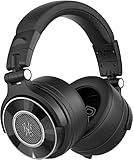
- Superior Sound Quality for Professionals: Engineered for audiophiles and...
- Enhanced Noise Isolation for Focused Listening: Designed with closed-back...
- Comfortable, Adjustable Fit for Long Sessions: The ergonomic design...
Best-fit user: Someone who needs wired monitoring in a shared room, home recording setup, or practice space.
The OneOdio Monitor 60 is the more monitoring-focused option in this selection. Its appeal lies in combining a wired connection with a closed-back design and practical physical adjustment, rather than adding commuting features.
Closed-back earcups can help reduce sound escaping into the room and limit some external noise entering your listening space. That is useful when checking a recording near other people or monitoring beside a live microphone. It does not mean that leakage disappears completely.
Fit matters as much as the label. A gap around the pads can weaken bass reproduction and reduce isolation. Glasses, ear shape, and headband adjustment can therefore change both what you hear and what nearby people hear.
The supplied product description identifies an adjustable steel headband, reinforced hinge construction, and 90-degree rotating earcups. Those are practical features for changing listening position and accommodating different head shapes. They do not establish long-term durability, but they are more relevant to everyday handling than an extended frequency-response claim.
Wired operation avoids Bluetooth transmission delay and eliminates charging as part of the monitoring workflow. Confirm the current cable bundle and connector arrangement against your equipment rather than assuming every OneOdio wired headphone includes the same leads.
The main limitation is that closed-back construction does not establish sound accuracy. Enclosed earcups affect acoustic behavior, and a monitoring label is not a substitute for frequency-response measurements or familiarity with reference recordings.
Before using any unfamiliar headphones for important mix decisions, learn how well-known music translates through them. Check bass, vocal level, and brightness against another playback system when possible.
Pros
- Closed-back construction is practical for shared spaces and recording environments.
- Wired operation and rotating earcups suit straightforward monitoring.
Con
- Its monitoring positioning does not, by itself, verify neutral sound or sufficient isolation for a loud room.
Verdict: Choose the Monitor 60 for a dedicated wired monitoring role. Skip it if you mainly want portable ANC, wireless calls, or an open-back listening experience.
OneOdio Pro50 High Resolution Headphones

- (Good Balance and Vibrating Sound) High quality sound quality from Pro...
- (Excellent Wearing and High Sound Isolating Performance) Made in Japan...
- (Musical Instrument Practice, Music Share) Comes with 0.25 inch (6.35 mm...
Best-fit user: A shopper comparing entry-level wired models who has a specific reason to move beyond the Pro-10.
The OneOdio Pro-50 deserves a more cautious recommendation than its name might suggest. A higher model number does not establish better sound, stronger construction, greater comfort, or better value.
Its relevant role is as an alternative wired model, not an automatic upgrade. The purchase decision should turn on documented differences in the exact current package: pad construction, included cables, connector compatibility, replacement-part availability, and return terms.
Comfort can justify choosing one wired headphone over another, but it is personal. Deeper pads may give some ears more room, while different padding can alter clamping pressure and heat buildup. Product photographs can help show shape, but they cannot establish how a pair will feel after an hour.
Sound comparisons require even more restraint. Terms such as “premium,” “Hi-Res,” and “professional” do not demonstrate a more balanced frequency response. A headphone can reproduce a broad frequency range while still emphasizing bass or treble in ways that affect monitoring decisions.
The supplied material establishes the Pro-50 as a related model but does not provide enough consistent current documentation to confirm a meaningful upgrade over the Pro-10. Consequently, it should remain an alternative to investigate rather than a confidently ranked winner.
If you are considering it for gaming or calls, confirm microphone support explicitly. A detachable headphone cable does not necessarily include a microphone, and a stereo connector does not carry microphone audio simply because it fits your device.
Pros
- Provides another wired option for shoppers comparing fit and package details.
- May make sense when a documented accessory or comfort difference addresses a specific need.
Con
- The available evidence does not establish a clear current advantage over the Pro-10.
Verdict: Choose the Pro-50 only when you can identify a verified difference that matters to your setup. Otherwise, the better-documented Pro-10 is the more straightforward starting point.
OneOdio A70 Bluetooth Over-Ear Headphones

- Dual Mode and Never Power Off - Enjoy up to 72 hours of playtime in...
- High-Resolution Sound Quality by Professional Audio Team - With custom-made...
- Maximum Comfort and Space-Saving Design - The over-ear, ergonomic design is...
Best-fit user: Someone who wants one pair for everyday Bluetooth listening and occasional wired use with music equipment.
The original OneOdio A70 occupies a useful middle ground between a conventional wireless headphone and an entry-level wired monitoring model. Its distinguishing benefit is the ability to change connection methods rather than committing to one workflow.
Bluetooth suits music, podcasts, and everyday listening without a cable running to your device. Its wired 3.5 mm and 6.35 mm connectivity is more relevant when connecting to an instrument’s headphone output, a mixer, or compatible audio equipment.
That flexibility needs one important qualification: wireless listening and wireless monitoring are different jobs. Bluetooth introduces delay through audio encoding, transmission, and buffering. You may barely notice it during music playback, but it can become distracting when playing an instrument or monitoring your voice.
For those tasks, use the analog connection and the equipment’s direct-monitoring function where available. A wired cable removes Bluetooth from the signal path, although software and audio-interface settings can still introduce their own delay.
Model identity matters here. The original OneOdio A70 and Fusion A70 GEN 2 are separate versions. Battery figures, Bluetooth features, controls, and accessories should be matched to the exact generation. A listing carrying an A70 name is not enough reason to transfer every specification from another version.
The original A70 is described with sound isolation rather than ANC. Its earcups can provide a physical barrier, but they do not electronically cancel engine noise. Microphone operation also needs checking separately: a microphone available over Bluetooth may not work through an ordinary stereo cable.
Pros
- Combines everyday wireless listening with useful analog connections.
- Reduces the need for separate casual-listening and basic practice headphones.
Con
- Ordinary Bluetooth is unsuitable for timing-critical monitoring and reliable DJ cueing.
Verdict: Buy the original A70 when connection flexibility is your priority. Skip it if you primarily need strong commuting noise reduction or expect Bluetooth to behave like a direct cable connection.
OneOdio Pro 10 Wired Over Ear Headphones

- Studio-Grade Sound Accuracy: Features 50mm large-aperture drivers with...
- Broadcast-Ready Boom Mic: Detachable cardioid microphone with...
- Universal Dual-Mode Compatibility: Connect via dual 3.5mm/6.35mm cables to...
Best-fit user: A beginner who needs straightforward wired headphones for a keyboard, audio interface, computer, or DJ mixer.
The OneOdio Pro-10, also called the Studio Pro-10, makes its strongest case through connectivity rather than promises of professional-grade accuracy. Its detachable cable arrangement accommodates both 3.5 mm and 6.35 mm connections, making it useful across consumer devices and music equipment.
The supplied product documentation describes a coiled 3.5 mm-to-6.35 mm cable and a shorter 3.5 mm cable with an inline microphone. Check the exact package before ordering, because a standard headphone bundle and a microphone-equipped bundle are not necessarily interchangeable.
Its 90-degree swiveling earcups are particularly useful for single-ear monitoring. A beginner DJ can listen to a cue through one ear while keeping the other open to the room. For keyboard practice or podcast editing, the detachable cable also makes storage and replacement more manageable than a permanently attached lead.
The closed-back construction provides passive isolation, not active noise cancellation. A good ear-pad seal can soften outside noise, but these headphones should not be treated as a substitute for ANC during travel—or hearing protection in a loud venue.
OneOdio emphasizes bass in the Pro-10’s product descriptions. That positioning may suit enjoyable listening and following a beat, but “studio” branding does not establish neutral reproduction. Likewise, its 50 mm drivers do not prove that it is more detailed than a headphone with smaller drivers.
Pros
- Detachable cables accommodate common consumer and music-equipment connections.
- Swiveling earcups support convenient single-ear monitoring.
Con
- Bass-focused positioning makes it an uncertain choice for judging tonal balance without additional references.
Verdict: Buy the Pro-10 for budget-friendly wired practice, cueing, and general monitoring. Skip it if your main requirement is ANC, wireless convenience, or a verified neutral reference for mixing.
Choosing the Right OneOdio Headphones
The most useful selection rule is simple: match the connection and enclosure to the job before comparing sound-related marketing claims.
1. For recording and instrument practice, prioritize a direct wired connection.
2. For commuting, prioritize ANC, fit, and manageable controls.
3. For shared rooms, prioritize a comfortable closed-back seal.
4. For calls, verify microphone operation in your intended connection mode.
5. For long sessions, give fit and return terms more weight than driver size.
Wired and Wireless Connections
Wired connections are usually the simplest option for audio interfaces, mixers, keyboards, and electronic drums. They avoid Bluetooth transmission delay and do not require a charged headphone battery for passive analog listening.
Check the output itself. A device needs a headphone-compatible output, not merely a socket of the right size. A guitar’s raw instrument output, for example, is not equivalent to an amplifier’s headphone output.
Wireless connections are convenient for moving around, listening from a phone, and taking occasional calls. However, Bluetooth availability does not establish suitability for latency-sensitive monitoring. Even a connection described as low latency needs a stated operating mode, compatible source, and meaningful end-to-end evidence.
Open-Back and Closed-Back Designs
Closed-back headphones are the more practical starting point for shared spaces, recording, and listening near other people. Their enclosed earcups help contain sound, although isolation varies substantially with design and fit.
Open-back headphones allow more sound to pass through the earcups. They leak music outward and offer limited protection against external noise. That makes them better suited to a quiet, private room than a commute or microphone-based recording session.
Neither design guarantees accurate reproduction. Choose the enclosure for your environment, then assess tuning separately.
Active Noise Cancellation and Passive Isolation
Passive isolation comes from the physical barrier created by the earcups and pads. ANC uses microphones and electronic processing to reduce some incoming noise.
The Pro-10’s passive isolation is not ANC. Similarly, closed-back construction alone does not mean a headphone contains noise-cancelling electronics.
ANC can reduce the temptation to overpower steady background noise with louder playback. Nevertheless, consumer ANC headphones are not a substitute for certified hearing protection in hazardous environments.
Microphone and Device Compatibility
For gaming or calls, check four things: whether a microphone is included, where it is located, which cable carries its signal, and whether your device accepts that signal.
A computer with separate headphone and microphone sockets may require a suitable splitter. A USB-C device may need an adapter supporting microphone input, not just headphone playback.
Also confirm whether a wireless headphone’s microphone works in wired mode. Audio compatibility and microphone compatibility are separate requirements.
Key OneOdio Model Comparisons
OneOdio Pro-10 vs Pro-50
For a OneOdio Pro-10 vs Pro-50 decision, start with the differences you can verify rather than assuming the latter is superior.
The Pro-10 has clearly described practical features: detachable cables, 3.5 mm/6.35 mm connectivity, and swiveling earcups. The supplied information does not establish a sufficiently clear current Pro-50 advantage to justify an automatic upgrade recommendation.
Compare exact package contents and fit-related details. If the Pro-50 costs more without providing a documented benefit you need, its model number is not a persuasive reason to spend extra.
OneOdio A70 vs Focus A10
Choose between these models according to the problem you need to solve.
The original A70 emphasizes wired/wireless flexibility, including connections relevant to music equipment. The Focus A10 emphasizes wireless everyday listening with hybrid ANC.
For instrument practice, the A70’s analog connectivity is the more relevant feature. For steady travel noise, the A10’s ANC is more relevant.
Do not compare their battery claims unless the operating conditions match. Also separate the original A70 from Fusion A70 GEN 2, and match A10 information to the exact current version.
Getting Better Results From Your Headphones
A suitable headphone can still disappoint if the connection, fit, or playback settings are wrong. A few setup checks can prevent unnecessary returns and make comparisons more meaningful.
Check the Entire Audio Path
Connect wired headphones to a proper headphone output and make sure the plug is fully seated. A partially inserted connector can produce missing vocals, uneven channels, or intermittent sound.
If you hear delay while recording through a cable, inspect your software monitoring settings. The problem may be the computer’s buffer rather than the headphones. An audio interface’s direct-monitoring feature can bypass that software delay.
For wireless calls, selecting a microphone mode can change playback quality on some devices. Check your operating system’s input and output selections before judging the headphone’s sound.
Prioritize Fit Before Equalization
Position the cups so the pads surround your ears consistently. Hair or glasses can break the seal, changing bass response and isolation.
Wear the headphones long enough to notice pressure points, heat, and ear contact. A fit that seems comfortable for two minutes may become distracting during a longer practice session.
Only adjust equalization after establishing a repeatable fit. Otherwise, you may compensate for a temporary seal problem rather than the headphone’s actual tonal balance. Keep changes modest and reduce excessive boosts if they cause distortion.
Read Specifications as Clues, Not Scores
Driver diameter, impedance, and frequency range describe different aspects of a headphone; none is a standalone quality ranking.
Impedance must be considered alongside sensitivity and the source’s output capability. Do not buy an amplifier solely because one headphone has a higher impedance figure.
Likewise, an unusually wide advertised frequency range does not tell you whether vocals sound natural or bass is balanced. The supplied Pro-10 descriptions contain conflicting frequency-response figures, so those numbers are not used here to separate the choices.
FAQ
Is OneOdio a good headphone brand?
OneOdio can be worth considering when a particular model matches your connection needs and budget. However, sound balance, comfort, construction, microphone performance, and noise cancellation vary across the range. Judge the exact model and package rather than assuming the brand name guarantees consistent performance for every use.
What headphones do audiologists recommend?
There is no universal headphone brand that audiologists recommend for everyone. Appropriate choices depend on fit, hearing needs, listening environment, and listening habits. Comfortable headphones that allow clear listening at moderate levels can help. Anyone experiencing tinnitus, pain, or hearing changes should seek individualized advice from a qualified hearing professional.
What is a safe listening level for headphones?
A safe listening level depends on both loudness and exposure duration, so a device’s volume percentage is not a reliable universal guide. Keep playback comfortable, take breaks, and reduce exposure when listening for extended periods. Ringing, discomfort, or muffled hearing afterward are reasons to stop and seek advice if symptoms persist.
Do noise-cancelling headphones protect your hearing?
Noise cancellation can make background noise less distracting and may help you avoid turning music up unnecessarily. However, ordinary consumer noise-cancelling headphones are not certified hearing protection. For concerts, power tools, industrial work, or other hazardous noise, use appropriately rated protection rather than relying on an electronic listening feature.