Could a different pair of silicone ear tips make your IEMs more comfortable, stay in place longer, and sound more consistent? Often, yes—but only when the replacement tips fit both your ear canals and your earphones.
The best IEM silicone ear tips are not necessarily the softest, widest, or most expensive. They are the tips that attach securely to your IEM’s nozzle, create a dependable acoustic seal, and remain comfortable without being pushed farther into your ears than necessary. A well-chosen replacement can solve slipping, inconsistent bass, or uncomfortable pressure. A poorly matched one can introduce those same problems.
Best Silicone Ear Tips for IEM
SpinFit W1

- Double W-shaped Tube Core to Enhance Stability.
- SpinFit patented spinnable 3D axis that bends to fit unique ear canals...
- Medical-Grade silicone reduces allergic reactions.
Who should consider it: Listeners whose existing tips seal inconsistently because the IEM nozzle does not line up comfortably with the angle of their ear canal.
SpinFit W1 silicone tips combine a flexible connection with a double W-shaped tube core. The flexible section allows the outer portion of the tip to change angle relative to the nozzle, while the core is designed to support attachment stability. That makes the W1 a useful candidate when a conventional tip feels as though it is being pulled sideways by the earphone housing.
Material, dimensions, and compatibility: The W1 is identified as silicone, with “medical-grade” used in its product description. That wording should not be interpreted as a guarantee against irritation or as an independently verified certification here. Size options shown include S, MS, M, and L. Exact outer diameters, stem height, and a manufacturer-supported nozzle range are not verified from the available product information.
Fit and comfort: Its main appeal is flexibility rather than softness alone. If a rigidly positioned tip loses its seal when the housing settles into your outer ear, the W1’s adjustable angle may help. It will not compensate for an oversized IEM shell or an incompatible nozzle.
Sound considerations: A more repeatable seal can make bass response more consistent. That is different from claiming that the W1 universally adds bass, improves detail, or expands soundstage. Compare it with your existing tips only after both achieve a stable seal at a similar insertion depth.
Limitation: Flexible construction does not establish secure nozzle compatibility. Confirm the correct version and attachment before wearing it.
Budget and pack options: Treat the W1 as a premium fit-focused option. Check whether the selected package contains one size or an assortment; the usable cost depends on how many included pairs actually fit.
Relevant alternative: SpinFit CP145 is worth investigating when a different stem and flange geometry may suit the earphone better, but verify its dimensions separately.
Verdict: A strong starting candidate for angle-related fit problems, provided the nozzle match is confirmed.
WHIZZER LT100
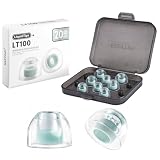
- Soft liquid silicone ear tips for wired IEMs and in-ear monitors
- Compatible with 5-6.5mm nozzle diameter earphones
- Includes 4 pairs of ear tips in XS/S/M/L sizes

Who should consider it: Listeners who want several sizes to compare before committing to a particular fit, especially when their IEM has a relatively wide standard nozzle.
WHIZZER LT100 liquid silicone ear tips are presented as a replacement option for wired IEMs. The described package includes four pairs in XS, S, M, and L, plus a storage case. That assortment is useful when the supplied tips are uncomfortable but you do not yet know whether the problem is diameter, shape, or a difference between your ears.
Material, dimensions, and compatibility: The material is identified as liquid silicone. The listed supported nozzle range is 5–6.5 mm. Exact flange diameters, stem height, and acoustic outlet measurements are not verified here. The nozzle range is a starting point, not a guarantee for every earphone measuring within it.
Fit and comfort: The XS option makes this a practical candidate for listeners who find ordinary small tips too large. However, “XS” describes a brand’s size category; it does not prove that its outer diameter is smaller than every competing small tip. Compare actual measurements when available.
The included case also makes it easier to keep neighboring sizes organized during fitting. That matters when one ear needs a different size from the other.
Sound considerations: Descriptions such as “tight bass” should be treated as intended benefits rather than fixed acoustic outcomes. If the LT100 stops a leak, low-frequency output may recover. If it changes insertion depth or bore loading, other parts of the response may also shift.
Limitation: Its listed range does not cover narrow-stem systems or proprietary attachments, and a short nozzle may still provide inadequate retention.
Budget and pack options: Position it as a mid-range sizing set rather than a single-pair luxury purchase. The four-pair assortment is most valuable while establishing your size.
Relevant alternative: DUNU S&S offers a distinctive cylindrical shape when conventional rounded flanges remain unstable.
Verdict: A sensible candidate for systematic size comparison on compatible wider nozzles, particularly when an extra-small option is useful.
Kiwi Ears Flow

- BRAND OVERVIEW. We are a professional audio engineering team dedicated to...
- WIDE TRUMPET BORE ACOUSTIC DESIGN. Built with a standard 4.5mm inner...
- PREMIUM SKIN-FRIENDLY SILICONE MATERIAL. Hypoallergenic soft elastic...
Who should consider it: Listeners who already have a reliable seal and want to investigate a wide-bore silicone design without jumping straight to unsupported promises about brighter or more spacious sound.
Kiwi Ears Flow is identified as a wide-bore silicone IEM ear tip available in S, M, and L. Its defining feature is the relatively open sound outlet. That makes it relevant to wide-bore versus narrow-bore comparisons, although the outlet’s exact diameter is not verified from the available information.
Material, dimensions, and compatibility: Silicone construction and the S/M/L size selection are stated. Exact outer diameters, stem height, and a supported nozzle-diameter range are not verified. Do not confuse a wide acoustic opening with confirmed compatibility for a large nozzle; those are related but separate measurements.
Fit and comfort: A wide-bore design can still fail to seal if its flange is too small, too large, or poorly positioned. Consider Flow after confirming that the IEM housing sits comfortably and that the tip reaches an appropriate sealing point. A change in flange shape may matter more than the bore.
Sound considerations: Wider outlets can change the acoustic path between the IEM and ear canal. The resulting difference depends on the nozzle, internal filters, insertion depth, and listener anatomy. Flow should not be described as an automatic treble boost or soundstage upgrade.
For a useful comparison, keep the same earphone, source, music, and approximate loudness. Reseat each tip before deciding that a tonal difference is repeatable.
Limitation: The available size labels are not enough to establish suitability for particularly small canals, and nozzle compatibility needs separate confirmation.
Budget and pack options: Treat Flow as an accessible mid-range experimentation option. Verify whether the selected package includes all three sizes or multiple pairs of one size.
Relevant alternative: Divinus Velvet Wide Bore is another wide-bore candidate, particularly when surface feel is a purchasing priority; its exact version and dimensions need independent checking.
Verdict: Worth considering for controlled wide-bore experimentation once fit and retention are already secure.
Kiwi Ears Flex Anti-Earwax

- 【𝐀𝐛𝐨𝐮𝐭 𝐊𝐢𝐰𝐢 𝐄𝐚𝐫𝐬】We are a small...
- ...
- ...
Who should consider it: Listeners who want a silicone replacement tip with an anti-earwax design, provided the attachment and cleaning requirements suit their IEM.
Kiwi Ears Flex is presented as an anti-earwax IEM ear tip. Its distinguishing feature is protection at the sound path, rather than an assurance of a particular tonal balance. This can be useful for people who frequently find debris near the nozzle opening, but it does not eliminate the need to inspect and clean their earphones.
Material, dimensions, and compatibility: Confirm silicone construction for the exact Flex package being purchased. Exact size coverage, outer diameters, stem height, nozzle range, and protective-element construction are not verified from the available product description. A similarly named product or a related brand model should not be assumed to share those specifications.
Fit and comfort: Protection is valuable only if the tip also fits. A barrier-equipped tip that becomes uncomfortable or detaches easily is not a suitable upgrade. Check whether the protective element sits clear of the IEM nozzle and whether the flange rests naturally without excessive pressure.
Sound considerations: Any structure placed in the sound path can potentially affect acoustic loading, especially if it becomes contaminated. No particular improvement in clarity, bass, or treble should be promised without controlled evidence. A clean protective element and a blocked one may behave differently.
Limitation: The additional protective feature introduces another area that needs inspection. Cleaning methods appropriate for plain silicone may not be appropriate for an integrated filter or mesh.
Budget and pack options: Consider Flex a feature-focused mid-range candidate. Verify the included sizes and number of complete pairs rather than assuming that every package is a sizing assortment.
Relevant alternative: AZLA SednaEarfit MAX is worth investigating for its exact standard-IEM version and protective design. Do not substitute MAX ASMR or a TWS version without checking differences.
Verdict: A potentially useful choice when debris protection matters, but only after confirming the material, fit specifications, and approved maintenance method.
Moondrop Spring Tips

- 【Acoustic waveguide + Double Support Structure】we designed a new type...
- The nozzle of Spring Tips is equipped with acoustic waveguide structure...
- In the actual measurement of frequency response curve matched with...
Who should consider it: Listeners seeking an affordable silicone replacement for a standard IEM nozzle, particularly when they want to experiment with a different flange construction.
Moondrop Spring Tips use silicone construction with a distinctive supported shape. They are a practical candidate for listeners who want to move beyond their stock tips without treating ear-tip replacement as a premium accessory purchase.
Material, dimensions, and compatibility: The available listing identifies silicone construction and a supported nozzle-diameter range of 4.8–6.4 mm. Exact outer diameters, stem height, and the complete size selection for a particular package are not verified here. Check the selected size and pack contents before ordering.
That stated range is useful, but nozzle length and the retention lip still matter. A nozzle within the range can remain unsuitable if its attachment area is too short or unusually shaped.
Fit and comfort: Spring Tips are worth considering when a standard rounded tip feels poorly supported or loses its shape during insertion. They are not guaranteed to solve small-canal discomfort, and a larger size should not be forced into place simply to obtain stronger bass.
Sound considerations: A different flange, outlet geometry, or effective insertion depth may alter the response. If a previously weak seal becomes reliable, bass may sound fuller. If your original tips already seal correctly, changes may be smaller or may appear mainly in the treble.
Limitation: Stretching a tip onto a nozzle does not prove secure retention. Check that the stem seats fully and does not slide during gentle handling.
Budget and pack options: Spring Tips occupy a budget-friendly position. Compare complete pairs and usable sizes, not just the total number of individual tips in the package.
Relevant alternative: Final Audio Type E is a useful narrow-bore comparison candidate, but its exact size and supported attachment must be checked independently.
Verdict: A sensible value-oriented option for compatible standard nozzles, with fit verification more important than acoustic marketing.
Choosing Silicone Tips That Fit Your IEM
An ear tip has two separate jobs: attach to the earphone and seal against the ear canal. A product can perform one perfectly and fail at the other. Before choosing a size for your ears, establish that the tip’s stem is appropriate for the IEM.
Compatibility is more complicated than matching two diameter numbers. The nozzle’s retention lip, usable length, taper, surface texture, and proximity to the housing all influence attachment. The tip’s stem flexibility and internal shape matter too.
For standard replacement tips, the most useful information is a manufacturer-supported nozzle range alongside the exact model and version. When that information is unavailable, ask the manufacturer or retailer rather than assuming that a popular tip is universal.
Nozzle Diameter and Retention Lip
The nozzle is the small projecting tube onto which the ear tip attaches. Its diameter determines how much the tip’s stem must stretch, but the nozzle may not have the same diameter along its entire length.
Many IEMs have a raised lip near the end. This lip helps stop the tip from sliding off. Other nozzles are tapered, grooved, or comparatively smooth. Two nozzles with the same nominal diameter can therefore retain the same tip differently.
A useful compatibility check follows this order:
1. Identify the exact IEM model and ear-tip version.
2. Find the tip manufacturer’s supported nozzle range.
3. Measure the nozzle body and retention lip separately if necessary.
4. Check that the stem seats fully without abnormal stretching.
5. Confirm that the fitted tip resists gentle pulling and twisting.
This sequence is more dependable than buying a tip because its internal opening appears close to the nozzle’s published diameter.
A digital caliper is useful for measuring an IEM nozzle. Remove the existing tip first, then place the external measuring jaws around the nozzle with minimal pressure. Keep the tool away from the nozzle mesh and avoid dragging metal edges across the housing.
Measure the main attachment area, not only the widest part of the retention lip. Record both measurements when the lip is prominent. If the nozzle is oval rather than round, record its wider and narrower dimensions. A round-number specification may conceal a shape that affects attachment.
Do not squeeze soft or delicate parts with the caliper. If you cannot position the tool safely, use the manufacturer’s dimensions instead. A ruler can provide a rough indication, but it is rarely precise enough to establish a marginal fit.
The tip’s internal diameter is also easy to misunderstand. Silicone stretches, so the unmounted stem opening may be smaller than the nozzle it is designed to fit. Conversely, an opening that seems almost identical to the nozzle diameter may lack sufficient grip.
An advertised “bore diameter” may refer to the acoustic outlet rather than the attachment opening. Those measurements are not interchangeable. A tip can have a narrow outlet with a stem that fits a larger nozzle, or a wide outlet with a relatively restrictive mounting section.
Look for language such as “supported nozzle diameter” or “compatible nozzle range.” If a specification simply says “inner diameter,” determine where that measurement was taken before using it to make a purchase decision.
Retention should be assessed outside the ear. Once the tip is fitted, hold the earphone securely and gently pull on the tip’s stem area. It should remain attached without slipping over the lip. A flange that flexes normally is not the same as a stem that migrates along the nozzle.
Avoid aggressive tugging or repeated overstretching. The goal is to detect an obviously insecure fit, not to stress-test the material until it tears.
Large-nozzle IEMs deserve particular care. A tip may stretch onto a wide nozzle yet become distorted, leaving its flange less able to conform to the ear canal. The stem can also develop small tears that are difficult to see until it is removed.
A helpful distinction is between attachment compatibility and wearing compatibility. The first asks whether the tip stays securely on the nozzle. The second asks whether the mounted assembly fits your ear comfortably. Both must be satisfied.
Nozzle Length and Tip Stem Height
Nozzle length determines how much attachment surface is available and how far the tip can reach beyond the IEM housing. Tip stem height determines where the flange sits relative to that nozzle.
This relationship is especially important with short-nozzle IEMs. A tip with a short stem may sit close to the housing, leaving the flange unable to reach a comfortable sealing point. The housing may contact the outer ear before the tip seals.
A longer stem can sometimes move the sealing surface farther forward, but it may also change the leverage on the attachment. If the stem extends well beyond a short nozzle, it can bend more easily or provide less stable support.
There is no universal rule that short nozzles require long tips. Housing shape, nozzle angle, and ear anatomy all affect the result. The useful question is whether the combination places the flange where it can seal without forcing the housing against your ear.
Published “height” measurements need interpretation. A manufacturer may list total tip height, stem height, or flange height. Total height alone does not reveal how deeply the nozzle sits inside the stem.
When comparing two tips, distinguish:
- The length of the internal attachment section.
- The distance from the nozzle end to the acoustic outlet.
- The position of the widest part of the flange.
- The overall height of the mounted tip.
These dimensions explain why similarly sized tips can produce noticeably different effective insertion depths.
If your current IEM sounds thin until you press the housing inward, insufficient reach may be part of the problem. However, pressing inward is not a solution. It can also indicate an undersized flange, a poor insertion angle, or a housing that does not suit your ear.
Try an appropriate neighboring size first, then investigate a different shape or stem geometry. Keep the housing in a comfortable position rather than chasing a seal by applying pressure.
A tip should normally sit where its manufacturer intends it to sit. Leaving it partially mounted to obtain extra reach can reduce retention and increase the chance of detachment. Do not use a deliberately loose position as an insertion-depth adjustment.
Check that the tip does not cover an IEM vent near the nozzle base. A blocked vent can affect pressure behavior and sound. If a replacement stem or flange overlaps an opening that the stock tip leaves clear, seek model-specific guidance.
The practical goal is a stable assembly that reaches naturally. You should not have to choose between a comfortable housing position and a proper seal.
Standard IEM Tips
Standard IEM tips usually attach by stretching over a cylindrical nozzle. Even within that category, nozzle sizes vary substantially. “Universal” usually means broadly compatible with certain conventional designs, not compatible with every in-ear product.
Narrow-stem systems need particular attention. Some earphones use much smaller attachment tubes than common modern IEMs. A replacement designed for a wider nozzle may remain visibly loose even if its flange fits your ear.