Want a dedicated music player that keeps your albums close and your phone out of the way? A digital audio player, or DAP, is a standalone device that stores and plays music through its own playback software and audio hardware. At the entry level, useful controls, dependable library browsing, and suitable headphone output matter more than impressive resolution numbers.
The five models below suit different listening habits, from wired FLAC playback to compact Bluetooth listening. Current stock, customer ratings, and delivered prices are not established by the supplied listings; confirm those details before treating any model as an eligible purchase within this budget.
Top DAPs under $100
HiBy R1

- 【Hi-Fi Sound Quality with Dual Hi-Res Certification】Entry-level Hi-Fi...
- 【MP3 Player with Bluetooth】Supports AAC, SBC, aptX, and LDAC for...
- 【Built-in Tidal & Qobuz Streaming (Offline Download Not...
The HiBy R1 is the strongest starting point for someone who wants a small standalone player without making every interaction revolve around basic folder navigation. Its touchscreen interface gives it a different emphasis from button-led players: browsing and selecting music are central to the experience.
The R1 combines a 3-inch display, a 3.5 mm headphone output, microSD storage, and Bluetooth functionality. It runs HiBy’s dedicated player software rather than an unrestricted Android environment. That distinction matters: wireless connectivity does not turn it into a miniature smartphone with universal app installation.
For a local music collection, the larger screen is the practical attraction. Album artwork, track information, and browsing controls have more room than on an ultracompact player. That should appeal to listeners who choose individual albums frequently rather than starting a playlist and leaving the player alone.
Two advantages stand out: the screen provides room for library navigation, and Bluetooth expands its usefulness beyond wired headphones. However, the touchscreen remains something you need to look at, and storage planning should include a microSD card rather than assuming substantial built-in music capacity.
Treat its network features separately from its local-file capabilities. Before buying for a particular streaming service, confirm current service support, account requirements, and offline functionality. Support for one service does not imply support for another.
Sensitive IEM owners should also check low-volume adjustment and background noise with their particular earphones. A feature-rich interface cannot compensate for an unsuitable headphone pairing.
Verdict: Choose the HiBy R1 budget DAP for local music if you regularly browse a tagged library and value a readable screen. Skip it if completely screen-free control or unrestricted streaming apps are essential. Its interface is the main reason to consider it—not a promise of universally better sound.
SnowSky Echo Mini
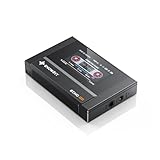
- Boasting an IPS full-view color screen, retro-inspired dynamic UI, and...
- Featuring Bluetooth 5.3 and SBC codec support, the ECHO MINI effortlessly...
- Supports a wide range of audio formats, including DSD, WAV, FLAC, APE, MP...
The SnowSky Echo Mini is aimed at listeners who prefer a tactile, deliberately simple music player. Its cassette-inspired appearance is distinctive, but its more consequential feature is the use of physical controls instead of touchscreen-led operation.
Its feature set includes a small color display, local-file playback, Bluetooth transmission, and both 3.5 mm and 4.4 mm headphone connections. The manufacturer lists internal music storage alongside microSD expansion, giving it a different starting point from players that depend entirely on a separately purchased card. Confirm the exact storage configuration of the unit being sold.
The practical appeal is straightforward: dedicated buttons can make routine playback commands easier to locate by touch. That does not automatically mean every operation is convenient inside a pocket. Selecting an album, changing settings, or finding a particular track still involves the screen and menu structure.
Its two principal advantages are physical playback controls and flexible wired connections. Its two important limitations are the small display and the need to verify firmware-dependent library features before buying.
For a SnowSky Echo Mini vs HiBy R1 decision, begin with how you select music. The Echo Mini makes more sense for starting an album or playlist and then using basic transport controls. The R1 deserves closer consideration if you frequently search through artists and albums.
Do not buy the Echo Mini’s balanced connection simply because it looks like an upgrade. Your earphones need a compatible cable, and the connection alone does not establish better audible performance. Likewise, Bluetooth transmission should not be confused with a receiver mode for playing audio sent from a phone.
Verdict: Buy it if physical buttons and straightforward standalone listening are your priorities. Skip it if you need expansive onscreen navigation, sophisticated playlist management, or a specific feature that the current manual and firmware documentation do not confirm.
MECHEN M30

- 【HIFI lossless sound quality】 The DAP lossless music player adopts...
- 【High-resolution music player】 The player adopts a 2.0-inch display...
- 【Fashionable craftsmanship】The non-destructive music player is made of...
The MECHEN M30 is a simpler proposition: a dedicated player for music files and wired headphones. It is worth considering when you want a portable FLAC player rather than another device built around apps, accounts, and wireless connections.
The M30 uses physical navigation controls and a 3.5 mm headphone connection. Its manufacturer documentation emphasizes local playback, including common formats such as FLAC and MP3. It is not a Bluetooth music player, so wireless earbuds are not a suitable pairing.
Storage deserves particular attention. Some offers describe a capacity that comes from an included memory card rather than built-in flash storage. Check the package contents and supported card capacity for the exact listing instead of assuming that every M30 bundle is identical.
The usability trade-off is its more traditional navigation system. Physical controls can be useful for pausing and skipping tracks, but they do not guarantee quick movement through a large collection. An orderly folder structure can make a player like this easier to live with, especially if your tagging is inconsistent.
The two advantages are its focused wired workflow and button-based operation. The two limitations are the absence of Bluetooth and the need to establish whether its library organization meets your expectations.
Gapless playback, imported playlists, and indexing limits should be treated as individual purchase requirements. Format compatibility alone does not answer those questions. A player may open your FLAC files successfully while still handling continuous albums or large libraries differently from your preferred software.
It also makes sense to check the return policy before pairing it with very sensitive IEMs. Low hiss and useful volume increments are more relevant than broad claims about audiophile sound.
Verdict: Consider the MECHEN M30 FLAC music player for a primarily wired, local-file setup. Skip it if wireless headphones, streaming access, or advanced library management are central to your listening routine.
TempoTec Variations V1

- Local High-Resolution Playback: Supports microSD (TF) cards up to 2TB...
- Online Streaming: Natively supports high-quality streaming services like...
- Portable DAC/Amp for Smartphones: Functions as an external high-quality...
The TempoTec Variations V1 deserves a closer look if you want more flexibility than a basic file player offers. It also requires careful identification: TempoTec has used similar V1 naming across products and generations, so an abbreviated listing title is not enough to establish exactly what you are buying.
Start with the complete model name, product photographs, current manual, and connector layout. Do not assume that a V1, V1-A, and Variations V1 have interchangeable specifications. For the exact Variations V1 offer, confirm the headphone outputs, Bluetooth directions, storage arrangement, and any advertised network playback functions.
Its buyer appeal is the possibility of combining standalone local playback with additional connection options. Those features can provide meaningful value if they replace something you would otherwise need another device to do. They add little value if your entire routine consists of wired album playback.
The concrete usability question is how easily its interface gets you from a stopped player to the music you want. Before buying, look for clear documentation of artist browsing, folder access, playlist handling, and playback shortcuts. A long feature list cannot establish whether those everyday actions are straightforward.
Two potential advantages are playback flexibility and a compact standalone format. Two significant limitations are model-name ambiguity and uncertainty around the complete delivered cost when buying across borders.
Treat streaming claims narrowly. A service logo, Wi-Fi connection, or network playback feature does not establish downloadable offline Spotify support. Similarly, a Bluetooth specification needs to distinguish sending audio to headphones from receiving audio from another source.
Verdict: Consider the TempoTec Variations V1 budget music player when its exact documented features meet a specific need. Skip an offer if the seller cannot establish the model, required connections, warranty terms, and final delivery charges. Do not choose it on naming or feature-count alone.
Shanling M0s

- Studio-Quality Hi-Res Sound MP3 Player - Experience stunning audio detail...
- Dual-Way Bluetooth 5.0 with LDAC/aptX - Stream wirelessly from your phone...
- Crisp Touch Screen & Ultra-Portable Design - Navigate easily on the...
The Shanling M0s is the compact option for buyers who want a dedicated player to occupy very little space. Its small touchscreen and rotary control make portability the central selling point, with corresponding compromises in how much information and control fit on the device.
The M0s has a 1.54-inch touchscreen, a 3.5 mm headphone output, microSD-based music storage, and Bluetooth functionality. It uses Shanling’s dedicated player software rather than providing an unrestricted Android app environment. Confirm current transmission and receiver capabilities in the manual if either mode is essential to your setup.
The physical size is particularly attractive when carrying a phone-sized player would defeat the purpose of buying a separate device. For walking, commuting, or listening away from a desk, reduced bulk can matter more than a larger display.
However, small dimensions do not make every interaction easier. Reading long titles, selecting small onscreen targets, and moving through settings can demand more attention than on a larger player. The rotary control helps with direct adjustment, but it does not eliminate touchscreen navigation.
Its two advantages are minimal pocket bulk and a combination of touch and physical control. Its two limitations are the restricted screen area and a card-dependent storage workflow.
For a compact music player, battery expectations should remain realistic. Manufacturer playback claims describe particular conditions, not guaranteed endurance with frequent screen use, wireless listening, or demanding files. Check the published conditions rather than comparing headline hours alone.
The model suffix matters here, too. The M0s is not interchangeable with every other player carrying the M0 name. Use documentation for this exact model when checking power, storage, or wireless features.
Verdict: Buy the Shanling M0s if small size is your overriding requirement and you are comfortable navigating a tiny screen. Skip it if readability, larger touch targets, or frequent library searches matter more than shaving down pocket space.
Choosing a DAP Under $100
Local Files Versus Streaming
A local-file player stores music you transfer onto the device or its memory card. It does not automatically download tracks from a subscription service.
Use this three-step buying check:
1. Identify your music source: purchased downloads, ripped CDs, or a streaming subscription.
2. Confirm the playback method: local files, a supported built-in service, or an installable app.
3. Check offline access separately: online streaming support does not establish downloadable playback.
For Spotify offline listening, you need supported app functionality and an eligible subscription. Bluetooth and Wi-Fi alone are insufficient. Avoid buying a basic DAP with the expectation that streaming apps can simply be added later.
Headphone and IEM Compatibility
For a budget DAP for sensitive IEMs, prioritize low background hiss, gradual volume adjustment, and sufficient clean output. Very powerful amplification is not necessarily helpful if the first few volume steps are already too loud.
Impedance is only part of the picture. Sensitivity, your preferred listening level, and available voltage and current also affect compatibility. Low-impedance headphones can still be demanding.
Check output specifications at a stated load where available. A power figure without its measurement conditions is difficult to compare meaningfully. Balanced output is an option, not an automatic improvement in sound quality.
Library Navigation and Gapless Playback
Library behavior often determines whether a player remains enjoyable after the first week.
Before committing, establish whether it supports:
- Browsing by artist, album, and folder.
- Your preferred tagging conventions and album ordering.
- Imported playlists and compatible path formats.
- Gapless playback for continuous albums.
- A track-count limit suitable for your collection.
Gapless playback prevents inserted pauses between tracks intended to flow together. File-format support does not guarantee it.
A supported memory-card capacity also says nothing about indexing speed or the number of tracks the library database can recognize. These are separate limitations, and both matter for large collections.
Storage Requirements
Internal storage is built into the player. Expandable storage uses a removable microSD card; an included card is still removable storage, not internal capacity.
For a rough planning estimate, assume:
- MP3: 10 MB per song.
- CD-quality FLAC: 30 MB per song.
Using a nominal 128 GB card as 128,000 MB gives approximately 12,800 MP3 tracks or 4,260 FLAC tracks. Actual capacity is lower after formatting, and file sizes vary with duration, encoding, and musical content.
High-resolution FLAC can require substantially more space. Budget for a reliable card separately whenever one is required, and verify both card-capacity support and library track limits.
Bluetooth Playback
A music player with Bluetooth transmission sends audio to wireless headphones or speakers. A Bluetooth receiver mode accepts audio from another source, such as a phone. These functions are not interchangeable.
Wireless headphones use their own DAC and amplifier to produce sound. Consequently, the player’s analog headphone-output circuitry is not driving the headphone speakers during Bluetooth listening.
Do not infer codec support from the Bluetooth version. Check the supported codec at both ends of the connection. A lossless FLAC source also does not guarantee lossless wireless transmission.
Battery-Life Expectations
Manufacturer battery ratings are useful reference points, not measured results for your routine.
Relevant conditions include wired versus Bluetooth playback, file format, volume, headphone load, screen brightness, and screen activity. Frequent browsing may reduce endurance compared with uninterrupted playback with the display off.
When comparing ratings, look for equivalent conditions. A wired MP3 claim and a Bluetooth FLAC result are not directly comparable. Leave a practical reserve for travel rather than planning around the maximum advertised figure.
Budget DAP Versus Phone With a USB DAC
A dedicated player makes sense when independent playback is the goal. It can keep music available without notifications, preserve your phone’s battery, and offer physical controls suited to routine listening.
A phone with a USB DAC is usually the simpler choice when streaming apps dominate. Your existing phone already handles account authentication, downloads, search, and service updates. A compatible dongle adds a wired audio output without requiring a second music library.
A dongle DAC is not a standalone DAP. It depends on another device for music storage, playback software, and usually power.
Neither approach universally sounds better. Headphone matching, output noise, usable power, and recording quality matter more than the category name. If your phone already works well with your headphones, buy a DAP for a better listening workflow—not an assumed sonic transformation.
FAQ
Which MP3 player has the best sound quality?
No MP3 player has the best sound quality for every listener and headphone. Look for clean output, low audible noise, appropriate output impedance, and enough power without distortion. Suitable volume adjustment matters with sensitive earphones, while recording quality and headphone tuning strongly influence the result.
Can a DAP under $100 play Spotify offline?
Offline Spotify requires a device that supports the Spotify app’s download functionality and an eligible subscription. Local-file playback, Bluetooth, and Wi-Fi do not establish that capability. Confirm current app support and download behavior before buying; subscription downloads are not ordinary MP3 files you can copy onto any player.
Can a budget DAP drive high-impedance headphones?
Sometimes, but impedance alone cannot answer the question. Headphone sensitivity, available output voltage, listening level, and musical peaks all matter. Check output specifications at an appropriate load and allow headroom. Reaching an acceptable average volume does not necessarily mean the player can reproduce louder passages cleanly.
Conclusion
A worthwhile budget DAP should make listening simpler: easy access to your collection, dependable controls, sufficient storage, and an output suited to your headphones. Decide whether you value library browsing, pocket operation, wireless playback, or minimal size most. Then confirm the exact model, required accessories, and delivered cost. The right choice is the one that fits your daily listening routine without adding unnecessary friction.