What is a Voltage Tester?
A voltage tester is an essential electrical tool designed to detect the presence of electricity in a circuit or device. It helps both professional electricians and DIY enthusiasts safely check whether a wire, outlet, or electrical component is live, preventing the risk of electrical shocks. Voltage testers come in various types, each suited for different applications, such as detecting low voltage, DC voltage, or standard household voltage.
Using a voltage tester allows users to quickly identify live wires, determine if a circuit is energized, and troubleshoot electrical problems without direct contact with electrical parts. This non-contact feature is particularly valuable for safety, as it minimizes the risk of accidental shocks.
Voltage testers often feature indicator lights, audible alarms, or LCD screens to signal the detection of voltage. Some advanced models include additional functionalities like infrared thermometers or flashlight attachments, providing a nice touch for professionals working in dimly lit or hard-to-reach areas.
Types of Voltage Tester
Voltage testers come in several types, each designed for specific electrical testing needs. Understanding these types can help you choose the best voltage tester for your particular application.
Non-Contact Voltage Testers (NCVTs)
Non-contact voltage testers are popular for their safety and ease of use. They detect voltage without requiring physical contact with wires or electrical components. By simply bringing the tester close to a wire or outlet, the device senses the presence of electricity, often indicated by a red light, audible beep, or vibration. These testers are ideal for quickly identifying live wires, troubleshooting light switches, or checking outlets, especially in residential settings or an old house where wiring may be outdated.
Neon Voltage Testers
Neon voltage testers use a small neon bulb to indicate the presence of voltage. They require contact with the circuit, typically by touching one probe to a hot wire and another to a neutral or ground. When voltage is present, the neon bulb lights up. These testers do not require batteries and are simple tools for checking voltage presence and polarity in circuits.
Plug-In Circuit Analyzers
Plug-in circuit analyzers are designed to test electrical outlets. They plug directly into a grounded outlet and use neon lights or LCD screens to provide information about wiring correctness, voltage levels, and potential issues such as reversed polarity or open grounds. These testers help ensure outlets are wired safely and function properly.
Continuity Testers
Continuity testers check whether an electrical path is complete, indicating if wires, switches, or fuses are intact. They do not test for voltage but instead test for resistance or breaks in a circuit. Using one probe at each end of the circuit or device, the tester signals continuity with a light or sound. This type of tester is essential for diagnosing broken wires or faulty components in electronics and electrical work.
Multimeters
Multimeters are versatile electrical testers capable of measuring voltage (both AC and DC), resistance, capacitance, continuity, and frequency. They provide precise readings and are suitable for a wide range of electrical and electronics applications. Multimeters typically have two leads with metal probes and a dial or digital interface to select the desired measurement. They are invaluable tools for professional electricians and electronics technicians.
Clamp Meters
Clamp meters combine the functions of a multimeter with a current sensor. They can measure voltage, current, and resistance without disconnecting wires by clamping around a conductor. This non-intrusive method is safer and more convenient for measuring current flow, especially in industrial or commercial electrical work.
Solenoid Voltage Testers
Also known as “wiggles,” solenoid voltage testers indicate voltage presence and polarity through clicking sounds or vibrations. They are simpler to use than multimeters, do not require batteries, and are useful for quick voltage checks and polarity testing.
Digital Clamp Meters with Additional Features
Some advanced clamp meters include features like infrared thermometers or laser pointers for temperature measurement. These multifunction tools assist in diagnosing electrical equipment that may overheat or require detailed analysis.
Key Features of Voltage Tester
When selecting the best voltage testers, several key features should be considered to ensure the tool meets your electrical work needs and safety requirements.
Safety Ratings
Voltage testers often come with safety ratings such as CAT III 1000V or CAT IV 600V, indicating the level of protection they provide against voltage spikes and electrical hazards. These ratings are crucial for professional electricians working in industrial or commercial environments, where higher voltage levels and transient spikes are common.
Voltage Detection Range
A good voltage tester should cover a wide voltage detection range, typically from low voltage levels to standard household voltages (up to 1000V). Some advanced testers offer dual-range detection, allowing them to sense both low voltage and standard voltage without manual adjustments. This is especially helpful when working on diverse electrical systems or devices like doorbells and thermostats.
Non-Contact Voltage Detection
Non-contact voltage testers (NCVTs) are popular for their ability to safely check for voltage without physically touching wires or components. They use sensors to detect the electric field around a conductor, providing a quick and safe way to identify live wires. Indicators such as red lights, audible beeps, or vibrations alert the user to the presence of voltage.
Indicator Types
Voltage testers use different types of indicators to signal voltage detection. Common indicators include:
Red Light: A bright red LED at the tip signals voltage presence.
Audible Beep: A sound alert complements the visual indicator.
LCD Screen: Some testers display voltage levels numerically or with bar graphs.
Vibration: A tactile alert useful in noisy environments.
Having multiple indicator types enhances usability across different working conditions.
Additional Features
Many voltage testers come with added functionalities to improve convenience and versatility:
Flashlight: Integrated LED lights help illuminate dark or cramped spaces.
Infrared Thermometer: Some advanced models measure temperature, useful for detecting overheating equipment.
Automatic Shutoff: Conserves battery life by turning the tester off after inactivity.
Battery Indicator: Alerts when batteries are low to prevent false negatives.
- Durability: Robust casing and drop resistance protect the tool during onsite use.
Ergonomics and Portability
Comfortable grip, lightweight design, and pocket-friendly size make voltage testers easy to carry and use, especially for professionals who need to move quickly between tasks. Features like a secure clip or rubberized body improve handling and reduce the chance of dropping the tester.
Accuracy and Sensitivity
High accuracy in detecting voltage levels ensures reliable diagnostics. Sensitivity settings or automatic range detection help distinguish between different voltage levels and reduce false positives, such as phantom voltages caused by nearby energized wires.
Compatibility with Electrical Systems
Consider whether the voltage tester can handle both AC and DC voltage detection, as well as the specific voltage ranges used in your work. Some testers are optimized for residential use, while others are designed for industrial or automotive applications.
Ease of Use
Simple controls, clear indicators, and intuitive design make voltage testers accessible to both professionals and DIY users. Features like one-button operation or automatic voltage range detection minimize the learning curve and speed up testing.
Top Voltage Testers
Fluke 1AC II VoltAlert Non-Contact Voltage Tester

- Be aware of voltage easily - the tip glows red and a beeper sounds when...
- Continuous self-test so you always know it’s working
- Voltage detection range for wide application use - 90 V to 1000 V AC or...
Fluke voltage testers are known for their high quality and accuracy, making them a popular choice among professional electricians, especially for professionals and DIY enthusiasts who prioritize safety and ease of use. This non-contact voltage tester can detect voltage in the range of 90V to 1,000V AC, making it suitable for most residential and commercial electrical applications.
One of the standout features of the Fluke 1AC II is its continuous self-test indicator. This feature ensures the tester is functioning properly by flashing a red light continuously when the device is powered on. This reduces the risk of false negatives, which can occur if the tester’s battery is low or if the device malfunctions.
The tester provides a quick power alert with a bright red LED at the tip and an audible beep when voltage is detected. Users can also disable the beep for use in quiet environments, allowing for discreet voltage detection. The compact design fits comfortably in a tool pouch or pocket, making it highly portable and convenient for electricians who move between job sites.
Battery life is another advantage of the Fluke 1AC II, as it includes two AAA batteries and features an automatic shutoff to preserve battery life when not in use. This ensures the tester is ready when needed without frequent battery replacements.
In addition to its safety and usability features, the Fluke 1AC II is known for its durability. It is built to withstand the rigors of everyday electrical work, providing reliable performance over time.
Klein Tools 69149P Electrical Test Kit
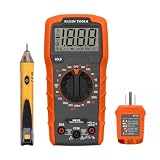
- VERSATILE MULTIMETER: Measures up to 600V AC/DC voltage, 10A DC current...
- CONTINUITY TESTING: MM320 multimeter with visual and audible indicators for...
- NON-CONTACT VOLTAGE TESTER: NCVT1P with bright LED indicating working...

The Klein Tools 69149P Electrical Test Kit is a comprehensive set designed for both professional electricians and serious DIY enthusiasts. This kit combines multiple essential electrical testing tools into one convenient package, making it a versatile choice for a variety of electrical diagnostics.
Included in the kit are a non-contact voltage tester, a standard multimeter, and a continuity tester, providing one tool for nearly every common electrical testing need. The non-contact voltage tester detects voltage quickly and safely without the need for direct contact, making it ideal for identifying live wires and troubleshooting outlets or switches. It features a bright red light and an audible beep to alert users when voltage is present, ensuring clear and immediate feedback.
The included multimeter offers precise measurements of AC and DC voltage, resistance, capacitance, and frequency, allowing users to perform detailed diagnostics beyond simple voltage detection. Its user-friendly dial and clear LCD screen make it accessible for users at all skill levels. This standard multimeter is suitable for a wide range of electrical work, from household repairs to more advanced electronics projects.
The continuity tester in the kit helps figure out if circuits are complete by checking for breaks or faults in wiring, switches, and fuses. It provides a light and sound indication when continuity is detected, allowing users to quickly identify issues in electrical paths.
All tools in the Klein 69149P kit are designed with durable construction and ergonomic grips for comfort during extended use. The kit also includes batteries and a carrying case, making it easy to transport and store the tools safely.
This all-in-one kit is a nice touch for anyone looking to equip themselves with reliable, quality electrical tools that cover a broad spectrum of testing functions. Whether you need to quickly detect voltage, measure electrical parameters, or test continuity, the Klein Tools 69149P Electrical Test Kit offers an efficient and practical solution.
Greenlee GT-16 Adjustable Non-Contact Voltage Detector

- ADJUSTABLE VOLTAGE DETECTOR: Adjusts to safely detect power and voltage in...
- NO-CONTACT DESIGN: Safely detects AC voltage without touching the bare...
- BATTERY POWERED: Includes 1 1.5V AAA battery for use and indicates once the...
The Greenlee GT-16 is a versatile and reliable non-contact voltage detector favored by many professionals for its adjustable sensitivity feature. This allows users to fine-tune the detection range, making it easier to identify voltage presence accurately even in complex wiring environments with multiple nearby energized wires. The adjustable sensitivity helps reduce false positives caused by phantom voltages, providing more confidence in readings.
Equipped to detect voltages typically ranging from 50 to 1000 volts AC, the GT-16 features a bright red LED indicator that flashes when voltage is detected, accompanied by an audible beep for added confirmation. The combination of visual and audio alerts ensures that users can safely and effectively identify live circuits, even in noisy or poorly lit conditions.
The device’s ergonomic design includes a rubberized grip for secure handling, minimizing the chance of slips during use. Its slender form factor makes it easy to carry in a shirt pocket or tool bag, which is a nice touch for electricians and technicians working on the go.
Durability is another strong point of the Greenlee GT-16. Built to withstand the rigors of daily electrical work, it is designed with robust materials that resist impact and wear. The tool also incorporates an automatic shutoff feature to conserve battery life, ensuring it is ready when needed.
AstroAI Digital Multimeter AM33D
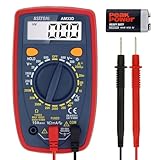
- Additional Tips - The following incorrect operations may cause the...
- Versatile Digital Multimeter - Accurately measures AC/DC Voltage, DC...
- Troubleshooting with Accuracy - This Multimeter has a sampling speed of...
The AstroAI Digital Multimeter AM33D is a reliable and affordable option for those needing a versatile electrical testing tool. It combines the functions of a standard multimeter with user-friendly features suitable for both beginners and experienced users. This multimeter can measure AC and DC voltage, resistance, continuity, and more, making it an essential tool for a wide range of electrical and electronics projects.
One of the key advantages of the AM33D is its clear digital display, which provides accurate and easy-to-read measurements. It includes a backlight feature, allowing users to work comfortably in dimly lit environments. The device also has a built-in continuity tester that emits an audible beep when a circuit is complete, making troubleshooting faster and more efficient.
Safety is a priority with the AstroAI AM33D, as it comes with overload protection to prevent damage to the device and the user. The multimeter is rated for CAT II 600V, which makes it suitable for most household and light commercial electrical work. Its compact size and ergonomic design make it easy to handle and carry, fitting well into toolkits or pockets.
The AM33D runs on a standard 9V battery, which is widely available and easy to replace. It also features an automatic shutoff to conserve battery life when not in use. This multimeter is a great choice for anyone looking for a quality, budget-friendly tool that covers the essential functions needed for electrical testing and diagnostics.
Conclusion
Voltage testers are indispensable tools that bring safety, precision, and confidence to any electrical project. Whether you’re quickly identifying a live wire or performing detailed diagnostics, having the right tester at hand ensures you can work efficiently and protect yourself from electrical hazards. Embracing these tools empowers both seasoned professionals and DIY enthusiasts to tackle electrical challenges with ease and accuracy.
FAQ
What is the difference between a voltage tester and a multimeter?
A voltage tester primarily indicates the presence or absence of voltage in a circuit, making it ideal for quick checks and ensuring safety before working on electrical components. In contrast, a multimeter provides detailed measurements, including voltage (both AC and DC), current, resistance, capacitance, and continuity. Multimeters are more versatile and suited for in-depth diagnostics and troubleshooting.
Can non-contact voltage testers detect low voltage?
Yes, some non-contact voltage testers are designed with dual-range capability, allowing them to detect both standard household voltage and low voltage levels. This feature is particularly useful for testing devices like doorbells, thermostats, and irrigation systems.
How do I know if my voltage tester is working properly?
Most voltage testers have a self-test feature or indicator light that confirms the device is operational. It’s recommended to perform a ‘live-dead-live’ test by checking a known live circuit, then a de-energized circuit, and finally the live circuit again. Additionally, testing the voltage tester on a known powered outlet or switch before use ensures accuracy.
Are voltage testers safe to use?
Voltage testers are designed with insulation and safety ratings to protect users from electrical shocks. However, it’s crucial to use the tester according to the manufacturer’s instructions, ensure the batteries are charged, and verify the tester’s functionality before each use.
Can a voltage tester help identify which breaker controls a specific outlet?
Yes, by turning off breakers one at a time and using a voltage tester to check outlets or wires, you can map out your electrical system. This process helps label breakers accurately and is especially helpful in older homes with unlabeled panels.