What are Passive Subwoofers?
Passive subwoofers are specialized speakers designed to reproduce low-frequency sounds, commonly referred to as bass, but unlike powered or active subwoofers, they do not include built-in amplification. Instead, passive subwoofers rely on an external amplifier or receiver to supply the necessary power to drive the speaker. This separation of amplifier and speaker components provides several advantages, including increased flexibility in system design and the potential for higher-quality sound reproduction.
One of the defining characteristics of passive subwoofers is their ability to be paired with a wide variety of amplifiers, allowing users to customize the power and tonal characteristics to suit their particular audio setup and preferences. This modular approach can be particularly appealing to audiophiles and home theater enthusiasts who want to fine tune every aspect of their sound system.
Many passive subwoofers incorporate design features such as passive radiators, which act as additional diaphragms that move in response to the primary woofer’s motion. This technology enhances the bass response by increasing the efficiency of the enclosure and extending the low-frequency output without the need for larger or more powerful drivers. The result is tight bass with greater depth and impact, enriching movie soundtracks and music with fuller, more immersive low-end sound.
Passive Subwoofer Benefits
Passive subwoofers come with a variety of benefits that make them an attractive choice for many audio enthusiasts. One of the main advantages is their flexibility in pairing with a wide range of external amplifiers. This allows users to select an amplifier that perfectly matches their power needs and tonal preferences, enabling a tailored audio experience. Because the amplifier is separate, it’s easier to upgrade or replace components individually, which can be more cost-effective and convenient over time. Without the internal amplifier and associated electronics, there are fewer parts that might fail or degrade, often resulting in increased reliability and longer lifespan. This simplicity also often translates to cleaner signal paths and reduced interference, which can contribute to better sound quality.
Passive subwoofers often incorporate advanced design elements such as passive radiators, which enhance bass performance by increasing efficiency and extending the bass range without requiring larger drivers or enclosures. This technology helps deliver tight bass with more depth and impact, which is especially beneficial for enjoying movie soundtracks and music with rich low-frequency content.
Additionally, passive subwoofers tend to have more compact and versatile enclosures, including sealed box designs that minimize distortion and produce clearer bass. Their modular nature means they can be integrated seamlessly into a variety of audio systems, from home theaters to high-fidelity music setups, providing powerful bass output while maintaining excellent sound quality.
How to Choose Passive Subwoofers for Your Setup
Selecting a good subwoofer involves considering several factors to ensure it integrates well with your existing audio system. It’s important to know how to connect your passive subwoofer to your amplifier or receiver using the proper cables or connection methods, as this ensures optimal performance and system compatibility. First, look at the subwoofer’s output and power handling capabilities. A great subwoofer should deliver more output than your other speakers to provide that little more oomph needed for an immersive listening experience.
The crossover frequency or crossover point is another critical aspect. This setting determines the frequency at which the subwoofer starts playing bass sounds, allowing you to fine tune your system for seamless sound blending between the subwoofer and other speakers. Most receivers and amplifiers allow you to adjust the crossover frequency, helping you achieve tight bass without overlap or gaps in the bass range.
Room size and placement also influence your choice. For smaller rooms, a compact passive subwoofer with a sealed box design might be ideal, while larger spaces may benefit from a subwoofer with a bigger cubic foot enclosure to produce more powerful bass. In-wall passive subwoofers are an excellent option for those looking to maintain a clean aesthetic without compromising on bass performance.
Top Passive Subwoofers
Polk Audio Atrium SUB100 Outdoor Passive Subwoofer

- SMART DESIGN - The enclosure of this outdoor subwoofer can be painted to...
- HIGHLY SPECIALIZED PASSIVE SUBWOOFER - The Polk Atrium SUB100 features...
- WEATHERPROOF OUTDOOR SPEAKERS - Enjoy outdoor music with deep effortless...
The Polk Audio Atrium SUB100 is a rugged outdoor passive subwoofer designed to deliver powerful and deep bass in outdoor environments. Built to withstand the elements, this subwoofer features weather-resistant construction with durable materials that protect it from rain, sun, and dust, making it an excellent choice for patios, gardens, and poolside audio setups. The MartinLogan Dynamo outdoor subwoofer, on the other hand, uses a 12-inch mineral-filled poly cone with a 2.5-inch high-power oversized voice coil, ensuring robust performance and durability in outdoor settings. The LS15T SUB includes a wide bandwidth Sonance Laminated Core Transformer with an adjustable tap, enhancing its versatility and performance in outdoor audio systems.
Equipped with a 10-inch driver and a sealed enclosure, the Atrium SUB100 produces tight, distortion-free bass that enhances outdoor music and movie soundtracks with rich low-frequency impact. Its passive design allows you to pair it with a compatible external amplifier, giving you flexibility in power and sound customization to match your outdoor sound system.
The subwoofer’s design also includes a rust-resistant grille and a sturdy enclosure that can be securely mounted or placed discreetly in outdoor spaces. Its ability to deliver deep bass outdoors helps create an immersive audio experience, filling open spaces with powerful sound while maintaining durability and reliability in various weather conditions. The Sonance Landscape Series subwoofer, featuring a 12-inch polypropylene cone with a rubber surround, is fully waterproof, making it another excellent option for outdoor audio setups.
Whether you’re hosting outdoor gatherings or simply enjoying music in your backyard, the Polk Audio Atrium SUB100 offers a robust and effective solution for adding deep bass to your outdoor sound system, combining performance and weather resistance in a compact package.
Dayton Audio MKSX4 Four 4″ Driver Low Profile Passive Subwoofer
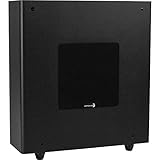
- Unique four driver design combines form and function
- Dual slot ports minimize air turbulence
- Utilizes same high excursion drivers as the MK402 bookshelf speakers...
The Dayton Audio MKSX4 is a unique low-profile passive subwoofer designed to fit into tight spaces without sacrificing bass performance. Featuring four 4-inch drivers, this subwoofer delivers surprisingly deep bass for its compact size, making it an excellent choice for rooms where space is limited but quality bass is still desired. Its low-profile design allows it to be placed discreetly under furniture or in other confined areas, blending seamlessly with your existing sound system.
Despite its small drivers, the MKSX4 uses a carefully engineered enclosure and driver arrangement to maximize bass output and minimize distortion. This subwoofer is ideal for users who want to add bass to their audio system without the bulk of larger, traditional subwoofers. It pairs well with a variety of amplifiers, allowing for customization of power and tonal characteristics to suit your listening preferences. Anti-vibration feet can further improve bass performance by reducing unwanted vibrations, ensuring a cleaner and more precise sound. Many passive subs are built using the same drivers that DIY enthusiasts use in custom-built boxes, offering flexibility and performance for those who prefer tailored audio solutions.
The MKSX4’s ability to deliver tight, controlled bass makes it suitable for both music and home theater applications. Its compact design and versatile placement options provide flexibility in integrating it into various room layouts. Whether you’re enhancing a compact home theater or filling a small room with rich bass, the Dayton Audio MKSX4 offers a practical and effective solution for delivering deep bass without compromising space or style.
OSD Audio IWS8 Custom Series in-Wall Passive Subwoofer
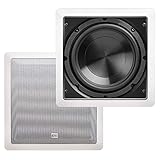
- POWER: The IWS8 features an 8 inch polypropylene subwoofer and butyl rubber...
- SOUND QUALITY: Place the IWS8 into the wall to fill in the low frequency...
- IN-WALL: The IWS8 has a low profile look when placed into a wall. It...
The OSD Audio IWS8 Custom Series is a premium in-wall passive subwoofer designed to deliver powerful and immersive bass while maintaining a discreet profile within your living space. With its 8-inch woofer and a carefully engineered sealed enclosure, this subwoofer offers tight, distortion-free bass that enhances both music and movie soundtracks. The CTSW12, another passive subwoofer, features a closed-box design that makes it easy to install in cabinetry, offering a practical solution for integrating bass into custom setups.
Its in-wall design allows for seamless integration into your home theater or audio setup without occupying valuable floor space, making it ideal for rooms where aesthetics and space-saving are priorities. The sealed box construction ensures accurate bass reproduction with minimal resonance, providing a clean and precise low-frequency response. The Sonance Reference in-wall subwoofer is specifically designed for installation in conjunction with new construction or renovation projects, offering a tailored solution for those building or upgrading their audio systems.
The IWS8 is built with high-quality components to ensure durability and long-lasting performance. It pairs well with a variety of external amplifiers, giving users the flexibility to choose the power and tonal characteristics that best suit their audio system and preferences.
Installation is straightforward for those familiar with in-wall speaker setups, and the subwoofer’s grille can be painted to match your wall color, further enhancing its discreet appearance. Whether you’re upgrading an existing system or building a new one, the OSD Audio IWS8 Custom Series in-wall passive subwoofer is an excellent option for achieving deep bass without compromising room aesthetics or space.
Tips for Optimizing Your Passive Subwoofer Setup
To get the most out of your passive subwoofer, proper setup and tuning are essential. Start by positioning the subwoofer in a spot that maximizes bass response without creating unwanted resonance or distortion. Corners often amplify bass but can sometimes lead to boomy sound, so experiment with placement in your room. Make sure your subwoofer is properly tuned to your room for the best bass response.
Use your amplifier or receiver’s crossover controls to adjust the crossover frequency, ensuring the subwoofer and other speakers blend smoothly. A typical crossover point for home theater systems ranges between 80 to 120 Hz, but this can vary based on your speakers and room acoustics. Adjust the subwoofer’s volume to match your other speakers and room acoustics for a balanced sound.
Pair your passive subwoofer with a quality amplifier that matches its power requirements. An underpowered amp can cause distortion and limit bass output, while an overpowered amp provides more headroom and control. Subwoofers should ideally be tested with the best possible amplification and signal processing to ensure they deliver optimal performance and sound quality. Power Sound Audio offers a five-year warranty that includes the amp for their subwoofers, providing peace of mind and long-term reliability for users.
Finally, consider the enclosure type—sealed boxes offer tight bass ideal for music, while ported boxes can deliver more output and depth, making them suitable for movie soundtracks and home theater applications. A well-tuned subwoofer can play loud without distortion, making it perfect for action movies or bass-heavy music.
Conclusion
Subwoofers involves balancing power, size, design, and compatibility with your existing audio system. A solid passive subwoofer can accurately reproduce deep bass notes, enhancing both music and movies with natural, immersive sound. Whether you seek deep bass for immersive movie soundtracks or tight bass for music, passive subs provide a versatile and high-performance solution that can play deep bass effectively. By understanding the nuances of crossover frequency, amplifier matching, and room placement, you can fine tune your setup to hear powerful bass that enhances every listening experience. Measurements like the CTA-2010 help evaluate subwoofer performance, providing a standardized way to compare models and ensure you choose the right one for your needs. Additionally, using two or four subwoofers can provide more even bass across multiple seating positions, enhancing the overall listening experience. However, high-end passive subwoofers are not widely provided by manufacturers in the home theater market, making them a niche choice for enthusiasts.
FAQ
What is a passive subwoofer?
A passive subwoofer is a speaker designed to reproduce low-frequency sounds (bass) but does not have a built-in amplifier. It requires an external amplifier or receiver to power it, allowing users to customize their audio setup by choosing the amplifier that best suits their needs.
How does a passive subwoofer differ from a powered subwoofer?
Unlike powered subwoofers, which include an internal amplifier, passive subwoofers rely on external amplification. This separation offers greater flexibility for customization and potentially improved sound quality, as users can select amplifiers that match their preferences and system requirements.
What are the benefits of using a passive subwoofer?
Passive subwoofers offer several advantages, including flexibility in amplifier choice, often simpler construction leading to increased reliability, and the ability to fine tune the sound system for optimal performance. They also tend to have fewer components that can fail and can deliver tight, deep bass when paired with the right amplifier.
Can I use any amplifier with a passive subwoofer?
While many amplifiers can power a passive subwoofer, it’s essential to match the amplifier’s power output with the subwoofer’s power handling capabilities to avoid damage or distortion. Using an amplifier with sufficient power headroom ensures clean, distortion-free bass performance.
What is a passive radiator, and how does it enhance bass?
A passive radiator is an additional diaphragm inside the subwoofer enclosure that moves in response to the primary woofer’s motion. It increases the efficiency of the enclosure and extends the low-frequency output, providing deeper and tighter bass without needing larger drivers or more powerful amplifiers.