Top Motorcycle Fairing Speakers
Rockford Fosgate TMS6SG
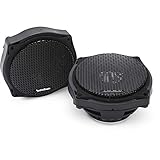
- The TMS6SG is a pair of 6.5” full range coaxial speakers designed to fit...
- No modification needed as the speaker directly replaces the existing...
- Featuring 75 Watts RMS/ 150 Watts MAX power and an ultra-efficient 25mm...
Best suited to: Owners of supported Harley-Davidson Electra Glide and Street Glide motorcycles who want purpose-built speakers for the original fairing locations.
The Rockford Fosgate TMS6SG is the most clearly identified replacement-speaker option in this selection. The supplied listing specifies select 2006–2013 Electra Glide and Street Glide models, rather than treating every Harley touring motorcycle as interchangeable. That application-specific approach makes it a sensible starting point for a premium factory-location upgrade.
These 6.5-inch coaxial speakers have a 4-ohm nominal impedance and 75-watt RMS power handling per speaker. Their motorcycle-oriented construction addresses exposure that ordinary indoor or automotive speakers may not tolerate. Nevertheless, environmental protection does not mean the speaker openings can safely receive a pressure-washer jet.
Principal advantage: A defined product designation and motorcycle-specific installation approach make compatibility easier to establish than with an unnamed speaker pair. The coaxial layout also keeps the woofer and tweeter together, avoiding a separate tweeter installation.
Principal limitation: TMS6SG compatibility must not be extended to a Harley-Davidson Road Glide simply because its speakers look similar. Road Glide applications use different fitment documentation. Likewise, these older-generation applications do not establish compatibility with newer Street Glide fairings.
Required supporting equipment: Confirm the supplied grilles, connectors, fasteners, and any installation-specific hardware against the current manual. An appropriately matched amplifier is worth considering for greater clean output, but its input integration must suit the motorcycle’s radio.
Before purchase, check mounting depth and grille clearance rather than relying solely on the 6.5-inch description. Also confirm whether the motorcycle retains its original radio and speaker mounting arrangement.
Verdict: A strong premium candidate for the specifically supported older Electra Glide and Street Glide applications—not a universal Harley-Davidson speaker replacement.
KICKER Motorcycle 5.25-Inch Speaker Package
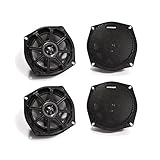
- 5-1/4" PowerSports Harley Motorcycle Speakers System
- Peak: 200 watts per pair / 100 watts each
- RMS: 100 watts per pair / 50 watts each
Best suited to: Riders whose existing fairing or adapter arrangement accepts 5.25-inch speakers and whose electronics support a 4-ohm load.
The supplied KICKER motorcycle package is described as a 5.25-inch, 4-ohm coaxial speaker package. That makes it relevant to smaller factory openings and certain aftermarket fairings, but the package’s exact speaker model needs confirmation before treating it as a direct-fit upgrade.
Its advertised 200-watt maximum output should not be interpreted as continuous power handling per speaker. Maximum, peak, package-total, and RMS figures are different measurements. Ask for the exact SKU and its continuous rating before selecting an amplifier.
Principal advantage: The smaller nominal diameter may suit installations where moving to 6.5-inch speakers would require adapter rings, replacement grilles, or cutting. Keeping an appropriately sized speaker can simplify installation and preserve the original appearance.
Principal limitation: Brand name and diameter do not establish motorcycle fitment. The package description alone does not confirm bolt spacing, mounting depth, connector compatibility, or the environmental rating of the specific speakers supplied.
A 4-ohm replacement also deserves special attention if the motorcycle originally used lower-impedance speakers. Depending on the radio’s design, changing the load can reduce available electrical output. A better-built speaker therefore does not automatically become a louder speaker on factory power.
Required supporting equipment: Potential requirements include model-specific mounting rings, wiring adapters, compatible grilles, and an amplifier rated for the actual speaker load. Verify whether those parts are included rather than assuming “package” means a complete installation kit.
For a mid-range upgrade, prioritize a clearly identified package with documented dimensions over one advertised mainly through maximum watts. Confirm weather suitability separately from the motorcycle label.
Verdict: A reasonable smaller-speaker candidate once the exact KICKER model and motorcycle application are established; not a confirmed drop-in replacement based on diameter alone.
TCMT 6.5-Inch Lower-Fairing Speaker Pods

- Conditon: Aftermarket brand new; You get everything shown in the picture...
- Fit For 1983-2013 Harley touring models Road King Street Glide Electra...
- Also fits 1998-2009 Road Glide by cutting off 2-1/2" the upper cap cover to...
Best suited to: Riders adding speakers in compatible lower-fairing locations rather than replacing the speakers beside the instrument panel.
The TCMT option combines lower-fairing speaker boxes with installed 6.5-inch speakers. Its appeal is structural: the enclosure and speaker arrive together, reducing the need to assemble unrelated parts. It belongs in an expansion plan, however, not a direct comparison with speaker-only upper-fairing replacements.
The supplied listing references 2014-onward applications, but that wording does not prove compatibility with every touring model or subsequent fairing redesign. Confirm the exact motorcycle, engine guard, lower-fairing arrangement, cooling configuration, and installation exclusions.
Principal advantage: A matched pod-and-speaker assembly can simplify the physical side of adding lower speakers. For a rider without existing lower speaker enclosures, this may be more practical than buying loose drivers and sourcing separate boxes.
Principal limitation: The description does not establish the installed speakers’ nominal impedance, continuous power handling, sensitivity, or mounting depth. Without those details, amplifier matching remains unresolved. “Pre-assembled” also does not mean electrically integrated with the motorcycle.
Required supporting equipment: Expect to investigate mounting brackets, wiring extensions, weather-protected connectors, amplifier channels, and any radio integration hardware. Check whether the package includes every bracket and fastener needed for the specific bike.
Lower speakers also sit farther from the rider’s ears and face different exposure than upper-fairing speakers. Their contribution depends on enclosure design, aiming, tuning, and how their output blends with the existing front speakers.
Treat this as a separate equipment category when comparing costs. A pod assembly includes physical components absent from a speaker-only pair, so the purchase totals are not directly comparable.
Verdict: A practical lower-fairing expansion candidate when mechanical compatibility and speaker specifications are confirmed—not a substitute for a documented upper-fairing replacement.
KSPEAKER 3-Inch Amplified Speaker System
No products found.
Best suited to: Riders considering an externally mounted audio system instead of opening or modifying a fairing.
The KSPEAKER system uses 3-inch metal speaker housings, a built-in amplifier, Bluetooth connectivity, and a 12-volt power supply. Unlike passive replacement speakers, it combines several audio functions in one package. Its intended mounting approach is handlebar-based rather than installation inside factory fairing speaker openings.
That distinction is decisive. It should not be purchased as a drop-in Street Glide fairing speaker upgrade or as a replacement for speakers inside a Road Glide enclosure.
Principal advantage: Integrated amplification and wireless playback can make sense on a motorcycle without a suitable radio or existing speaker system. The buyer does not necessarily need to assemble a separate head unit, amplifier, and passive-speaker combination.
Principal limitation: Small external speakers cannot be assumed to match the usable output, midbass, or visual integration of a properly designed fairing system. The supplied description also does not establish continuous amplifier output, a documented IP rating, or the speaker impedance.
Required supporting equipment: Verify clamp dimensions, handlebar clearance, fused power wiring, control placement, and cable routing. The installation must preserve full steering movement and avoid interference with the throttle, brake lines, switches, and instruments.
Although this is a more self-contained purchase, “built-in amplifier” does not eliminate installation work. A secure electrical connection and vibration-resistant mounting remain essential.
For anyone searching for Harley-Davidson speakers with Bluetooth, remember that Bluetooth normally belongs to the source or amplifier. Passive fairing speakers do not need wireless capability when the existing radio already supplies it.
Verdict: An alternative for bikes needing external audio, but not an appropriate choice when the goal is specifically to replace fairing-mounted speakers.
Fairing Speaker Fitment
Motorcycle Model and Year
Use 1998–2013, 2014–2023, and 2024+ as research checkpoints, not universal fitment rules. Exact model, factory audio package, speaker location, and previous modifications matter just as much.
For newer installations, the Rockford Fosgate TMS14-65 and TMS24-65 are separate application candidates; their names should not be treated as interchangeable. Verify current model-specific exceptions and required hardware.
Likewise, investigate Hogtunes 462F-RM factory-radio compatibility for the exact radio configuration. A replacement intended for one factory system is not automatically suitable for another.
Mounting Depth and Grille Clearance
Before ordering, verify these five items:
1. Cutout diameter and bolt pattern: The basket must seat correctly.
2. Mounting depth: Allow clearance behind the magnet.
3. Front clearance: The tweeter must not touch the grille.
4. Connectors: Confirm polarity and harness compatibility.
5. Adapters and seals: Check ring thickness, gasket fit, and hardware.
Nominal diameter does not establish fit. Even two 6.5-inch coaxial speakers can have substantially different installation requirements.
Upper and Lower Fairing Locations
A speaker approved for an upper fairing is not automatically approved for lower-fairing speaker pods. Enclosure volume, mounting angle, drainage, depth, and surrounding hardware can differ.
The same warning applies when researching the best 6×9 speakers for motorcycle fairing installations: changing speaker shape generally requires an enclosure designed for it, not simply a larger hole.
Speaker and Amplifier Matching
Factory-Radio Compatibility
Physical connection is only the first requirement. The radio must support the speaker’s load, and its available output must suit your expectations.
A higher-power aftermarket speaker may work on factory power without becoming louder. For an Infinity Kappa Perfect 600X upgrade, verify physical adapters and amplifier requirements together. For Cicada CX65.2, confirm the current model designation and design the speaker-and-amplifier pairing deliberately.
RMS Power, Impedance, and Sensitivity
Continuous or RMS power handling describes an operating limit under specified conditions—not the power a speaker always consumes. Peak figures are less useful for system planning.
Match amplifier output at the actual nominal impedance, per channel. Also compare sensitivity only under equivalent measurement conditions: a 2.83-volt specification and a one-watt specification are not automatically comparable across different impedances.
Radio Flashing and DSP Requirements
A Harley audio upgrade may require a radio flash, signal correction, DSP configuration, or a combination. The answer depends on the radio, factory amplifier, aftermarket interface, and installation instructions.
“Plug-and-play” may describe connectors while still leaving battery wiring, fairing removal, gain adjustment, and tuning to complete. Never assume it means no configuration is necessary.
Sound Quality at Highway Speeds
Prioritize intelligible vocals and usable clean output rather than chasing the loudest motorcycle speakers by advertised watts. Wind, exhaust, helmet design, windshield position, and road speed all affect what reaches your ears.
Small fairing speakers have limited deep-bass capability. Riders seeking the best motorcycle speakers with bass should expect better midbass definition rather than subwoofer-like impact.
Excessive bass boost consumes headroom and increases cone movement. Appropriate high-pass filtering and sensible tuning can preserve clarity, but higher volume is not a safe substitute for overcoming every source of riding noise.
Weather Resistance for Fairing Speakers
Look for documented environmental protection rather than relying solely on “marine-grade” or “waterproof” wording.
In an IP rating, the first character addresses solids and the second addresses water. IPX5 identifies a water-protection level, while the X means no solids rating is specified. It does not mean the product failed a dust test.
The Infinity Kappa Perfect 600X carries an IPX5 rating; do not transfer that rating to unrelated Infinity products. Also check UV-resistant materials, corrosion protection, sealed connections, and installation orientation. Rain resistance does not authorize pressure washing.
Total Upgrade Cost
Compare complete installations, not isolated speaker purchases. Request an itemized list covering:
- Speaker adapters, gaskets, grilles, and mounting hardware.
- Harnesses and weather-protected connectors.
- Amplifier, mounting bracket, fused wiring, and power distribution.
- Radio interface, DSP setup, or flashing.
- Installation and tuning labor.
A speaker-only replacement is usually the simplest path when compatibility is established. An amplified DIY upgrade adds wiring and integration responsibilities. A professionally installed system adds labor but can include fitment verification, configuration, and troubleshooting.
Do not compare a premium complete system with a budget speaker pair as though they provide the same equipment or installation scope.
FAQ
What are the best speakers for a Harley-Davidson motorcycle?
The right speakers match the motorcycle’s exact model, year, mounting location, and audio configuration. Confirm physical clearance, nominal impedance, weather protection, and factory-radio compatibility before comparing power ratings. Decide whether you want a straightforward replacement or an amplified upgrade, because those goals require different equipment and expectations.
Is Rockford Fosgate a good brand?
Rockford Fosgate is worth considering for motorcycle audio because it offers application-specific equipment and installation documentation. Judge the relevant equipment by supported motorcycles, electrical specifications, included hardware, integration requirements, warranty, and technical support. Brand reputation alone does not establish compatibility or guarantee an improvement with your existing stereo.
What speaker brand has the best sound quality?
No speaker brand has universally superior sound quality across every motorcycle installation. Enclosure fit, amplification, frequency response, tuning, and riding conditions strongly influence the result. Compare suitable equipment under similar conditions, and prioritize clean vocal reproduction and balanced output rather than assuming a brand name determines the final sound.
Do motorcycle fairing speakers need an amplifier?
Not always. A compatible replacement can operate from factory power when its impedance and installation requirements match the original system. An amplifier becomes more useful when the goal is greater clean output. It must still receive an appropriate signal and be configured correctly; additional power alone does not guarantee better sound.
Can the same speakers fit upper and lower motorcycle fairings?
Sometimes, but matching diameter is not enough. Upper and lower locations may differ in mounting depth, bolt pattern, enclosure volume, connectors, grille clearance, and weather exposure. Use a speaker in both locations only when installation documentation supports those applications and the electrical system can drive the resulting configuration correctly.
Conclusion
A successful fairing-speaker upgrade begins with a complete understanding of the motorcycle, not a maximum-wattage claim. Verify the mounting arrangement, match the electrical load, and plan any amplification or signal correction before buying. Realistic expectations about highway noise and bass performance help keep the project focused on what matters: clearer, balanced audio from a secure, weather-appropriate installation.