What is a FM Synth?
FM synthesis, or frequency modulation synthesis, is a powerful and versatile method of sound generation that has significantly influenced the landscape of electronic music. At its core, FM synthesis involves modulating the frequency of one waveform (called the carrier) with another waveform (called the modulator) at audio rates. This interaction produces complex harmonic content, allowing for the creation of rich, evolving, and dynamic timbres that are difficult to achieve with traditional subtractive synthesis.
Unlike subtractive synthesis, which starts with harmonically rich waveforms and sculpts sound by filtering frequencies away, FM synthesis builds complex spectra by varying the frequency of oscillators in real time. This allows FM synths to generate a wide range of sounds, from bright metallic bells and electric pianos to deep basses and evolving pads. The characteristic FM sound is often described as bright, glassy, or bell-like, but the technique is capable of producing a vast palette of tones.
What is FM Synthesis?
FM synthesis, also known as frequency modulation synthesis, is a method of sound creation that involves modulating one waveform with another at audio rates to produce complex timbres. FM synthesis enables the creation and manipulation of harmonics, resulting in rich and complex sounds. Traditional FM synthesis relies on multiple operators—oscillators that act as carriers and modulators, with the modulator shaping the frequency and harmonic content of the carrier—to shape sounds dynamically. This technique uses different waveforms as the basis for modulation, allowing for the creation of sounds ranging from bright, metallic tones to deep, evolving textures.
The history of FM synthesis dates back to the late 1960s when composer and researcher John Chowning at Stanford University discovered that modulating the frequency of one waveform with another at high audio rates could produce complex and musically rich sounds. His pioneering work culminated in a 1973 paper titled “The Synthesis of Complex Audio Spectra by Means of Frequency Modulation,” which introduced the concept to the wider academic and music technology communities.
Yamaha licensed Chowning’s patent in the late 1970s, leading to the release of the iconic Yamaha DX7 in 1983, the first commercially successful FM synthesizer. The DX7 became one of the best-selling synthesizers of its era, renowned for its distinctive sound and extensive preset library. Despite its popularity, the complexity of FM synthesis programming meant that many users relied heavily on factory presets, earning the DX7 the nickname “preset machine.”
Classic FM synthesis is often associated with the Yamaha DX series, which popularized the sound with its distinctive presets and capabilities. These synthesizers are renowned for their unique tone, offering a wide palette of sonic colors and textures. They became best-selling instruments due to their ability to produce both realistic and otherworldly sounds, making them a staple in music production. The Yamaha DX series, along with other vintage hardware, set the foundation for what many consider the quintessential FM sound.
Key Features of FM Synths
Multi-Operator Architecture
FM synthesizers are distinguished by several key features that set them apart from other types of synthesis. One of the most notable is the use of multiple operators—oscillators that can function as carriers or modulators—allowing for intricate modulation paths and complex harmonic structures. This multi-operator architecture enables the creation of a vast range of sounds, from bright, bell-like tones to deep, evolving pads.
Audio-Rate Frequency Modulation
Another important feature is the ability to modulate frequencies at audio rates, which produces rich and dynamic timbres not achievable with slower modulation techniques. Many FM synths include algorithms that define how operators interact, giving musicians control over the routing and modulation depth, which directly shapes the character of the sound.
Envelopes, Filters, and Effects
FM synths often incorporate features such as looping envelopes, which allow for sustained or evolving modulation patterns, adding movement and life to patches. The inclusion of filters, effects, and modulation sources like LFOs further expands the sonic possibilities, enabling users to craft unique textures and tones.
Polyphony and Performance Capabilities
Polyphony is another critical aspect, with many FM synthesizers offering multiple voices so that complex chords and layered sounds can be played simultaneously. This capability is essential for modern music production, where rich harmonic content and expressive performance are key.
Hardware and Software Variants
Additionally, FM synthesizers can be found in both hardware and software forms, each offering distinct advantages. Hardware FM synths provide tactile interfaces and often a distinctive character, while software FM synths offer visual programming, presets, and integration with digital audio workstations. Many modern FM synths also feature MIDI compatibility and sequencers, facilitating their use in live performance and composition.
Top FM Synths
Yamaha Montage 8
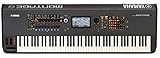
- The Motion Control Synthesis Engine unifies and controls two iconic Sound...
- Motion Sequences are tempo-synchronized, completely customizable control...
- Montage features professional, stereo balanced outputs with “Pure Analog...
The Yamaha Montage 8 is a flagship synthesizer that combines classic FM synthesis with modern technology, offering a powerful platform for sound design and performance. Building on the legacy of Yamaha’s iconic DX series, the Montage 8 integrates FM synthesis with advanced sample-based synthesis, providing users with a hybrid engine that delivers both rich FM tones and realistic acoustic sounds.
One of the standout features of the Montage 8 is its Motion Control Synthesis engine, which allows seamless blending and morphing between FM and sample-based sounds. This capability enables musicians to create dynamic, evolving sounds that go beyond traditional FM synthesis. The Montage 8 also boasts an 88-key weighted keyboard, providing a premium playing experience for pianists and keyboardists alike.
With extensive real-time control options, including multiple assignable knobs, sliders, and a touch screen interface, the Montage 8 offers hands-on manipulation of parameters, making it easier to craft and modify sounds on the fly. Its comprehensive effects section, high polyphony count, and integration with MIDI and DAWs make it a versatile instrument suitable for studio production and live performance.
The Yamaha Montage 8 continues to uphold Yamaha’s reputation for delivering high-quality FM synthesis instruments while embracing modern features that appeal to today’s musicians and producers. It is an excellent choice for those seeking a powerful, expressive synthesizer capable of producing both classic FM sounds and innovative sonic textures.
Elektron Digitone II 16-Track Polyphonic Digital Synthesizer

- Four synth engines, 16 voices: Wavetone, Swarmer, FM Tone and FM Drum cover...
- Deep sound shaping: Six filter machines, a base-width filter, 3 LFOs and...
- Sequencer built for playing: 128 steps, parameter locks, trig conditions...
The Elektron Digitone II is a modern evolution of the popular Digitone, offering a powerful and flexible platform for FM synthesis enthusiasts. With 16-voice polyphony and a 16-track sequencer, it provides extensive capabilities for complex compositions and live performances. The Digitone II combines classic FM synthesis with Elektron’s renowned workflow, featuring hands-on controls, parameter locks, and an intuitive interface that makes programming and tweaking FM patches accessible and engaging.
One of the key strengths of the Digitone II is its ability to blend FM synthesis with effects such as overdrive, delay, chorus, and reverb, allowing users to craft rich, textured sounds that go beyond traditional FM timbres. Its four-operator FM engine supports multiple algorithms and modulation routings, enabling the creation of both classic sounds and innovative textures. The device also supports MIDI integration, making it a versatile addition to any setup.
The Digitone II’s sequencer offers advanced features like parameter locking, allowing musicians to automate changes in FM parameters on a per-step basis, leading to dynamic and evolving patterns. This makes it particularly well-suited for electronic music producers who value both sound design depth and performance flexibility.
Korg Opsix MKII 37-key FM Synthesizer

- Next-generation digital synthesizer with true six-operator FM synthesis for...
- Features 64 voices for expansive tone-crafting and multidimensional...
- Equipped with 37 velocity-sensitive keys for expressive performance.
The Korg opsix MKII is a modern reimagining of FM synthesis, designed to provide musicians with a highly flexible and expressive instrument. Building on the original opsix’s reputation, the MKII version introduces enhanced sound engines, improved user interface, and expanded modulation capabilities, making it one of the best FM synths available today.
This synthesizer features six operators with a wide range of algorithms and operator waveforms, allowing users to explore beyond traditional FM synthesis into new sonic territories. The opsix MKII offers Variable Phase Modulation (VPM), a unique approach that refines the relationship between modulators and carriers, resulting in richer and more harmonically complex sounds.
The 37-key keyboard provides a comfortable playing experience, and the synth includes a high-resolution color display alongside numerous knobs and sliders for intuitive real-time control. Users can freely route modulation sources, apply filters and effects at the operator level, and utilize multiple envelope generators and LFOs, making sound design both deep and accessible.
With extensive MIDI and USB connectivity, the opsix MKII integrates seamlessly into modern studio setups and live performances. Its ability to produce a wide variety of sounds—from classic bell-like FM tones to aggressive, distorted textures—makes it a versatile tool for producers and performers alike.
Yamaha Reface DX Portable FM Synthesizer

- 4-operator FM Sound Engine offers dynamic and expressive additive synthesis
- 32 Voice memory locations allow storing and recalling favorite Voices
- Integrated phrase Looper: capture song ideas or just jam!
The Yamaha Reface DX is a compact, portable FM synthesizer that brings the classic FM synthesis experience into a modern, accessible format. Designed for musicians and producers who want to explore the rich textures and evolving sounds of FM synthesis without the complexity of larger hardware, the Reface DX offers a streamlined interface and a powerful sound engine.
Despite its small size, the Reface DX features four operators, allowing users to create a variety of classic FM tones reminiscent of the iconic Yamaha DX series. Its touch-based keyboard and intuitive controls make it easy to experiment with sound design, making it an excellent choice for both beginners and seasoned FM enthusiasts.
The synth includes a range of preset sounds that showcase the versatility of FM synthesis, from electric pianos and bells to basses and leads. Users can also delve into crafting their own patches, adjusting parameters such as operator frequency ratios, envelopes, and modulation depths. The Reface DX supports MIDI connectivity, enabling integration with other hardware and software in a studio or live setup.
Portability is a key feature of the Reface DX, with battery operation and a lightweight design that make it ideal for music production on the go or live performances. Its built-in effects, including chorus and delay, add depth and character to patches, enhancing the overall sound palette.
Korg Volca FM2 Digital Synthesizer

- Powerful 6-voice, 6-operator FM synthesizer with classic DX7 algorithms
- Features a 16-step sequencer for intuitive and flexible music programming
- Includes built-in chorus and reverb effects for enhanced sound quality
The Korg Volca FM2 is a compact and affordable digital FM synthesizer that builds upon the legacy of classic FM synthesis while offering modern usability and portability. As the successor to the popular Volca FM, the FM2 enhances the user experience with improved sound quality, increased polyphony, and a more intuitive interface.
Featuring a six-operator FM engine, the Korg Volca FM allows musicians to create complex and expressive sounds that range from bright, metallic tones to deep basses and evolving pads. Its compact size makes it ideal for mobile music production, live performances, and integration into modular gear setups. The device includes a built-in sequencer and MIDI connectivity, enabling seamless synchronization with other instruments and digital audio workstations.
One of the standout features of the Volca FM2 is its ability to access and edit classic FM synthesis parameters, giving users the freedom to craft their own patches beyond factory presets. This flexibility appeals to both beginners and experienced FM enthusiasts looking to explore interesting sounds and develop unique sonic textures. Additionally, the Volca FM2 supports sample playback and layering, expanding its sonic palette and making it a versatile tool for modern musicians.
Conclusion
FM synthesis continues to captivate musicians and sound designers with its ability to unlock a world of rich, evolving tones and intricate sonic textures. Its unique approach to sound creation offers endless possibilities for innovation and expression, blending complexity with creativity to inspire fresh musical ideas. Whether explored through hardware, software, or modular setups, FM synthesis remains a powerful and dynamic tool that pushes the boundaries of modern music production.
FAQ
Can I create my own sounds on FM synths?
Absolutely. While FM synthesis can be complex, many modern FM synths allow users to craft their own sounds beyond the factory presets. They offer hands-on control over multiple operators, modulation routings, envelopes, and filters, enabling deep sound design and unique patch creation.
What is filter FM and how does it differ from traditional FM synthesis?
Filter FM involves modulating the filter cutoff frequency at audio rates, adding another layer of complexity and texture to the sound. This contrasts with traditional FM synthesis, where the frequency of oscillators (operators) is modulated. Some synths, such as the Novation Bass Station II and Dave Smith Instruments’ Prophet series, incorporate filter FM to achieve grittier or more dynamic tones.
Are hardware FM synths better than software FM synths?
Both have their advantages. Hardware FM synths often provide tactile control and a distinctive character that many musicians appreciate, while software FM synths offer visual interfaces, easy integration with digital audio workstations, and often more affordable options. Popular software synths include Native Instruments FM8 and Ableton’s Operator, both known for their flexibility and sound quality.
What makes the Yamaha DX series iconic in FM synthesis?
The Yamaha DX series, particularly the DX7, popularized FM synthesis in the 1980s with its distinctive sound and extensive preset library. It became one of the best selling synthesizers of its time, known as a “preset machine” due to its complex programming interface which led many users to rely on factory patches. Despite this, it remains a foundational instrument for classic FM sounds and has influenced countless modern synth designs.
What is an operator in FM synthesis?
An operator is essentially an oscillator with an envelope generator, capable of acting as a carrier or modulator in FM synthesis. The interaction between multiple operators creates the complex sounds characteristic of FM synthesis.