Want one music player that can bring both your CDs and cassette tapes back into everyday use? A CD-and-cassette boombox combines a CD player, a cassette mechanism, and speakers in one system, often with radio reception and additional audio connections. CD cassette player combo suit different priorities, however. Detachable speakers, straightforward controls, recording capability, and replaceable batteries can matter more than a long feature list. The five options below cover those different needs, with important distinctions between advertised features and capabilities that still need confirmation.
Top CD and Cassette Player Combos
Greadio Boombox CD and Cassette Player Combo

- 【9-in-1 CD and Cassette Player Combo】Supports CD/ Tape/ Recording/ AUX...
- 【5000mAh Rechargeable CD Boombox】Built-in lithium-ion battery with...
- 【Dual Full-range Stereo CD Cassette Player】This boombox with cd and...

The Greadio rechargeable CD and cassette boombox suits listeners who want to move their music between rooms or occasionally listen away from an outlet without buying disposable batteries. The configuration identified by product number B0DCZYG73H is advertised with a 5,000mAh rechargeable battery, CD and cassette playback, Bluetooth, FM radio, tape recording, and remote control.
Its principal advantage is convenience. A built-in rechargeable battery removes the need to keep a separate set of large batteries available. The listing also identifies USB, microSD, and AUX playback, giving this system more ways to play music than a basic physical-media boombox.
Those extra sources are useful if your collection spans several formats. You could listen to an album on CD, play a cassette, and connect another audio source without replacing the whole system. However, USB playback does not automatically mean the player can convert cassette recordings into digital files.
Two concrete advantages:
- Rechargeable operation makes occasional outdoor or room-to-room use more convenient.
- Multiple advertised playback sources reduce dependence on a phone or a single media format.
Two limitations:
- Battery runtime under specific CD, cassette, volume, and Bluetooth conditions is not confirmed.
- Bluetooth transmission to wireless headphones is not confirmed; do not interpret the Bluetooth version as proof of output capability.
The exact configuration matters because similar-looking Greadio listings may describe different features. Match the product identifier, connection panel, included power supply, and instruction manual before ordering. Also check whether the remote operates only electronic playback functions or provides any cassette control.
For value, judge this model by whether you will actually use its rechargeable battery and additional inputs—not by feature count alone.
Buying verdict: Choose this Greadio configuration when rechargeable convenience is your priority, but confirm Bluetooth direction and realistic battery endurance before relying on it for travel.
Emerson EPB-4000 Portable CD Cassette Boombox with AM/FM Radio

- Play CDs, Tapes, Radio & More: Enjoy standard CDs, CD-Rs, CD-RWs, cassette...
- Detachable Speakers, Bigger Stereo Feel: Two 4" detachable speakers deliver...
- Bring Your Old Music Back to Life: Dust off the cassette collection and...
The Emerson EPB-4000-BL is the most distinctive choice here for shoppers who want a CD cassette boombox with detachable speakers. The blue variant is listed with CD and cassette playback, AM/FM radio, an AUX input, and removable speaker sections.
Detachable speakers offer a practical benefit that fixed-speaker boomboxes cannot: you can position the speakers farther apart when listening at a desk, on a shelf, or in a small room. Greater separation can make stereo recordings easier to appreciate, although it does not by itself establish better sound quality.
This design is especially appealing if the player will spend most of its time at home. Keep the speakers attached for a compact arrangement, then separate them when the furniture layout allows. Before planning placement, confirm the speaker-cable length and connector type; “detachable” does not mean wireless.
Two concrete advantages:
- Separate speaker positioning gives you more flexibility than a one-piece enclosure.
- AM/FM radio and AUX input extend its usefulness beyond CDs and tapes.
Two limitations:
- Detached speakers and their cables make the system less convenient to carry as one tidy package.
- Bluetooth functionality, MP3-CD compatibility, and cassette recording sources should not be assumed from abbreviated retail titles.
Pay particular attention to the phrase “MP3 AUX input.” An AUX input can accept analog audio from an MP3 player, phone adapter, or other source. That wording does not establish that the CD mechanism reads discs containing MP3 files.
The silver EPB-4000-SL also appears in product listings, but check its own documentation rather than assuming every specification or included accessory matches the blue version.
Buying verdict: Choose the EPB-4000-BL for a home-focused setup where speaker placement matters more than rechargeable convenience, and confirm power requirements and recording support before purchase.
Retekess TR621 CD and Cassette Player Combo
- Durable cd cassette player combo; plug in wall radio can be used anywhere...
- Versatile cd and cassette player combo; Retekess tr621 combines various...
- User-friendly design; portable cd player design is convenient; intuitive...
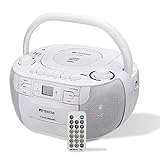
The Retekess TR621 is a useful option for listeners whose music collection includes commercial CDs, homemade discs, cassette tapes, and files stored on USB drives. The supplied listing identifies CD and cassette playback, CD-R/RW and MP3-CD support, USB playback, cassette recording, Bluetooth, and AC/battery operation.
That combination makes the TR621 more relevant to a mixed collection than a player documented only for standard audio CDs. MP3-CD support is particularly useful if you previously saved large music libraries onto data discs. It is a separate capability from playing a CD-R containing conventional audio tracks.
AC and battery operation also give you flexibility. You can keep the player plugged in for regular listening and use batteries when moving it elsewhere. Confirm the battery size, quantity, and whether batteries are included; battery operation should not be interpreted as built-in charging.
Two concrete advantages:
- Explicitly listed MP3-CD and CD-R/RW support accommodates more disc types.
- USB playback provides an alternative to continually handling discs or connecting a phone.
Two limitations:
- Bluetooth direction is not established by the supplied listing, so wireless-headphone compatibility remains unconfirmed.
- Cassette recording is advertised, but the supported recording sources and exact recording procedure need checking in the model-specific manual.
Do not confuse the TR621 with the Retekess TR642. Both appear in searches for CD-and-cassette systems, but their model numbers are not interchangeable. Recording options, controls, power arrangements, and supported formats must be checked separately.
If you want a CD and cassette player with tape recording, establish whether your intended source—CD, radio, USB, AUX, or Bluetooth—can actually feed the cassette recorder. One supported recording source does not prove support for all the others.
Buying verdict: Choose the TR621 when documented disc-format breadth and USB playback are more important than having the simplest possible control layout.
GPX BCA209B Portable CD Boombox with AM/FM Radio
- CD & CASSETTE PLAYER: Enjoy your favorite CDs and cassette tapes in one...
- RECORD TO CASSETTE: Record directly to cassette from the CD player or AM/FM...
- AM/FM RADIO: Tune in to your favorite local AM and FM stations with easy...
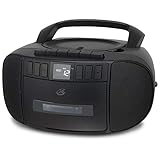
The GPX BCA209B belongs on the shortlist for shoppers who want the familiar layout of a conventional portable stereo rather than a feature-heavy entertainment system. It combines a CD player, cassette player, AM/FM radio, and an audio input in a compact boombox format.
Its appeal is straightforward: it concentrates on the sources many physical-media listeners already own. If your routine consists of playing an album, listening to a tape, and occasionally switching to the radio, additional wireless modes and memory-card slots may contribute little.
The model is commonly specified for CD and CD-R/RW playback, cassette recording, and AC or battery operation. Check those details against the exact unit’s documentation, especially if a seller combines several GPX models on one page. BCA209B should not be confused with CD-only GPX models that have a similar appearance.
Two concrete advantages:
- A conventional boombox layout keeps core playback functions easy to identify.
- Radio reception and an external audio input add useful listening options without requiring wireless pairing.
Two limitations:
- Bluetooth and MP3-CD playback are not confirmed and should not be expected.
- Battery-powered portability brings the ongoing cost and carrying weight of replaceable batteries.
Before choosing it for recording, confirm the available source-routing instructions and whether the controls include the functions you need. A record button alone does not explain whether the unit supports recording from an external input or how recording levels are handled.
Avoid assigning it a budget label without comparing current offers. An older or less feature-rich product can become poor value when stock is limited, even if it originally occupied an entry-level position.
Buying verdict: Choose the BCA209B for a familiar physical-media listening routine, provided its current offer and confirmed features make sense beside more versatile alternatives.
Memorex MX-BCCD50(K) AM/FM Top Loading Cassette CD Player

- ✅ DUAL PLAYBACK FUNCTIONALITY – CD and CASSETTE SUPPORT: Enjoy the best...
- ✅ INTUITIVE MUSIC CONTROLS FOR EASY PLAYBACK: Navigate your music...
- ✅ CLEAR AM/FM RADIO RECEPTION FOR MUSIC & NEWS: Stay connected to your...
The Memorex MX-BCCD50(K) is aimed at listeners who want a recognizable top-loading CD player and cassette deck in one portable stereo. The supplied listing identifies AM/FM radio, programmable CD memory, an auto-stop cassette deck, an auxiliary input, and a red LED display.
Its strongest fit is everyday listening at home. A top-loading CD compartment can make disc changes straightforward when the unit sits below eye level and has enough overhead clearance. Programmable memory allows a custom track sequence on compatible discs without repeatedly skipping tracks manually.
The auto-stop cassette feature is another useful convenience. However, do not assume “auto-stop” applies identically to playback, recording, fast-forward, and rewind. Check which transport operations stop automatically and whether the mechanism requires manual intervention afterward.
Two concrete advantages:
- Programmable CD playback supports custom listening sequences.
- AM/FM radio and AUX input provide alternatives when you do not want to use physical media.
Two limitations:
- Cassette recording is not confirmed by the supplied model description.
- Battery requirements, Bluetooth capability, and expanded disc-format support need exact-model confirmation.
There is also a variant-identification issue worth resolving before purchase: the supplied product title mixes blue and black color wording. Match the model label and product photographs rather than relying on the color name alone.
Display type is not a guarantee of readability. Consider whether you need to read track numbers across a room, distinguish small mode indicators, or operate the stereo in low light. Likewise, confirm whether any remote is included rather than assuming one accompanies programmable playback.
This is a playback-first candidate, not an automatic choice for recording or digital conversion.
Buying verdict: Choose the MX-BCCD50(K) when its conventional controls and listed playback features match your needs, but verify power requirements and cassette functionality before ordering.
Choosing the Right CD Cassette Player Combo
The right purchase starts with your collection and listening habits, not the longest list of specifications.
1. Match the media: Confirm your CDs, burned discs, and cassette tapes are supported.
2. Choose the power arrangement: Decide between outlet use, replaceable batteries, and built-in rechargeable operation.
3. Check recording and connections: Verify specific recording sources and Bluetooth direction.
4. Consider daily operation: Prioritize accessible controls, readable displays, and convenient media loading.
Current ratings, prices, stock, and seller terms can change. Check them for the exact variant you intend to buy, and prioritize a clear return policy over an impressive but poorly documented feature list.
CD Format Compatibility
Commercial audio CDs, recordable discs, and MP3 CDs are not interchangeable compatibility categories.
A standard audio CD contains tracks in the conventional CD-audio format. A CD-R or CD-RW describes a writable disc type; that disc can contain either audio tracks or computer files. An MP3 CD is generally a data disc containing compressed music files.
Look for explicit confirmation of each format:
- Audio CD: The starting requirement for this category.
- CD-R: Important for many homemade audio discs.
- CD-RW: Requires separate support; CD-R compatibility does not guarantee it.
- MP3-CD playback: Necessary for supported MP3 files stored on a data disc.
Even a compatible player may struggle with damaged media, poor-quality burns, unsupported file structures, or discs that were not finalized. If burned discs make up much of your collection, try several during the return period rather than testing only a commercial album.
Cassette Playback and Recording
A cassette mechanism does not automatically include recording. Some combos only play tapes, while others record from one or more internal or external sources.
For a CD and cassette player with tape recording, check three things: whether it records at all, which sources it accepts, and how the recording process works. CD-to-tape recording may be available even when Bluetooth-to-tape recording is not.
Also distinguish recording onto cassette from converting a cassette into a digital file. Neither USB playback nor a record button proves digital conversion capability.
Use an expendable tape for the first recording attempt. Confirm the correct side is selected, the record-protection tabs allow recording, and playback sounds right before recording anything important. Keep irreplaceable tapes away from an unfamiliar transport until you know it operates reliably.
Bluetooth Input Versus Output
Bluetooth direction is one of the most important details in this category.
A Bluetooth receiver accepts audio from a phone, tablet, or computer and plays it through the boombox’s speakers. A Bluetooth transmitter sends the boombox’s audio to compatible wireless headphones or speakers.
Many CD cassette players with Bluetooth input do not transmit CD or cassette audio. Bluetooth 5.1 or 5.3 describes a technology version, not the direction or availability of those functions.
For wireless headphones, look for an explicit statement covering Bluetooth output and the sources it supports. A model might transmit one source but not another. If the documentation only says “Bluetooth speaker,” treat headphone transmission as unconfirmed rather than assuming two-way operation.
Battery Power and Portability
“Portable” can mean a carrying handle, not necessarily a practical travel system.
An AC and battery-powered CD cassette player may use replaceable cells, while a rechargeable model stores power internally. Replaceable batteries are easy to swap when you have spares, but large cells add weight and recurring cost. Built-in batteries are convenient, though charging access and eventual battery aging matter.
A 5,000mAh capacity claim is not a runtime measurement. Playback duration depends on battery voltage, volume, source, speaker load, and the power required by the CD or cassette mechanism.
Compare weight with batteries installed, not just the empty enclosure. Also check the handle, charging method, and whether playback works while charging.
For travel, place the player on a stable surface. A boombox suitable for a picnic table is not necessarily designed to play reliably while walking or riding over bumps.
Speaker Sound Quality
For most buyers, clear voices and comfortable listening levels matter more than dramatic bass claims.
Small boombox speakers can suit a kitchen, bedroom, or desk, but they are not automatically appropriate for a large room or noisy outdoor gathering. “Super Bass,” “Hi-Fi,” and similar labels do not establish balanced sound or low distortion.
Wattage figures also need context. Without consistent measurement conditions, they are a poor basis for ranking different products.
During the return period, listen to familiar speech and music at low and moderate volume. Check whether vocals remain intelligible, percussion sounds harsh, and the enclosure rattles as bass increases. Both speakers should play consistently.
Detachable speakers can improve placement flexibility, but their benefit depends on the room, spacing, and the speakers themselves—not simply their ability to detach.
Controls and Everyday Usability
A player can have all the right features and still be frustrating to operate.
Look for clear source selection, readable button labels, an obvious volume control, and enough space around frequently used buttons. Mechanical cassette controls may require more finger pressure than electronic CD controls, which matters for anyone with limited hand strength.
Consider where the player will sit. A top-loading CD lid needs overhead clearance, while a cassette door needs room in front. Controls mounted on top can become awkward on a high shelf.
Remote functionality deserves particular attention. A remote may handle CD tracks and volume while leaving the cassette transport entirely manual. It may not power the whole system on from every operating state.
For shared use, a predictable operating sequence often matters more than extra playback modes.
Headphone and External Audio Connections
A CD cassette player combo with a headphone jack can be useful for private listening, but different sockets perform different jobs.
- Headphone output: Supplies audio to wired headphones, usually under the player’s volume control.
- AUX input: Receives analog sound from another device.
- Line output: Sends audio to an amplifier or other equipment, sometimes at a fixed level.
- USB port: May support music playback, charging, recording, or only one specific function.
An AUX input cannot send cassette audio to powered speakers. Likewise, a USB socket does not establish computer connectivity or tape digitization.
Check connector size and function in the manual. If connecting to existing equipment is essential, map the entire path before buying: source output, cable, player input or output, and destination. This avoids discovering that two apparently compatible devices both have inputs but neither provides the required output.
New Combos Versus Vintage CD and Cassette Systems
A new combo offers the convenience of buying a complete system with contemporary seller support and, where provided, a manufacturer warranty. Vintage equipment may offer substantial construction, more capable speakers, or a better cassette mechanism, but condition matters more than age or brand reputation.
An older system that powers on is not necessarily ready for dependable use. Cassette belts can stretch or deteriorate, rollers can harden, and transports can run at the wrong speed or damage tape. CD mechanisms may struggle to recognize discs, skip later tracks, or fail as they warm up.
Use this checklist when considering vintage equipment:
- Check cassette playback: Listen for unstable pitch, weak channels, and inconsistent speed.
- Operate the transport: Test play, stop, fast-forward, rewind, and eject.
- Inspect the tape path: Look for dirt, corrosion, and damaged rubber components.
- Test multiple CDs: Include track skipping and playback near the end of a disc.
- Check every connection: Headphone jacks and speaker connectors can develop faults.
- Confirm service history: Ask what was repaired, when, and by whom.
- Review return rights: “Powers on” and “untested” offer little protection.
- Allow for repair costs: Servicing and shipping can erase an attractive purchase price.
New does not guarantee excellent performance, and vintage does not automatically mean better sound. A serviced older system can be worthwhile for an enthusiast with repair access. A well-documented new combo is usually simpler for someone who wants to insert a disc or tape and listen without arranging maintenance.
FAQ
Can a CD cassette player combo record CDs onto cassette tapes?
Yes, some combos can record CD audio onto cassette, but others provide cassette playback only. Check the manual for explicit CD-to-tape recording instructions. You will need a suitable recordable cassette with intact recording tabs. Recording from radio, AUX, USB, or Bluetooth must be confirmed separately.
Can I connect Bluetooth headphones to a CD cassette player combo?
Only if the player supports Bluetooth transmission for the source you want to hear. Many Bluetooth-equipped combos receive music from phones but cannot send CD or cassette audio to headphones. A separate transmitter connected to a compatible headphone or line output may provide an alternative, though it adds equipment.
Do CD cassette player combos play burned CDs and MP3 CDs?
Some do, but compatibility must be confirmed separately for CD-R, CD-RW, and MP3 CDs. A burned audio CD differs from a data disc containing MP3 files. Disc condition, finalization, file format, and folder structure can also affect playback, even when the player lists the relevant format as supported.
Is a new CD cassette combo better than a vintage system?
A new combo is generally simpler to purchase and return, while a vintage system may offer worthwhile hardware if properly serviced. Condition is decisive. Aging cassette belts, transport faults, and unreliable CD reading can make an older bargain expensive. Compare total ownership costs rather than assuming either category is better.
Can a CD cassette player combo convert tapes into digital files?
Only models with an explicitly documented cassette-to-digital recording function can do this internally. USB playback alone is not enough. Otherwise, digitization typically requires a suitable audio output, a recording interface, and recording software. Check connections carefully before buying equipment specifically to preserve a cassette collection.
Conclusion
A good CD-and-cassette combo makes a physical music collection easier to enjoy without turning every listening session into a technical project. Start with the discs and tapes you own, then confirm power arrangements, recording sources, connections, and everyday controls. Clear documentation and dependable operation matter more than an oversized feature list. Choosing around your actual listening habits gives you a system that remains useful long after the novelty of rediscovering an old album wears off.