How do you keep a group connected when people are moving, background noise rises, or visitors need to ask questions? The best wireless tour guide systems combine clear speech, manageable controls, and dependable charging. These complete group-listening kits deliver narration to individual listeners rather than broadcasting through a portable speaker.
Top Wireless Tour Guide Systems
Retekess TT126

- Two-way communication; unlock the power of two-way communication with our...
- 280m/918ft; discover the freedom of movement with our wireless tour guide...
- Long working time; discover the power of our plant tour headsets; equipped...
The Retekess TT126 targets buyers who need a two-way tour guide system for factory visits, training, and question-and-answer sessions. Its defining attraction is guest interaction rather than narration alone.
That distinction matters during technical demonstrations. A visitor may need clarification without walking back to the guide, while a trainer may want to check understanding before moving to the next station. Talk-back can make those exchanges more manageable than collecting questions after the tour.
However, “two-way” does not explain the entire conversation workflow. Before choosing a TT126 package, confirm which participant devices transmit speech, how guests activate talk-back, and how many people can speak simultaneously. Also establish whether a guest response reaches the whole group or only designated users.
Request a demonstration using the exact transmitter, participant hardware, and headsets being supplied. A receive-only accessory or an incompatible microphone can undermine an otherwise suitable configuration.
For industrial use, communication and hearing protection require separate decisions. A headset that reduces perceived background noise is not necessarily protective equipment. Where protection is required, confirm an appropriate noise reduction rating (NRR), connector compatibility, and approval from the facility’s safety team.
Budget for the complete interactive arrangement rather than comparing its headline kit cost with a basic one-way package. Microphone-equipped participant accessories, charging capacity, and spare headsets can change the total considerably.
Verdict: A relevant candidate when visitor questions are essential, but purchase only after the supplier demonstrates talk-back controls, speaker limits, and the proposed industrial headset combination.
Retekess T130U

- CLEAN AND HYGIENIC; Prioritize hygiene for group shared devices; the...
- SIMULTANEOUS INTERPRETATION MODE; Church translation system is ideal for...
- CLEARER SOUND QUALITY; Compared to analog tour guide system ;digital tour...
The Retekess T130U is a separate candidate from the original T130, not simply an interchangeable replacement. The listed configuration includes two transmitters and 32 receivers, making it relevant to operators comparing complete kits for larger visitor groups.
This version is marketed with digital operation and an advertised transmission distance of up to 200 meters. That longer headline range may be useful outdoors, but it does not establish reliable coverage through production machinery, museum walls, or crowded exhibition halls.
Its strongest purchasing advantage is the larger receiver allocation. Thirty-two receivers can accommodate a substantial group, although guides should still reserve spare devices for unexpected guests, discharged batteries, or damaged accessories. Included receiver count is different from the system’s maximum supported audience.
For a wireless tour guide system with multiple receivers, confirm these details before comparing offers:
- Exact T130U transmitter and matching receiver model numbers.
- Transmitter and receiver runtime separately.
- Included microphones, earphones, lanyards, and chargers.
- Whether charging capacity covers every supplied device.
- Whether both transmitters can contribute to one group, and under what restrictions.
Do not assume that two transmitters mean full-duplex communication or that visitors can respond through their receivers. Those capabilities require explicit confirmation for the purchased configuration.
Position this as an upgrade-oriented alternative to the original T130 rather than automatically calling it superior. Better suitability depends on controls, charging workflow, coverage, and accessory availability—not the generation label alone.
Verdict: Worth shortlisting for larger narration groups, particularly when the supplied receiver count and charging package match daily operating needs.
EXMAX ATG-100T 195 MHz
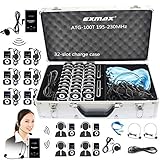
- EXMAX wireless audio transmission system could transmit voice of who...
- Transmitter weighs 56g and receiver weighs 46g,Small and light for carry or...
- The wire of microphone and earphone has antenna function, please do unfold...
The EXMAX ATG-100T appears in several group-listening configurations, including a package with two transmitters, 30 receivers, and a 32-slot charging case. That arrangement is appealing for organizations seeking a self-contained narration kit with centralized storage and charging.
Its operating concept is simple: a guide transmits speech, and guests listen through matching receivers. This suits basic guided visits and human interpretation where participants do not need microphones of their own.
The principal purchase concern is the exact frequency version. Listings identify a 195 MHz version, while other descriptions reference broader frequency ranges or an ATG-100T Plus model. Those labels should not be treated as equivalent.
For US use, do not assume that a product’s retail availability establishes lawful operation. Ask the supplier for the exact frequency range, FCC identification, and applicable operating authorization or licensing requirements. Have those details checked before committing to a fleet.
Package contents also deserve attention. Confirm that the advertised charging case is included, supports the supplied devices, and provides the required power supply. Verify microphones, earphones, replacement batteries or service arrangements, and spare-receiver compatibility.
The trade-off against more configurable equipment is limited interaction and potentially less flexibility when expanding or replacing components. Two transmitters should not be assumed to support simultaneous speakers on one channel.
Verdict: A conditional shortlist option for simple listening tours; frequency eligibility, exact model identity, and replacement support must be resolved before purchase.
AGJ 813 Wireless Tour Guide System

- 【PRETTY & STRONG】- Devices are made in a good-looking design, strong...
- 【WIDE APPLICATION】- Wireless one way audio communication system is...
- 【LONG WORKING RANGE】- The working range between the transmitter and...
The AGJ 813 system suits organized tours where one guide speaks and visitors listen through individual receivers. The larger configuration includes two transmitters and 30 receivers, making it worth considering for recurring school visits, church interpretation, and facility walkthroughs.
Its main advantage is straightforward operation. The guide and guests select matching channels, while listeners adjust their own volume. Physical buttons and a control-lock function help reduce accidental changes during a tour. Standard 3.5 mm headphone connections also offer flexibility, although accessory compatibility still needs checking.
For the 813 hardware, advertised specifications include:
- Wireless band: 902–928 MHz.
- Selectable channels: 26.
- Line-of-sight range: Approximately 150–180 meters.
- Transmitter runtime: Approximately eight hours.
- Receiver runtime: Approximately 15 hours.
- Charging time: Approximately three hours.
These are advertised figures, not guaranteed performance along an obstructed route.
The important limitation is that only one 813T transmitter operates on a group’s channel at a time. Two included transmitters therefore do not create simultaneous conversation. The second can serve as a spare or support a separately configured group.
Treat this as a value-oriented large-group option, but inspect the charging arrangement carefully. A package containing 32 devices needs sufficient charging capacity; a supplied charger does not necessarily charge everything simultaneously. Confirm microphone quantities, earphones, case contents, and charger slots against the exact bundle.
Verdict: A practical shortlist choice for straightforward narration, especially when simple controls matter more than guest talk-back.
Retekess T130
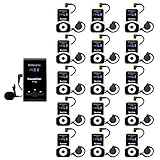
- Clear sound quality; tour guide microphone and speaker uses PLL technology...
- Slim and stylish; smooth front surface of the transmitter; matte finish on...
- Automatic pairing; one-click automatic pairing synchronizes all receivers...
The original Retekess T130 transmitter combination is a budget-oriented wireless tour guide system for walking tours, educational visits, and other guide-to-group applications. A listed larger bundle pairs two transmitters with 30 receivers and additional earpieces.
Its appeal is a familiar operating model: the guide wears a microphone, guests carry receivers, and everyone uses the same channel. Individual volume adjustment lets listeners choose a comfortable level without requiring the guide to raise their voice for the whole group.
The original T130 is commonly identified by its 99-channel configuration. However, selectable channels should not be interpreted as a promise that 99 nearby tours can operate reliably together. Actual coexistence depends on the equipment, channel spacing, interference, and site conditions.
Model identification is especially important here. T130, T130S, T130P, and T130U are distinct products. Battery endurance, transmission distance, charging accessories, and receiver compatibility should not be transferred between them.
The practical limitation is receive-only guest operation. Visitors cannot ask questions through a T131 receiver. Guides must pause for questions or repeat them into the microphone so everyone can hear.
Verdict: A sensible lower-cost option for uncomplicated narration, provided the exact hardware, charging equipment, and replacement-receiver availability are confirmed.
Choosing the Right Wireless Tour Guide System
One-Way, Two-Way, and Full-Duplex Communication
Match the communication mode to the tour before comparing range:
1. One-way: A guide speaks; guests listen.
2. Two-way: Participants can respond, often using push-to-talk communication.
3. Full-duplex: Supported participants can speak and listen simultaneously.
Multiple transmitters do not necessarily mean simultaneous speakers. Check listening capacity and active-speaker capacity separately, including any leader-priority rules.
Speech Clarity in Noisy Environments
Clear speech starts with microphone placement. A close-talking microphone near the guide’s mouth usually captures speech more effectively than a poorly positioned lapel microphone.
Microphone noise suppression, acoustic isolation, and rated hearing protection perform different jobs. Industrial sites need an on-site trial and a safety assessment. Higher listening volume is not a substitute for hearing protection.
Real-World Wireless Range
Advertised range typically reflects favorable conditions. Walls, machinery, crowds, body placement, and competing radio equipment can reduce usable coverage.
No frequency band is universally superior. Likewise, frequency-hopping spread spectrum is a specific technology—not a feature to assume across all digital systems.
Demonstration checklist: Walk the entire route, check intelligibility at the group’s rear, assess comfort, and verify charging turnaround.
Battery Life and Charging Capacity
Compare transmitter runtime and receiver runtime separately. The guide’s unit may run out first even when guest receivers remain charged.
Check charging-slot capacity, recharge time, power-supply requirements, and overnight storage. Charging cases and multi-unit chargers should accommodate the actual fleet, including spare devices, without creating an impractical rotation between tours.
Receiver Capacity and Concurrent Groups
A kit’s included receiver count is not necessarily its maximum supported receiver count. Ask how additional units are added and whether replacements require matching hardware versions.
Selectable channels are also different from verified simultaneous-group capacity. Nearby tours need a tested channel plan, especially where routes overlap or several guides gather at one meeting point.
Hearing-Aid and Listening-Accessory Compatibility
Confirm neckloop compatibility, connector wiring, and supported hearing-aid configurations. Neckloops generally require a compatible telecoil setting; not every hearing aid has one.
A headphone socket alone does not establish accessibility compliance. Ask about appropriate listening accessories and provide alternatives for visitors who cannot comfortably use the standard shared earphones.
Renting vs. Buying a Complete Tour Guide Kit
Renting often suits occasional events, uncertain attendance, or first-time industrial tours. Buying becomes more attractive when equipment is used regularly and staff can manage charging, cleaning, storage, and repairs.
Compare complete costs: headsets, chargers, spare devices, cleaning supplies, shipping, replacement batteries, and technical support.
Use this starting calculation:
Purchase and ownership cost ÷ comparable per-event rental cost = approximate break-even event count.
The rental comparison must cover equivalent group sizes and accessories. Maintenance, staff time, equipment downtime, and rental support can shift the result. A trial rental can also expose route or comfort problems before a larger purchase.
FAQ
What is the difference between one-way and two-way tour guide systems?
One-way systems transmit the guide’s speech to listening receivers. Two-way systems also allow suitably equipped participants to respond. Some use push-to-talk controls, while full-duplex systems permit supported speakers to talk simultaneously. Confirm the participant hardware and speaker limits rather than relying on the “two-way” label.
How many receivers can connect to one tour guide transmitter?
Capacity depends on the system’s transmission method and configuration. Some broadcast systems support many compatible receivers without individual pairing; others impose participant limits. The number included in a package is not necessarily the maximum. Ask separately about audience capacity, active speakers, and nearby groups.
What helps a wireless tour guide system work in noisy factories?
Effective factory communication combines close microphone placement, intelligible audio, suitable listening accessories, and reliable route coverage. Where hazardous noise exists, separately rated hearing protection may be necessary. Test the complete setup during normal production, with the safety team involved, rather than judging suitability by volume alone.
Do wireless tour guide systems translate languages automatically?
Most conventional systems transmit audio; they do not translate it. A human interpreter can speak into a transmitter while guests listen on an assigned channel. Built-in automatic translation requires additional, explicitly specified technology. Multiple channels or “translation system” wording alone does not establish that capability.
Is it better to rent or buy a wireless tour guide system?
Renting usually suits occasional events or changing requirements, while buying can suit frequent, predictable use. Compare equivalent complete kits and include shipping, cleaning, charging, maintenance, and support. Divide ownership cost by comparable per-event rental cost, then account for staff workload and equipment replacement.
Conclusion
Choose communication mode first, then validate coverage, intelligibility, comfort, and charging on the actual route. A complete, manageable setup matters more than impressive headline specifications when keeping visitors informed and engaged.