Top Wall-Mountable CD Players
These are conditional buying candidates, not tested winners. The available product descriptions establish useful starting points, but current US stock, buyer ratings, warranty terms, and complete mounting instructions have not been independently verified. Before purchasing, confirm a current rating of at least four stars and check the exact model’s manual, package contents, and return policy.
For a wall-mounted installation, documentation matters more than a product photograph. A listing that shows a player upright does not establish that it includes a suitable bracket or supports safe vertical playback.
Jensen JEN-JMC-180A: A Vertical-Loading Candidate

- Vertical Loading CD Player, CD-R/RW Compatible
- Auxiliary Input Jack for Connecting Smartphones, Tablets, and Additional...
- Wake to Radio, Alarm or CD
The Jensen JEN-JMC-180A is the conventional-system candidate for someone who wants CD playback and stereo speakers rather than a decorative disc display. Its supplied listing identifies it as a wall-mountable, vertical-loading CD player with stereo speakers.
That description makes it worth investigating for a bedroom, kitchen, or compact living space. Vertical loading should allow disc changes without moving the system off the wall, provided the installation leaves sufficient clearance around the loading mechanism. The listed stereo speakers also suggest a more complete listening setup than a player requiring separate audio equipment.
However, the available extract does not establish whether those speakers are integrated into the main housing or supplied separately. It also does not verify Bluetooth input, Bluetooth output, CD-R/CD-RW compatibility, MP3-CD playback, power requirements, or included mounting hardware. Do not borrow specifications from the Jensen JBS-300 or another similarly named system.
Treat this as the straightforward, value-oriented candidate rather than assuming it is the cheapest choice. Check the total installation cost, including any missing bracket, adapter, remote, or speaker cables. Used units deserve particular scrutiny because essential accessories may be absent.
Verdict: A sensible conventional-system candidate if the exact JEN-JMC-180A documentation confirms the speaker arrangement, supported discs, and manufacturer-approved wall installation.
CoolGeek M1: An External-Speaker Candidate

- 【More Than Audio: Kinetic Art Piece】 Turn your CD collection into a...
- 【Truly Wireless & Wall-Mountable】 Experience freedom with our portable...
- 【Bluetooth 5.0 & 3.5mm AUX Out】 Built for Bluetooth speakers or...
The CoolGeek M1 targets buyers who want a visible-disc design and already own compatible audio equipment. Its supplied listing describes a vertical player for wall or desk placement, with a Bluetooth transmitter and a rechargeable battery advertised to provide eight hours of operation.
The important distinction is that the listing explicitly says it requires an external speaker. This is not a complete all-in-one music system. Its appeal lies in separating the disc player from the sound-producing equipment, potentially letting you position a compatible wireless speaker where it sounds best.
Bluetooth transmission is useful because it can carry CD audio outward. Nevertheless, confirm whether the exact version supports your intended speaker or headphones, how pairing works, and whether it reconnects reliably. The supplied description does not verify Bluetooth reception, available wired outputs, or headphone compatibility.
The eight-hour runtime is a seller claim, not an independently measured result. Charging requirements, battery replacement options, and included mounting hardware also need confirmation. A rechargeable battery reduces dependence on continuous mains power but does not eliminate charging access.
Position this as the premium-style, design-led candidate rather than a proven high-end audio component. Add the cost of external equipment before comparing overall value.
Verdict: Worth considering for an existing compatible audio setup, provided Bluetooth pairing and the exact wall-mount arrangement are confirmed before purchase.
Qoosea Wall-Mountable CD Player: A Budget-Oriented Candidate
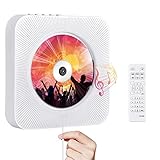
- 【Multifunctional CD Player】 It can be used as a Portable CD Player...
- 【Creative Design】 Wall mounted and creative pull switch design, makes...
- 【Bluetooth Music Player】33ft Bluetooth 4.2 connectivity range, it can...
The Qoosea wall-mountable CD player is the feature-focused candidate for someone seeking a self-contained system. The supplied listing names built-in speakers, a remote control, FM radio, an LCD display, a headphone jack, and AUX input and output.
Those features could make it practical for casual listening in a bedroom or home office. Built-in speakers reduce the number of devices you need, while a remote can be valuable when wall placement makes the controls less convenient. A documented AUX output would also provide a wired route to compatible powered speakers.
However, the listing’s “Bluetooth” wording does not establish signal direction. Do not assume it can transmit CD audio to wireless headphones. Likewise, “MP3” does not prove MP3-CD compatibility unless the manual explicitly identifies that disc format.
Its main weakness is model identification: the supplied title does not provide a clear model number or SKU. Confirm the exact version before relying on specifications, replacement accessories, or customer reviews. The wall-mount claim also needs supporting instructions and a verified hardware list.
Consider it a budget-oriented candidate because of its all-in-one, feature-heavy positioning—not because a current price comparison has established it as the lowest-cost option. “HiFi” in the listing is marketing language, not measured sound-quality evidence.
Verdict: Potentially convenient for everyday listening, but buy only when the seller supplies exact-model mounting, Bluetooth, power, and support documentation.
Choosing the Right Wall-Mountable CD Player
Your intended listening setup should determine the purchase. Start with where the player will go, whether you need separate speakers, and which discs or headphones you expect it to support. Decorative details are worth considering afterward.
A good specification checklist prevents two common mistakes: buying a receiver-only Bluetooth player for wireless headphones, and buying a vertically oriented desktop player without a safe way to attach it to the wall.
Manufacturer-Approved Wall Mounting
A genuine wall-mountable CD player should have a manual, a purpose-designed bracket, or explicit manufacturer installation instructions. Look for documentation that identifies the exact model rather than a generic picture used across several products.
Useful evidence includes:
- A diagram showing the intended mounting orientation.
- A package list identifying the wall-mount bracket or plate.
- Instructions explaining how the player locks onto that bracket.
- Requirements for fasteners, wall surfaces, and installation clearance.
- Confirmation that the disc mechanism operates in the mounted position.
Vertical desktop operation is not enough. A player may stand upright safely on its base while lacking suitable attachment points for wall installation. Similarly, a hanging slot does not tell you what load the fixing must support or whether additional retaining hardware is required.
Built-In Speakers and External Audio
Built-in speakers make a wall-mounted CD player a complete listening device. You insert a disc, connect power, and play music without purchasing an amplifier or separate speakers. That simplicity suits background listening, small rooms, and installations where extra equipment would defeat the space-saving goal.
An external-audio player serves a different purpose. It may connect to powered speakers, an amplifier, compatible headphones, or a Bluetooth speaker. Passive speakers generally need an amplifier; they cannot ordinarily be driven directly from a line-level output.
Check connection labels carefully:
- AUX line-in accepts sound from another source, such as a phone.
- AUX line-out sends sound to another audio device.
- Headphone output is intended to drive compatible wired headphones.
- Digital output, when documented, requires compatible downstream equipment.
A socket that looks familiar does not guarantee the function you need. Some multifunction ports change behavior by operating mode, so the manual should explain their use.
Sound-quality claims also need perspective. “Hi-Fi” is not a standardized performance result in a marketplace title. Small enclosures can limit bass output, and a visible disc mechanism may contribute audible operating noise.
Byford’s review of the Muji Wall-Mounted CD Player, specifically the CPD-4, reported thin sound and noticeable mechanism noise. Those are that reviewer’s findings, not measurements performed for this guide.
Designed by Naoto Fukasawa, the Muji player remains notable for its pull-cord interaction and appearance. Its design appeal should not be confused with evidence of room-filling sound, nor should CPD-4 findings automatically apply to another revision.
Bluetooth Input Versus Bluetooth Output
A wall-mounted CD player with Bluetooth can perform two very different jobs. The direction of the signal determines whether it works with your intended equipment.
Bluetooth input, also called receiver mode:
Phone → CD player’s Bluetooth receiver → built-in speakers
Bluetooth output, also called transmitter mode:
CD playback → CD player’s Bluetooth transmitter → wireless headphones or speaker
Receiver-only Bluetooth lets the player act as a wireless speaker for another device. It does not let you listen to CDs through Bluetooth headphones.
For a wall-mountable CD player with Bluetooth output, check:
- Whether transmission works during CD playback.
- Whether your speaker or headphones use a supported connection mode.
- How pairing is initiated without a detailed screen.
- Whether previously paired equipment reconnects automatically.
- Whether the player remembers more than one device.
- Whether volume is controlled at the player, receiving device, or both.
A newer Bluetooth version alone does not guarantee easier pairing, better sound, or broader compatibility. Both devices must support a workable connection, and any advertised advanced audio codec needs support at both ends. Buy with a practical return window so you can check the actual pairing behavior.
Disc and File Compatibility
A player that reads commercial audio CDs may not support every disc in your collection. Distinguish the disc medium from the way music is stored on it.
Audio CDs use the standard music-CD format. Most conventional CD players are intended to read them.
CD-R and CD-RW identify recordable and rewritable media. A home-burned disc can contain standard audio tracks or computer files, and those are not interchangeable playback requirements.
MP3-CDs contain MP3 files recorded onto a data disc. They require explicit MP3-CD support, not merely ordinary CD playback.
This difference matters because a listing may advertise MP3 playback through USB or a memory card. That does not establish that its disc mechanism can decode MP3 files from a CD. The same caution applies to WMA and other file formats.
For burned discs, check whether the manual requires finalization and specifies folder, file-count, or encoding limits. Poorly written, damaged, or deteriorated discs can fail even in a compatible player.
If you regularly listen to live albums or classical recordings, also investigate gapless playback. Added pauses between tracks can disrupt a continuous performance. Compatibility lists rarely explain this behavior, so a trustworthy review or your own return-window check may be necessary.
Power Supply and Cable Routing
The best location for appearance may not be the best location for power. Measure the route from the planned mounting position to the outlet, including turns around furniture and any extra length needed to avoid strain on the connector.
Check these details before installation:
- The required adapter voltage and current.
- Whether the correct adapter is included.
- The supplied cable length.
- Whether the cable can be replaced.
- Whether the socket remains accessible after mounting.
- Whether the player can operate while charging.
A USB-C connector does not automatically establish compatibility with every charging arrangement. Follow the manufacturer’s power specification rather than choosing an adapter based only on the connector’s shape.
For mains-powered equipment, confirm that the supplied adapter is suitable for US electrical service. An imported product’s plug shape and input-voltage rating both matter. A simple plug adapter does not necessarily resolve a voltage mismatch.
Rechargeable models offer flexibility but still require a charging plan. Advertised battery capacity is not a reliable substitute for measured runtime, and playback conditions can affect how long a charge lasts. Battery availability alone does not justify calling an installation cable-free.
Avoid routing a standard power cord inside a wall unless that installation is specifically permitted and appropriate equipment is used. Surface cable channels may provide a neater alternative. Keep cables away from heat sources, moving furniture, and places where they could be pulled accidentally.
Dust Covers and Disc Access
Exposed-disc players emphasize the album itself, turning playback into a visual feature. Covered mechanisms provide a physical barrier against casual contact and some settling dust. Neither design eliminates the need for sensible placement and occasional care.
An exposed mechanism is less suitable where children, pets, sleeves, or nearby decorations could touch a spinning disc. Avoid installing any player where steam, grease, or splashes are likely to reach it. “Wall mounted” does not mean moisture resistant.
For a covered player, consider how the door or lid opens. The housing may fit your chosen space while the loading mechanism does not. Check clearance above, below, and in front of the player, as well as the hand space needed to remove a disc safely.
Also consider:
- Whether the disc clamp is easy to reach.
- Whether physical controls remain accessible.
- Whether the display is readable from your normal position.
- Whether the remote receiver faces the listening area.
- Whether cleaning requires removing the player from its bracket.
A wall-mounted installation should make everyday operation easier, not turn disc changes into a balancing exercise.
Safe Wall-Mount Installation
Model-specific instructions take precedence over general advice. Do not assume the same fasteners, mounting height, or bracket arrangement will work for every wall-mounted CD system.
1. Read the exact model’s manual. Confirm that wall mounting is permitted, identify the supplied parts, and check the installation sequence. Make sure any separately mounted speakers have their own instructions.
2. Identify the wall construction. Drywall, masonry, timber, and other surfaces require different approaches. Check for concealed wiring or plumbing before drilling. Ask a qualified installer if you cannot identify the surface confidently.
3. Use appropriately rated hardware. Follow the manufacturer’s requirements and select fixings suitable for the wall and installed load. Do not substitute adhesive strips or universal anchors without explicit approval.
4. Preserve access and ventilation. Allow room for the disc door, controls, plugs, and any specified ventilation gaps. Test the loading motion before committing to the final position.
5. Route power and audio cables safely. Leave enough slack to avoid pulling on sockets, but prevent loose loops from becoming snagging hazards. Keep the adapter accessible and avoid trapping cables behind the bracket.
6. Check stability before playback. Confirm that the player is fully seated and any retaining mechanism is engaged. Insert a disc gently, check for movement, and stop if the unit shifts or vibrates against the wall.
When considering mounting height, balance convenience with accidental-contact risks. You should be able to change discs without stretching awkwardly, while keeping the mechanism away from busy walkways and easily disturbed decorations.
FAQ
Can a wall-mountable CD player connect to Bluetooth headphones?
Yes, if it has Bluetooth transmission or output and supports a compatible connection with your headphones. Receiver-only Bluetooth cannot send CD audio outward; it receives music from another device. Check the exact manual, pairing procedure, and return policy because transmission capability does not guarantee compatibility with every headset.
Conclusion
A good wall-mountable CD player should suit your listening system as well as your wall. Prioritize documented mounting support, the correct Bluetooth direction, disc compatibility, and practical access to power and controls. Check exact-model instructions and seller support before purchasing, then install the player with appropriate hardware and clearance. Those decisions make a compact music setup more useful, safer, and easier to enjoy every day.