Which sustain pedal will make your guitar notes last longer—and will it produce the sound you actually want? “Sustain pedal” covers several different effects, from compressors that extend audible note decay to pedals that hold an entire chord while you play something new.
The best sustain pedals for guitars are therefore best chosen by musical goal, not ranked as though they do the same job. This guide separates clean sustain, captured chord drones, and feedback-style lead sounds before examining five options. Ordinary keyboard sustain footswitches are different: they send control commands and do not sustain a guitar’s audio signal.
Three Types of Guitar Sustain Effects
Guitar sustain pedals work in three main ways:
1. Compressors make decaying notes audible longer.
2. Freeze pedals hold captured notes or chords.
3. Feedback-generation pedals create singing, harmonic sustain.
Choose compression for longer clean notes, freeze processing for chord drones, or generated feedback for expressive lead effects.
Compressor Pedals for Longer Clean Notes
Dynamic range compression reduces the difference between louder peaks and quieter passages. With appropriate output gain, the quieter portion of a decaying guitar note becomes easier to hear, creating the impression of longer sustain.
This makes a compressor useful for clean melodies, country picking, rhythm parts, and leads that fade too quickly. Unlike distortion, compression can extend audible decay without deliberately adding heavy clipping.
However, a compressor does not keep the string vibrating indefinitely. Once the useful signal falls into the noise floor, there is little musical information left to amplify. Higher sustain settings can also make pickup hum, fret noise, and handling sounds more noticeable.
Freeze and Sample-Hold Pedals for Sustained Chords
Freeze pedals use sample-and-hold processing to capture a short section of incoming audio and turn it into a sustained sound. That captured layer continues while your live guitar signal remains available for a new part.
This is the right category if you want a guitar pedal that holds a chord while you play a melody over it. It also suits drones, ambient transitions, and sustained harmony beneath a solo.
The important distinction is that the pedal holds recorded audio, not the vibrating strings. Subsequent bends, vibrato, or chord changes do not alter an already captured chord unless you capture again or use additional processing.
Feedback-Generation Pedals for Singing Leads
Feedback-generation pedals create the impression of a guitar interacting with a loud amplifier. Depending on the design, the sustained effect can emphasize the fundamental note or develop into a higher harmonic.
The DigiTech FreqOut is an example aimed at feedback-style lead sustain without requiring high stage volume. This approach is different from holding a chord underneath your playing.
Generated harmonic feedback also differs from physically re-energizing strings. A handheld EBow Plus or an installed sustainer system supplies energy to the strings themselves; an audio-processing pedal works on the electrical signal after the pickup.
Top Sustain Pedals
These five choices cover two common needs: holding captured audio and extending the audible decay of your playing. Their category labels describe intended uses rather than hands-on comparative rankings. Prices, stock, and product revisions can change, so confirm the exact model before ordering.
Electro-Harmonix Freeze

- Latch mode for infinite sustain at the touch of a momentary switch
- Fast decay mode
- Slow decay mode
The Electro-Harmonix Freeze Sound Retainer suits guitarists who want straightforward note and chord capture without a large control surface. Its purpose is easy to understand: play something, capture it, and continue playing over the sustained result.
This is a freeze pedal rather than a compressor. It maintains a captured sound instead of trying to amplify the fading tail of your original performance. That makes it useful for solo arrangements, chord drones, and transitions where you need harmony to continue after your fretting hand moves elsewhere.
The Freeze’s control layout centers on an Effect Level knob and a three-position mode switch. Fast provides immediate response, Slow introduces a more gradual envelope, and Latch allows the captured sound to continue without keeping your foot on the switch.
Those options matter in performance. A momentary capture can punctuate a phrase, while latch operation frees your foot for another pedal. The level control determines whether the held chord sits quietly underneath your playing or becomes the dominant texture.
Its main limitation is its focused scope. There is no dedicated effects loop for independently processing the frozen layer, and it is not designed as a multi-layer ambient workstation. You also need accurate capture timing: an unwanted string or an untidy chord becomes part of the sustained sound.
Positioned as a mid-range dedicated sustainer, it makes sense when simplicity matters more than extensive editing. Leave room in your arrangement for the captured harmony, especially when changing chords above it.
Verdict: Choose the Freeze if you want a simple guitar pedal for holding chords and prefer a few useful operating modes over deep sound design. Choose a compressor instead if your goal is longer, continuously responsive clean notes.
TC Electronic Infinite Sample Sustainer

- Samples and sustains your guitar signal, creating an ambient pad to play...
- Optional layering allows you to stack up multiple layers of sustained notes...
- Infinite mode can add and sustain an indefinite number of layers which...

The TC Electronic Infinite Sample Sustainer is aimed at players who want captured sound to become part of an evolving arrangement. Compared with a basic chord holder, its attraction is the ability to shape how sustained layers arrive, overlap, and disappear.
Its sustain method is digital audio capture. You can hold a note or chord beneath live playing, then use its layering and envelope options to build a more continuous background texture. This makes it a candidate for ambient guitar, spacious solo performance, and transitions that need more movement than a static drone.
The full-size Infinite includes Fade In, Decay, and Level controls. These let you soften the entrance of a captured layer, determine its release behavior, and balance it against your live guitar. That is useful when a hard-edged capture would interrupt a gentle passage.
Its TonePrint support provides access to additional settings, while built-in modulation and reverb options help turn captured guitar into a broader sound bed. A dedicated effects loop allows external processing of the sustained signal rather than automatically applying everything to your live playing.
The distinction between this model and the smaller Infinite Mini matters. Controls, connectivity, and workflow are not interchangeable, so check that the listing is for the full-size Infinite Sample Sustainer discussed here.
The limitation is complexity. More envelope and layering choices mean more preparation before a performance. Dense overlapping notes can also obscure chord changes unless you manage capture levels and decay deliberately.
As a mid-range ambient option, its value lies in control rather than merely offering longer sustain.
Verdict: Choose Infinite if you want an infinite sustain pedal for ambient guitar with adjustable fades, layering possibilities, and separate processing for the held sound. A simpler freeze pedal is easier when you only need one dependable chord underneath a melody.
Keeley Compressor Plus
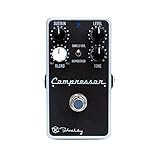
- Compression with sustain: Limits peaks and adds gain as notes decay, so...
- Blend control: Mixes the dry signal back in to keep pick attack and...
- Tone control and release switch: Tone restores the highs that compression...
The Keeley Compressor Plus is for guitarists who want notes to remain audible longer while preserving some of the immediacy of uncompressed playing. It suits clean lead lines, picked rhythm parts, and players who find conventional compression too flattened.
Unlike the two capture pedals above, it processes your performance continuously. Bends, vibrato, and changes in picking remain part of the live sound. There is no separately held chord to leave behind.
Its most important feature is the Blend control, which mixes the compressed signal with your dry guitar. The compressed portion supports quieter detail and note decay, while the dry portion restores some of the initial pick transient. That combination is useful when you want sustain without making every note feel equally forceful.
The Sustain, Level, and Tone controls provide compression intensity, output adjustment, and tonal balancing. A single-coil/humbucker switch changes the release behavior to accommodate the response of different pickup types.
Circuit descriptions deserve care here. The manufacturer’s Compressor Plus documentation describes its development from the Keeley compressor lineage; it should not be selected on the assumption that an “optical” label in a retailer title accurately identifies its circuit.
The main limitation is that blend does not remove compression’s trade-offs. Heavy settings can still bring up noise and reduce expressive level differences. Mixing in substantial dry signal also means some original peaks remain, so this is not the same as strict peak limiting.
Among these choices, it occupies the upper part of the conventional compressor tier while remaining simpler than a studio-style compressor with detailed metering.
Verdict: Choose the Compressor Plus if you want a compressor pedal for clean guitar sustain and need an accessible way to retain pick attack. It is not the right tool for infinite chord holding or independent ambient layers.
BOSS CS-3 Compressor/Sustainer

- Compact Design: Compression/Sustainer pedal with high-quality circuitry in...
- Dynamic Signal Control: Compresses loud signals and boosts softer signals...
- Precise Tonal Shaping: Onboard level, tone, attack and sustain controls for...
The BOSS CS-3 Compressor/Sustainer suits players who want a traditional compression workflow with dedicated controls for sustain, attack character, tone, and output level. It is a practical option for making clean passages more even and helping quieter note tails remain audible.
Its sustain comes from compression rather than audio capture. Your playing stays continuous and responsive to pitch changes, but the volume envelope becomes more controlled. This can help picked melodies sit consistently in a mix and reduce the jump between forceful chord strikes and softer single notes.
The control set comprises Level, Tone, Attack, and Sustain. Level helps balance engaged and bypassed loudness. Tone compensates for brightness changes, while Attack adjusts the character of the note’s onset. Sustain increases the compression effect and the prominence of quieter detail.
The CS-3 also uses the familiar BOSS compact-pedal format, with a broad footswitch surface and battery or external-adapter operation. Its buffered bypass is relevant on pedalboards where cable length and signal loading need attention, although it should not be confused with a dedicated solution for every routing problem.
The meaningful limitation is the absence of a dry-blend control. You cannot restore an independent uncompressed signal directly from the pedal. Players who want their hardest picking to remain almost untouched may prefer a parallel-compression design.
High Sustain settings also require realistic expectations. They can reveal existing noise and produce a more obviously compressed response rather than simply adding “more note.”
Verdict: Choose the CS-3 if you want a mid-range guitar compressor sustainer pedal with conventional controls and familiar footswitch operation. It makes more sense for controlled dynamics and audible decay than for players seeking an almost invisible effect at extreme compression settings.
Behringer CS400

- Get super-smooth compression and endless sustain
- This BEHRINGER product has been designed to compete head to head with...
- Compress loud and boost low signals without degrading the original sound
The Behringer CS400 Compressor Sustainer is for guitarists who want to explore compression without committing to a higher-priced pedal. Its appeal is functional: it provides the familiar controls needed to understand how sustain, attack, tone, and output interact.
It uses compression to reduce level differences and make quieter parts of a note more apparent. That makes it suitable for experimenting with clean lead sustain, more even picking, and rhythm parts that need steadier volume. It does not capture chords or generate an independent background layer.
The Level, Tone, Attack, and Sustain controls provide a useful learning layout. Start with modest Sustain, match the engaged volume to bypass using Level, and adjust Attack while listening to the first instant of each note. Tone then helps correct a result that feels too dull or too sharp.
The CS400 supports 9-volt battery operation or a compatible external power supply. As with other pedals, check whether the adapter is included rather than assuming the product package contains everything required.
Its most obvious compromise is the lightweight plastic enclosure. That can be acceptable for home use, occasional rehearsals, or a carefully protected pedalboard, but it deserves consideration if your equipment faces frequent transport and heavy foot traffic.
It also lacks a blend control, so preserving a separate dry transient is not an available adjustment. Strong compression can make background noise more noticeable, particularly with noisy pickups or gain pedals elsewhere in the chain.
Its budget positioning is most compelling when you are still deciding whether compression belongs in your sound.
Verdict: Choose the CS400 if affordability is the priority and you want conventional sustain controls for practice or a modest pedalboard. Spend more when enclosure construction, parallel blending, or a specific compression response is central to your playing needs.
Choosing a Sustain Pedal for Your Playing Style
Momentary, Latch, and Automatic Capture
Momentary and latch switching determine how much attention your foot must give a captured sound.
- Momentary operation: The effect follows the footswitch, making it suitable for brief accents and precise releases.
- Latch operation: The sound continues after you release the switch, freeing your foot for other duties.
- Automatic capture: The pedal detects incoming notes and updates the sustained sound according to its detection settings.
Modes vary by product; they are not universal features. Practice clearing a held chord as carefully as capturing it. An unwanted drone continuing into the next key change is a bigger problem than a slightly imperfect fade.
For more elaborate control, the Electro-Harmonix Superego+ offers automatic capture, envelope shaping, onboard effects, and an effects loop. The Gamechanger Audio PLUS Pedal takes a piano-style foot-control approach. These are alternative workflows, not evidence that every player needs a more complex sustainer. Confirm current production, stock, and support directly before purchasing either.
Acoustic-Electric Guitar Compatibility
These effects can work with acoustic-electric guitar, provided the guitar reaches them through a suitable electrical signal path.
An onboard pickup and preamp can usually feed instrument pedals directly. A microphone typically requires a preamp and appropriate level matching; a microphone cable alone is not a substitute for that interface. Hot preamp outputs can overload pedal inputs, so begin conservatively.
Compression can smooth acoustic picking but may emphasize finger squeaks and body noise. Freeze processing can create useful chord beds, although dense low strings may crowd the live part.
None of these pedals increases an unplugged acoustic guitar’s physical sustain.
Pedalboard Fit and Power Requirements
Check enclosure size with cables connected, not just the published chassis dimensions. Side-mounted audio sockets, power connectors, and effects-loop cables all consume space.
Voltage, polarity, connector size, and current capacity must match the individual pedal. For example, the original EHX Freeze specifies a 9-volt DC, center-negative supply with 140 mA available. The BOSS CS-3’s specified current draw is 11 mA, illustrating why different effects need different power allocations.
An isolated supply can help reduce shared-power noise. Never substitute a higher voltage merely because a plug fits.
If you are also considering an Orange Kongpressor, it is an optical compressor alternative for dynamic control and audible sustain—not a chord-freeze pedal. Its power requirements should be checked separately.
Sustain-Pedal Placement in the Signal Chain
Compressor Placement
A useful starting chain is:
Guitar → compressor → overdrive → modulation → delay → reverb → amplifier
Before drive, compression provides a more consistent signal to the clipping stage. This can make sustain and gain response feel steadier, although excessive compression reduces the difference between soft and hard picking.
After drive, compression controls the already-distorted signal. That may help level contrasting sounds, but it can also emphasize hiss from the gain stages.
Start with moderate settings and compare at similar perceived loudness. A louder compressed signal can seem more impressive even when its actual note decay is not much more useful.
Freeze and Sample-Hold Placement
Effects placed before capture become part of the held sound. Effects placed after capture process the sustainer’s output.
For example, overdrive before a freeze pedal lets you capture a distorted chord. Delay afterward adds repeats to both the captured layer and subsequent playing unless separate routing is available.
A practical starting point is:
Guitar → drive → freeze → modulation → delay → reverb
Move the freeze pedal earlier if you want to capture a cleaner source. Place it after modulation when you want the captured texture to contain that movement, while remembering that the resulting held sound may not behave like the original continuously running effect.
Feedback-Pedal Placement
For the DigiTech FreqOut, the manufacturer-supported starting point is near the beginning of the signal chain, before other effects. A relatively clear input helps its tracking respond to the played note.
Downstream overdrive can then shape the generated feedback along with your guitar signal. Noise gates need particular care: a gate that closes too aggressively can interrupt the note or effect before the desired transition develops.
Placement remains contextual. Follow the manual first, then experiment within your rig rather than assuming that every feedback pedal belongs in exactly the same position.
Effects Loops for the Sustained Layer
A sustainer’s dedicated effects loop can route the captured layer through external effects while leaving your live playing comparatively untouched. This is valuable when the held chord needs a different role from the melody above it.
For example, an octave effect in the loop can make the drone occupy another register. Tremolo can add pulse, while reverb can move the held layer farther into the background. The Infinite, Superego+, and PLUS Pedal provide loop-based processing options, though their routing details differ.
This is not the same as an amplifier’s effects loop. An amplifier loop generally inserts processing between preamp and power-amp stages; a sustainer loop serves the pedal’s internal routing.
Check the manual before connecting equipment. Signal levels, wet/dry behavior, and what happens when the sustainer is bypassed vary. A loop does not automatically mean every connected effect will remain audible during ordinary dry playing.
Conclusion
Choosing a sustain pedal starts with deciding what should continue: the audible decay of your live notes, a captured chord beneath new playing, or a feedback-style lead texture. Those are different musical tools, each with its own controls and limitations. Match the effect to your arrangement, then consider switching, signal routing, noise, and power. The most useful sustain is not simply the longest—it is the kind that supports the phrase without getting in the way.
FAQ
Can you use a keyboard sustain pedal with a guitar?
A standard keyboard sustain footswitch does not process audio, so connecting a guitar to it will not extend notes. It sends a switching command to compatible equipment. Some guitar processors accept external footswitches, but connector wiring, polarity, and control assignments must match the receiving device.
Can a guitar sustain pedal hold a chord while I play over it?
Yes, a freeze or sample-hold pedal can capture a chord and maintain it while your live guitar passes through for additional playing. This creates an independent backing layer. Capture timing, wet/dry balance, and release settings determine how clearly the held harmony supports the new part.
Does a sustain pedal keep guitar strings vibrating?
Most sustain pedals do not physically maintain string vibration. Compressors reshape the signal’s volume envelope, while freeze effects reproduce captured audio. Devices that actively excite strings work differently. This distinction matters if you want sustained notes that continue responding directly to bends and finger vibrato.
Why does a compressor make background noise louder?
Compression reduces the level difference between strong notes and quieter sounds. When output gain restores loudness, pickup hum, hiss, and handling noise can become more noticeable, particularly as a note fades. Moderate sustain settings, clean power, sensible gain staging, and good muting help keep that noise manageable.
Can a sustain pedal increase unplugged acoustic sustain?
No audio-processing pedal can extend the physical vibration of an unplugged acoustic guitar. It only affects a signal sent through pickups or microphones and heard through amplification or recording equipment. For longer natural acoustic decay, investigate setup, fret condition, playing technique, and the instrument’s underlying response.