What are Studio Monitor Amps?
Studio monitor amplifiers, often called monitor amps, are specialized power amplifiers designed to drive studio monitors. These amps ensure the audio signal sent to the monitors is clean, transparent, and powerful enough to reproduce music sounds accurately without coloration or distortion. Unlike general-purpose amplifiers, studio monitor amps deliver a flat frequency response, faithfully reproducing audio across the audible spectrum, from deep bass to crisp highs. An important factor in their design is the inclusion of balanced outputs and inputs, such as XLR and TRS connectors, which help reduce noise and interference in the signal path, especially over long cable runs typical in recording studios. The use of bass ports in some studio monitors also influences amplifier requirements, as these ports affect the low-frequency response and phase characteristics, making impedance and crossover matching critical. Studio monitor amps are widely used in the studio market, powering countless pairs of monitors in professional and home studio environments.
Types of Studio Monitor Amplifiers
Active vs Passive Amplifiers
Studio monitor amplifiers come in various types, each suited for different studio needs and setups. The most common distinction is between active and passive amplifiers. Active studio monitors have built-in amplifiers, which means the power amps are integrated into the speaker enclosure. This design simplifies setup, reduces cable clutter, and ensures the amplifier is perfectly matched to the speaker drivers for optimal performance. Active monitors are especially popular in home studios and for users who want a plug-and-play solution without worrying about matching separate amps.
Passive studio monitors, on the other hand, require separate power amps to drive them. This setup is often preferred by professionals who want greater flexibility and control over their monitoring system. With passive monitors, you can select and upgrade the amplifier independently, tailoring the power and sound characteristics to your specific needs. Passive speakers are common in high-end studios and in situations where custom amplification is desired.
Amplifier Classes and Designs
Within these categories, amplifiers can be further classified by their circuit design or class. Class D amplifiers are widely used in modern powered monitors due to their efficiency, compact size, and low heat generation. They provide ample power while maintaining a small footprint, making them ideal for space-conscious studio environments. Class A and Class AB amplifiers, although less efficient and bulkier, are favored by audiophiles and certain professionals for their warm and detailed sound characteristics. Some high-end studio monitor amplifiers employ bi-amping, where separate amps power the woofer and tweeter, offering improved clarity and dynamic response.
Channel Configurations
Additionally, studio monitor amplifiers vary in channel configuration. The most common are two-channel amps designed to power a stereo pair of monitors. However, multi-channel amplifiers exist for setups involving multiple speakers or surround sound configurations. When choosing an amplifier, it’s important to consider not only the type but also the power output, impedance compatibility, and connectivity options to ensure seamless integration with your monitors and audio interface.
Key Features of Studio Monitor Amplifiers
Flat Frequency Response for Accurate Sound
Studio monitor amplifiers are designed with specific features to meet the demanding requirements of professional audio environments. One of the most important characteristics is a flat frequency response, which ensures that the amplifier does not color the sound and accurately reproduces the entire audible spectrum—from deep bass to sparkling top end. This fidelity is crucial for mixing and mastering, where hearing every detail clearly can make the difference between a good mix and a great one.
Balanced Inputs and Outputs for Noise Reduction
Another key feature is the availability of balanced inputs and outputs. Balanced connections, such as XLR and TRS, are standard in studio monitor amplifiers because they help reject noise and interference, particularly over long cable runs common in recording studios. This results in a cleaner, more transparent signal path, allowing you to hear your music sounds exactly as intended without unwanted hum or buzz.
Power Output and Headroom
Power output is also critical. The vast majority of studio monitors require an amplifier that can supply sufficient power to drive them effectively without distortion or clipping. Ideally, the amplifier should provide 20% to 30% more power than the speakers’ rated wattage to ensure headroom for dynamic peaks. This extra power helps maintain a consistent volume level and a wide sweet spot, allowing you to hear your mix clearly from different listening positions within the control room.
Reliable Speaker Connectivity
Speaker connectivity options are another important consideration. Reliable speaker terminals such as binding posts, banana plugs, or speakON connectors ensure secure and stable connections, which are essential for consistent performance. Additionally, many modern studio monitor amplifiers are designed with convection cooling systems to minimize fan noise, preserving the quiet environment needed for critical listening.
Bi-Amping Capabilities
Some amplifiers offer bi-amping capabilities, allowing separate amplification of woofers and tweeters. This setup can improve overall sound quality and power handling by providing dedicated power to different frequency ranges, reducing distortion and enhancing clarity.
Compact and Efficient Designs
Finally, compact and efficient designs, particularly class D amplifiers, have become a popular feature in studio monitor amps. These designs offer high power output with low heat generation and small physical footprints, making them suitable for both home studios and professional recording environments where space and energy efficiency are important.
Best Studio Monitor Amps
Avantone Pro CLA-100 Studio Reference Amplifier

- Stereo Studio Reference Amplifier with 100W/Channel (8 ohms...
The Avantone Pro CLA-100 Studio Reference Amplifier is a highly regarded choice among audio professionals seeking transparent and accurate amplification for their studio monitors. Designed in collaboration with renowned mixing engineer Chris Lord-Alge, this amplifier emphasizes delivering a clean, flat frequency response that faithfully reproduces audio signals without coloration or distortion.
Offering 100 watts per channel into 8 ohms, the CLA-100 provides ample power for most nearfield and midfield passive studio monitors, ensuring sufficient headroom for dynamic peaks and complex mixes. Its Class A/B design balances efficiency with sonic fidelity, delivering a warm yet detailed sound that many engineers appreciate for critical listening tasks.
The amplifier features balanced XLR and 1/4-inch TRS inputs, enabling noise-free connections with professional audio interfaces and mixing consoles. Its robust binding post speaker outputs support secure and reliable connections, accommodating banana plugs or bare wire for versatile setup options.
Compact and rack-mountable, the CLA-100 fits comfortably into professional studio racks without occupying excessive space. The unit employs convection cooling, eliminating the need for noisy fans and maintaining a quiet environment essential for critical monitoring.
An important factor that sets the Avantone Pro CLA-100 apart is its ability to drive bi-amped speaker configurations, allowing separate amplification of woofers and tweeters for enhanced clarity and dynamic control. This feature is especially beneficial in professional studio environments where precise sound reproduction is paramount.
With its combination of expert advice in design and reliable performance, the CLA-100 remains a popular brand among audio engineers who demand accurate, transparent power amplification. It represents an ideal balance of power, build quality, and sound fidelity, making it a valuable addition to any serious studio setup.
Behringer KM750 with Accelerated Transient Response

- 750-watt 2-channel Power Amplifier with Accelerated Transient Response
- Item Package Dimension: 20.49999997909L x 16.799999982864W x...
- Item Package Weight - 22.89941515394 Pounds
The Behringer KM750 is a popular choice among budget-conscious audio professionals and enthusiasts looking for reliable power amplification in their studio setups. This amplifier features Behringer’s Accelerated Transient Response (ATR) technology, which enhances the amplifier’s ability to deliver fast, precise transient signals. This means that the KM750 can accurately reproduce the quick peaks and dynamic shifts in music, making it ideal for studio monitor applications where clarity and detail are paramount.
With a power output typically around 250 watts per channel into 8 ohms, the KM750 provides ample headroom to drive a wide range of passive studio monitors, including those with demanding power requirements. Its robust build quality and efficient Class AB design ensure low distortion and minimal noise, contributing to a clean and transparent sound signature that many users appreciate.
The KM750 also offers a variety of input options, including balanced XLR and 1/4-inch TRS connectors, which help reduce noise and interference in professional studio environments. The amplifier’s reliable speaker terminals support secure connections with banana plugs or bare wire, ensuring stable performance during long sessions.
Compact and rack-mountable, the Behringer KM750 fits well into most studio racks without occupying excessive space, making it suitable for both home and professional studios. Its cooling system uses convection rather than noisy fans, preserving a quiet control room environment essential for critical listening.
Behringer KM750 with ATR technology is an incredible value amplifier that balances power, accuracy, and affordability, making it a solid choice for those looking to upgrade or build a studio monitor amplification system on a budget.
Rockville RPA9 3000W
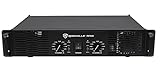
- HIGH POWER OUTPUT:- Delivers 3000W peak and 800W RMS for robust sound in...
- DURABLE CONSTRUCTION:- Built with a rugged metal chassis to withstand heavy...
- VERSATILE CONNECTIVITY:- Features XLR, 1/4-inch, and RCA inputs, plus...
The Rockville RPA9 3000W is a powerful studio monitor amplifier designed to deliver high wattage and robust performance for demanding studio environments. With an impressive output of 3000 watts, this amplifier is well-suited for powering large passive speakers or multiple sets of monitors, making it a versatile choice for professional studios that require substantial headroom and dynamic range.
One of the standout features of the Rockville RPA9 is its rugged build and reliability, ensuring consistent performance during long mixing or recording sessions. It incorporates advanced protection circuitry to safeguard both the amplifier and connected speakers from damage due to overheating, short circuits, or overloads.
The amplifier supports a variety of input options, including balanced XLR and 1/4-inch TRS connectors, which help maintain a clean signal path free from noise and interference. Its speaker output terminals are designed for secure connections, compatible with banana plugs and bare wire, providing flexibility for different studio setups.
Despite its high power output, the Rockville RPA9 employs efficient cooling mechanisms to minimize fan noise, preserving the quiet environment crucial for critical listening. Its design also includes features like a flat frequency response and low total harmonic distortion (THD), ensuring that the sound remains transparent and accurate across the full audio spectrum.
This amplifier is ideal for studios that demand a robust and reliable power source to drive their passive monitors or multiple speaker arrays. Whether you are mixing, mastering, or producing, the Rockville RPA9 3000W offers the power and clarity needed to hear every detail of your music with precision and confidence.
Conclusion
When it comes to studio monitor amplifiers, striking the perfect balance between power, clarity, and flexibility transforms your listening experience and elevates your music production. Whether powering passive speakers with separate amps or integrating compact multi-channel units, the right amplifier ensures every detail shines through with a flat frequency response and minimal distortion. Investing in quality amplification not only enhances the accuracy of your mixes but also future-proofs your setup, making every session in the control room a step closer to sonic perfection.
FAQ
How much power do I need for my studio monitor amplifiers?
Your amplifier should provide about 20% to 30% more power than the speakers’ rated wattage to ensure sufficient headroom and avoid distortion. Most studio monitor amplifiers range from 50W to 300W per channel, with 50W to 100W being sufficient for most home and project studios.
Why are balanced inputs important in studio monitor amplifiers?
Balanced inputs use connectors like XLR or TRS to reduce noise and interference, especially over long cable runs. This ensures a clean, accurate audio signal, which is critical in studio environments with multiple devices and cables.
Should I use separate amplifiers or one unit to power my monitors?
Using separate amplifiers for each monitor channel offers greater flexibility, better stereo imaging, and easier upgrades. However, a single multi-channel amplifier can be convenient and space-saving. The choice depends on your studio setup, budget, and preferences.
How do I match amplifier wattage to my studio monitors?
Check your monitors’ recommended power handling and impedance, and select an amplifier that provides slightly more power (20%-30% extra) to ensure clean headroom and avoid distortion or damage.