What makes an active pickup work well for metal: more output, sharper attack, or better control over the low strings? The best choice balances all three without fighting your guitar or amplifier. Tight bass response, clear chord separation, useful clean sounds, and compatible electronics matter more than sheer power. This guide explains four focused options, their limitations, and the installation details that can turn a straightforward upgrade into a larger project.
Top Active Pickups for Metal Guitarists
These choices cover different purchases: a complete six-string pairing, a versatile seven-string set, and two individual bridge pickups. Compare complete sets with complete sets—not with the price or capabilities of a single pickup. The tonal descriptions below are guidance, not results from a controlled listening test.
Fishman Fluence Modern Active Humbucker 2-piece 7-string Pickup Set
No products found.
The Fishman Fluence Modern 7-string set suits players who need one extended-range guitar to handle aggressive rhythm parts, spacious cleans, and less saturated passages. Its strongest advantage is selectable voicing rather than simply high output.
The pairing combines a ceramic bridge pickup with an Alnico neck pickup. In the updated three-voice generation, the bridge offers Modern Active, passive-style, and single-coil voices; the neck likewise provides active, passive-style, and single-coil choices, with different tonal targets appropriate to its position. Check the generation before ordering: older Modern sets have two main voices and should not be treated as identical purchases.
For low-string rhythm work, the active bridge voice is intended to deliver a pronounced attack and controlled response. The alternate humbucker voice changes the character and feel rather than merely reducing volume. The single-coil voice gives clean passages another useful texture, especially when a full neck humbucker sounds too thick.
This is a premium choice among active pickups for seven-string metal guitar, particularly when versatility can replace the need for a second instrument. However, accessing its capabilities requires suitable push-pull controls, switches, or another manufacturer-supported wiring arrangement. A basic three-way selector alone does not expose every voice.
The buying unit is a bridge-and-neck seven-string set, requiring power and compatible electronics. Fishman offers Modern pickups for other string counts, but their dimensions must be checked separately. The seven-string housing should not be assumed to fit a conventional passive-humbucker cavity.
Verdict: Choose this set when switching between heavy and clean sounds is central to your music. If you mainly use one distorted bridge sound, its additional wiring and premium positioning may offer less practical value.
EMG ZW Zakk Wylde Signature Humbucker Guitar Pickup Set
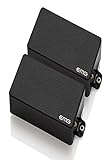
- Zakk Wylde Signature Pickup Set
- Includes both EMG 81 & 85 active pickups
- Long shaft volume and tone controls
The EMG ZW set packages the familiar 81/85 combination as a complete six-string upgrade. It is a strong fit for players who want a clearly defined bridge sound, a contrasting neck voice, and straightforward operation rather than extensive switching.
The ceramic EMG 81 normally occupies the bridge position. Its established appeal is a concentrated attack and prominent upper-mid character that can help palm-muted riffs remain distinct through substantial distortion. “Tight” is a useful description of its intended role, but the result still depends on pickup height, tuning, amplifier settings, and how much bass enters the gain stages.
The Alnico V EMG 85 provides the contrast. In the neck position, it is generally associated with a rounder, fuller voice suited to sustained leads and thicker clean passages. That warmth can be useful, although a bass-heavy neck sound may require less gain or lower bass settings.
The standard 81 and 85 are single-voice active humbuckers. They do not provide conventional coil splitting, and turning down the guitar volume does not transform them into passive pickups. Their simplicity is part of the buying proposition: select a pickup, set your level, and play.
The ZW package is positioned as a complete, mid-range-to-premium conversion option rather than a bare pickup purchase. Check its supplied control arrangement and shaft lengths against your guitar. A control kit intended for a thick carved top may not be the most convenient match for every instrument.
EMG’s solderless system can simplify compatible connections, but the selector switch and existing guitar wiring still deserve attention.
Verdict: Choose the ZW set if you want the EMG 81/85 pairing for metal rhythm and leads without building a package from separate components. Look elsewhere if multiple clean voices or coil-switching sounds are essential.
Seymour Duncan Blackouts Metal AHB-2 Bridge
No products found.
The Seymour Duncan Blackouts Metal AHB-2 is an individual active bridge humbucker for players who want a forceful signal and an unapologetically aggressive character. It is not the same pickup as the original Blackouts AHB-1, and the distinction matters.
The AHB-2 uses a ceramic magnet and includes a selectable output arrangement. A jumper provides access to its higher-output setting or a more moderate level. That feature is useful because a very hot pickup does not automatically produce a clearer metal sound: additional signal can push an amplifier or pedal further into saturation, sometimes reducing separation.
Its appeal is strongest for players who enjoy a substantial, hard-hitting bridge sound. The perceived balance of bass, mids, and attack will vary with the instrument, but this is not the obvious starting point for someone seeking a restrained vintage voice.
A rig that already produces excessive low-end bloom may need its bass reduced before the first major distortion stage. Similarly, changing the output setting may require adjusting input gain rather than judging both settings through an unchanged, heavily saturated preset.
The selectable level is not equivalent to multi-voice switching. It does not provide a dedicated single-coil sound or the range of separate voicings available from a more elaborate system. Clean usability depends partly on input headroom and gain staging.
The buying unit discussed here is the six-string AHB-2 bridge pickup, not a matched neck-and-bridge set. Budget for a compatible neck solution if you are converting an entire two-pickup guitar. Also confirm which controls, jack, connectors, and power accessories accompany the particular package.
Verdict: Choose the AHB-2 when aggressive bridge performance and selectable output are your priorities. For a broad range of clean textures or a complete matched conversion, a different buying unit makes more sense.
EMG 81 Bridge Pickup
No products found.
The standalone EMG 81 makes sense when you already know you want its bridge character and do not need an entire signature set. It is particularly relevant to a guitar that already has compatible EMG active electronics.
This is the same core pickup used in the ZW pairing, not a separate tonal alternative. Its inclusion is about buying the right amount of hardware. Replacing one bridge pickup in an existing active guitar can be more economical and less disruptive than purchasing an unnecessary neck pickup and control package.
The six-string EMG 81 uses a ceramic magnet and an onboard preamp. Its focused presentation has made it a familiar reference point for high-gain rhythm playing. Pick attack and upper-mid emphasis can help fast riffs cut through, while its bass balance can be useful when an amplifier already supplies plenty of weight.
That does not mean it guarantees articulation. Excessive gain, a poor setup, or loose string tension can still blur the lowest notes. Nor does active construction guarantee silence: electrical interference, grounding faults, noisy pedals, and amplifier hiss remain possible.
The standard model provides one humbucker voice. There is no conventional split-coil facility, so players wanting contrasting clean textures should not expect switching options that the pickup does not support. Its bridge cleans can be useful, but they are not its main reason for inclusion.
Confirm the exact package before purchasing. A retail single-pickup kit and a bare replacement pickup may contain different installation hardware. If your guitar currently has passive pickups, the EMG 81 alone does not necessarily complete the conversion.
Verdict: Choose the standalone 81 for a focused bridge replacement, especially in an already compatible active guitar. Choose a complete set instead when you need a coordinated neck sound and the electronics for a full conversion.
Fishman Fluence Modern vs EMG 81 vs Blackouts
The decisive distinction is functionality first, tonal preference second.
- Fishman Fluence Modern: The updated generation provides three selectable voices per pickup. Its broader switching capability suits guitars covering several roles, but adds wiring decisions.
- EMG 81: A single-voice design with a familiar focused bridge application. It is comparatively straightforward when installed into compatible EMG electronics.
- Blackouts Metal AHB-2: An aggressive bridge design with selectable output. Its level setting should not be confused with separate clean and distorted voices.
Descriptions such as “compressed,” “open,” “full,” and “tight” are listening impressions, not universal measurements. The EMG 81 is commonly associated with concentrated attack; Blackouts are often considered for a weightier presentation; Moderns offer deliberate changes of voice.
Installation complexity depends on the starting guitar. A simple replacement can be easy, while a passive-to-active conversion with several new switching functions is a different job.
Choosing Active Pickups for Your Metal Sound
Low-Tuning Clarity
For down-tuned riffs, prioritize bass control, audible attack, and note separation over maximum output. A stronger signal can create more distortion without making the fundamental pitch easier to hear.
Scale length, string gauge, string condition, and setup all influence how the lowest strings behave. A pickup cannot correct inadequate tension, fret buzz, or poor intonation.
Start by reducing unnecessary gain and checking bass before distortion. A boost or EQ adjustment may solve the problem more effectively than replacing a pickup. Judge complex chords as well as single-note palm-muted riffs; a sound that excels at one may obscure the other.
Clean-Tone Flexibility
Selectable voices help when one guitar must cover clean and heavily distorted parts. Dedicated single-coil voices can offer a different texture, while alternate humbucker voices change the balance without requiring another instrument.
Check the wiring diagram rather than assuming every active humbucker supports splitting. Some designs offer dedicated switching connections; others do not.
A passive-style voice still requires power when it belongs to an active system. It describes a tonal target, not a battery-free operating mode. Also leave sufficient headroom at the amplifier or interface so a hot signal does not unintentionally distort your clean sound.
Pickup Fit and Mounting
Before buying, check:
1. Housing dimensions: Measure length, width, mounting tabs, and corner clearance.
2. Cavity depth: Allow room for connectors, wiring, and height adjustment.
3. Mounting arrangement: Identify pickup rings, pickguard mounting, or direct mounting.
4. String coverage: Confirm the sensing area covers the outer strings.
5. Control space: Check battery clearance and push-pull pot depth.
“Active mount” and “passive mount” describe physical formats, not whether the electronics need power. An active pickup can use a passive-style housing.
Verify extended-range variants individually. Seven- and eight-string models may use different housings even within the same product family.
Active Pickup Installation and Ownership Costs
Passive-to-Active Conversion Requirements
A conversion usually involves more than changing the pickups. Follow the manufacturer’s requirements for potentiometers, tone components, switching, power connections, and the output jack. Many conventional active systems use lower-value controls than typical passive humbuckers.
The output jack commonly switches battery power when an instrument cable is inserted. Wiring it incorrectly can cause malfunction or unnecessary battery drain.
Routing is not always necessary. A securely insulated battery may fit inside the existing control cavity, provided it cannot crush wiring or short against electronics. A dedicated battery compartment requires more work.
Solderless connectors are not universally interchangeable across brands. Similar-looking plugs do not establish compatibility.
Total Upgrade Cost
Build your budget from four separate items:
- Pickups: One bridge pickup or a complete matched set.
- Electronics: Missing pots, selector hardware, jack, and wiring.
- Power: Battery, holder, or a compatible rechargeable system.
- Labor: Installation, troubleshooting, and any woodworking.
A premium set with useful hardware may be better value than a cheaper bare pickup requiring several additional purchases. Conversely, an existing compatible active installation may need very little extra work.
Where the jack switches power, unplug the instrument cable from the guitar after playing. Battery life varies by system and usage; do not assume every active pickup has the same consumption.
Conclusion
A successful active-pickup upgrade should make your guitar more useful, not simply louder. Match the response to your tuning and amplifier, decide how much clean-tone flexibility you genuinely need, and confirm the physical and electrical requirements before ordering. Controlled bass, clear attack, sensible gain staging, and a reliable installation usually contribute more to satisfying metal tones than chasing the hottest available signal.
FAQ
Are active pickups better than passive pickups for metal?
Neither type is universally better. Active pickups use powered electronics that can buffer the signal and support specific voicings, while passive designs offer many equally useful responses. Choose according to attack, frequency balance, playing feel, and compatibility. High output alone does not determine clarity, heaviness, or suitability for metal.
Can you install active pickups in a guitar with passive pickups?
Yes, provided the pickups fit and the guitar can accommodate compatible electronics and a power source. Conversion commonly requires replacement controls, wiring changes, and a switching output jack. Routing may be unnecessary if sufficient cavity space exists. Confirm the complete installation requirements before purchasing individual components.
Do active guitar pickups need a battery?
Active pickups need electrical power, usually supplied by an onboard battery. Some systems support compatible rechargeable packs or purpose-designed external supplies. A passive-style voice still needs power if it operates within an active system. Follow the specified voltage and wiring requirements, and never assume a pedal supply can connect directly.
Are active pickups good for low tunings?
Yes, appropriately voiced active pickups can work very well for low tunings. Controlled bass and clear attack are more useful than maximum output. Scale length, string tension, setup, pickup height, amplifier gain, and EQ also affect articulation. Changing pickups will not automatically correct loose strings or excessive distortion.
Can you mix active and passive pickups in one guitar?
Yes, but the circuit needs careful planning. Different output levels, impedances, and preferred control values can make a simple shared-control arrangement unsatisfactory. Buffering, separate controls, or other matching circuitry may help. Use a proven wiring design or consult a qualified technician rather than connecting incompatible components by guesswork.