Looking for the best balance of traditional bass tone and extended range? A five-string P-style bass combines a split-coil pickup’s familiar punch with notes below low E. The important differences are pickup configuration, neck comfort, electronics, and how evenly the low B responds.
Top 5-String P-Bass Guitars
Fender American Professional II Precision Bass

- 1 Single-coil Pickup - Dark Night
- Electric Bass with Alder Body
- Rosewood Fingerboard
The Fender American Professional II Precision Bass V is a straightforward choice for players who specifically want a Fender five-string Precision rather than a PJ alternative. Its single V-Mod II split-coil pickup and passive volume-and-tone controls keep the instrument focused: there is no pickup blend or onboard active EQ to manage.
The Olympic White version pairs an alder body with a maple neck and rosewood fingerboard. Its 34-inch scale length maintains familiar long-scale proportions, while the five-string layout extends standard tuning down to B. That combination suits players moving between conventional bass parts and arrangements requiring lower notes without changing instruments.
Comfort features include a “1963 C” neck profile, rolled fingerboard edges, and a sculpted neck heel. The fingerboard carries 20 narrow-tall frets, and the approximately 1.875-inch nut width accommodates the additional string. These details are useful starting points, but they cannot establish whether the neck will fit your hands. Profile depth and fingerboard width need to be considered together.
The HiMass Vintage bridge supports either through-body or top-loading string installation. That provides a practical choice when fitting compatible strings, although neither installation method guarantees a clearer B string. String condition, setup, and playing technique remain important.
Be precise about the model name when shopping. The American Professional II is distinct from earlier American Professional and American Standard versions; similar finishes and body shapes do not establish identical pickups, neck details, or hardware. Confirm the exact version, condition, and included case before ordering.
Its meaningful limitation is its premium positioning. You are paying for a US-made Fender with specific construction and finishing features—not proof that it will outperform every less expensive P-style bass. Players needing bridge-pickup definition or onboard EQ may also find its simplicity restrictive.
Verdict: Shortlist it if a genuine, passive Fender Precision Bass V is your priority and its neck feels comfortable. Choose it for that focused specification, not an assumption that the badge guarantees superior low-B performance.
Fender Player II Precision Bass – 3-color Sunburst with Rosewood Fingerboard

- 1 Single-coil Pickup - 3-color Sunburst
- Electric Bass with Alder Body
- Rosewood Fingerboard
Fender Player II Precision Bass in 3-Color Sunburst with Rosewood Fingerboard represents a stunning evolution of the absolute industry standard. It provides the definitive look, feel, and sound that has anchored countless hits across every imaginable musical genre. The defining strength of this updated model is its foundational, vintage-voiced tone, powered by a Player Series Alnico V split single-coil pickup. This setup delivers the legendary, chest-thumping low end and mid-range growl that immediately carves out its own distinct space in any live venue or studio mix. Furthermore, the gorgeous 3-color sunburst finish is paired beautifully with a premium rosewood fingerboard, adding an organic warmth to the tone and a classic, professional aesthetic that never goes out of style.
Fender has drastically elevated the playability of this second-generation model by focusing heavily on modern neck ergonomics and player comfort. The instrument features an incredibly smooth satin-finished neck sculpted into a comfortable “Modern C” profile, which vastly reduces hand fatigue during long sets. A standout upgrade for the Player II series is the inclusion of rolled fingerboard edges, a premium treatment typically reserved for much higher-end models that gives the neck a broken-in, luxurious feel right out of the box. Additionally, the standard 34-inch scale length provides familiar string tension, while the rock-solid open-gear tuners and classic four-saddle bridge ensure dependable tuning stability and precise intonation through hours of aggressive playing.
However, the traditionalist design parameters of this Precision Bass mean it lacks some of the modern versatility and lightweight convenience found in its contemporary rivals. It is a full-sized, solid-alder instrument that completely eschews the compact footprint, headless design, and travel-friendly portability of minimalist options. The bass is inherently heavier and bulkier, making it a much more cumbersome option for musicians who frequently commute or fly to gigs. Additionally, the iconic split-coil pickup configuration offers an undeniable signature sound, but it lacks the tonal flexibility of dual-pickup configurations or active electronics, meaning players seeking ultra-modern, highly shaped active tones might find its passive layout somewhat limiting.
Hardware and structural elements also lean heavily into old-school design choices that might frustrate players accustomed to modern conveniences. The traditional heel-adjust truss rod requires specific tools and care for seasonal setup adjustments compared to easily accessible headstock wheels. While the upgraded hardware is incredibly durable, it lacks high-end features like a high-mass bridge or lightweight tuners, which keeps the bass strictly in line with vintage form factors. Ultimately, it is a purist’s instrument built for uncompromising tone and road-warrior reliability, trading away experimental features to deliver the exact, unadulterated foundation of electric bass history.
Fender Squier Affinity Precision Bass Pack
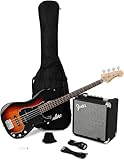
- One Squier Affinity Series Precision bass guitar, a padded gig bag, Rumble...
- Affinity Series Precision Pack: This specialty pack was masterfully curated...
- Lightweight and Comfortable: The Squier Affinity Series Precision bass...

Fender Squier Affinity Precision Bass Pack stands as the ultimate, all-in-one gateway for aspiring bassists. It provides everything needed to start playing immediately in a single box. The core strength of this bundle is its incredible out-of-the-box value, pairing a highly versatile bass with a 15-watt Fender Rumble amplifier, a padded gig bag, a strap, and a cable. The instrument itself features several beginner-friendly refinements, most notably a thin, lightweight poplar body and a slim, satin-finished “C”-shaped neck that drastically minimizes fretting-hand fatigue for new players. Sonically, it punches well above its price tier by utilizing a hybrid “PJ” pickup configuration. Combining a thumping split-coil Precision pickup in the neck with a growling Jazz Bass single-coil at the bridge gives students an exceptionally wide tonal palette to explore.
However, the budget-conscious nature of an entry-level starter pack introduces some inevitable compromises in components and longevity. While the bass features a full 34-inch scale length for proper string tension, the hardware—such as the standard stamped-steel bridge and open-gear vintage tuners—feels lightweight compared to mid-tier models. Serious students may find the need to upgrade the factory strings and the basic gig bag relatively quickly as they begin traveling to lessons or rehearsals.
Additionally, while the included Rumble 15 amplifier is an exceptional tool for silent headphone practice and bedroom learning, its 8-inch speaker lacks the raw wattage and low-end headroom required to keep up with an acoustic drum kit or a full garage band rehearsal. Ultimately, it trades away premium, stage-ready hardware to deliver an unmatched, friction-free introduction to the instrument.
P-Only and PJ Bass Differences
A P-only bass uses one Precision-style split-coil pickup. A PJ pickup configuration adds a J-style bridge pickup, giving you another sound to blend in or select separately.
Turning the bridge pickup off produces a P-led sound, but not necessarily an identical Precision tone. Pickup placement, construction, strings, and electronics all influence the result.
Neither configuration is automatically better. P-only instruments favor simplicity; PJ instruments offer additional tonal choices.
Choosing a Comfortable Five-String P-Bass
Low-B Clarity
A five-string P bass with a clear low B should produce notes with a recognizable attack and useful sustain—not simply abundant bass frequencies.
Use this short audition sequence:
1. Start with a clean signal. Bypass distortion, heavy compression, and exaggerated bass boost.
2. Compare open and fretted notes. Play the open B, then move through several frets while keeping your attack consistent.
3. Compare the same pitch across strings. For example, compare the fifth fret on the B string with the open E string.
4. Listen in a mix. A huge solo sound can become indistinct beside drums, guitars, or keyboards.
Check string condition and setup before rejecting an instrument. Worn strings, unsuitable action, fret problems, and pickup adjustment can all affect definition.
Neck Width and String Spacing
Nut width and bridge string spacing measure different things. Nut width helps describe fretting-hand reach near the headstock; bridge spacing describes the distance between adjacent strings where your plucking hand often works.
Some players prefer 17–18 mm bridge string spacing for a compact five-string feel. Others want wider spacing for fingerstyle articulation or slap technique. Neither preference is universally correct.
Try low-position stretches, string crossings, and your usual plucking patterns. A neck that feels manageable for a few scales may become tiring during repeated first-position passages. Neck thickness and shoulder shape also matter, even when two instruments share similar measurements.
Weight and Playing Balance
Check the actual instrument’s weight rather than treating an owner’s reported figure as a model-wide specification. Wood density and individual construction differences can produce variation.
Play standing with your usual strap. Notice whether the neck drops, whether your fretting hand must support it, and whether the body sits comfortably against you. Good balance can matter as much as a modest difference in total weight over a rehearsal.
Passive Electronics and Active Flexibility
Passive electronics offer a direct control layout: volume adjusts output, while the tone control rolls off high frequencies. They suit players who prefer making broader adjustments at the amplifier or mixing desk.
An active preamp adds powered onboard EQ, allowing frequency boosts and cuts. An active preamp does not necessarily mean active pickups. Many active/passive instruments combine passive pickups with a switchable preamp.
Passive bypass behavior deserves attention. Check whether the instrument retains a functioning tone control, which controls become inactive, and whether bypass works without a battery. Battery-free operation should never be assumed if the pickups themselves require power.
Matching the Instrument to Your Budget
For a budget-conscious purchase, prioritize a comfortable neck, functional hardware, and an even response across all five strings. Cosmetic upgrades are less useful if the instrument needs substantial fretwork or cannot achieve your preferred action.
A used premium instrument can be worthwhile, but inspect fret wear, truss-rod operation, electronics, and modification history. Allow room for a professional setup rather than spending the entire budget on the instrument alone.
At higher price levels, identify what the additional spending actually buys: construction details, finishing, hardware, accessories, or a particular specification. Compare those benefits with your playing needs instead of treating price as a performance ranking.
Conclusion
A good five-string P-style bass should make its extended range feel like a natural part of the instrument. Start with the sound and control layout you need, then assess low-B consistency, neck dimensions, and standing balance. The right purchase is the one that remains comfortable and musically useful—not simply the one with the longest specification list.
FAQ
Are 5 string basses worth it?
Yes, if your music benefits from notes below low E or additional fingering options. A five-string lets you play some passages higher on the neck without losing lower notes. The trade-offs are a wider neck, another string to mute, and potentially greater weight.
Do five-string P-basses have a muddy B string?
No. Muddiness is not inherent to five-string P-basses. String condition, setup, pickup adjustment, playing technique, and amplification all affect clarity. Compare open and fretted notes through a clean signal, then listen in a mix before deciding whether the instrument’s low B meets your needs.
Can a five-string PJ bass sound like a P bass?
Yes, selecting only the P pickup can deliver a convincing P-style sound. However, identical pickup settings do not guarantee identical tone across instruments. Pickup placement, pickup design, construction, strings, and control circuitry all influence how closely a PJ resembles a particular Precision-style bass.