What are 5-inch Studio Monitors?
5-inch studio monitors are a popular choice among musicians, producers, and audio engineers for their balanced size and accurate sound, making them ideal for home studios and smaller mixing environments. Featuring a 5-inch woofer paired with a tweeter, these monitors deliver a flat frequency response essential for critical listening, mixing, and mastering.
Their clear midrange and high-frequency detail, combined with a respectable bass response, make them less prone to problematic bass buildup in untreated or lightly treated rooms. This helps avoid muddy or boomy mixes in smaller spaces.
Most 5-inch studio monitors are powered studio monitors with built-in amplifiers matched to their drivers, ensuring optimal power delivery and simplifying setup. Many models include digital signal processing (DSP) for sound tailoring to room acoustics. Designed for nearfield listening, these monitors are typically placed 3 to 5 feet from the listener in an equilateral triangle formation, with tweeters at ear level for an ideal listening position.
Their compact size offers excellent value and portability, making them a great entry point for those setting up their first home studio or for electronic music producers needing precise midrange clarity.
Key Features of 5-inch Studio Monitors
Compact Size and Versatility
5-inch studio monitors are prized for their versatility and suitability in a variety of studio environments, particularly home studios and smaller rooms. Their compact size allows them to fit comfortably on most desks or speaker stands without overwhelming the space. One of the primary features of these monitors is their balanced frequency range, which typically covers the critical midrange frequencies with clarity, while still providing a respectable bass response. For the average home studio, a 5-inch studio monitor should be the best size to avoid excessive bass buildup in untreated rooms.
Two-Way Design for Accurate Sound
These monitors usually combine a 5-inch woofer with a dedicated tweeter, often a soft dome or ribbon type, to handle high frequencies with precision. This two-way design ensures that both low and high frequencies are reproduced accurately, contributing to a flat frequency response that is vital for critical listening and mixing tasks.
Built-in Amplification and DSP Features
Many 5-inch studio monitors are active, meaning they come with built-in amplifiers that are specifically matched to the drivers. This built-in amplification eliminates the need for external power sources and helps maintain a clean signal path, reducing noise and distortion. Active monitors are generally more convenient because they do not require a separate amplifier. They often include features such as volume control, and some models offer built-in equalizers or digital signal processing (DSP) to tailor the sound to the room’s acoustics. This is especially useful in untreated or small spaces where room modes and reflections can color the sound.
Connectivity and Balanced Inputs
Connectivity options on 5-inch studio monitors typically include balanced inputs such as XLR or 1/4-inch TRS jacks, which help minimize interference and ensure the best audio quality when connected to an audio interface or mixer with balanced outputs. Using balanced cables is recommended to maintain signal integrity.
Nearfield Listening Optimization
Another key feature is their nearfield design, optimized for listening distances of about 3 to 5 feet. This design minimizes the influence of room acoustics by focusing the sound directly toward the listener, allowing for more accurate monitoring even in rooms without excellent room treatment.
Port Design and Placement Considerations
Port design is also an important consideration. Some 5-inch monitors have rear ports, which require placement at least 25-30 cm away from walls to avoid bass buildup, while others have front ports or sealed designs that offer more flexible placement options.
Acoustic Treatment and Room Setup
Acoustic panels, bass traps, and sound diffusers will make a massive difference to your mixes by controlling reflections and bass buildup. Positioning your monitors in an equilateral triangle with your listening position and keeping them away from corners and the front wall of the room is crucial for optimal sound. The ideal position for your listening should be approximately 38% away from the shortest wall in a rectangular room to achieve the best acoustic results.
Considerations for Different Monitors and Usage
While most studio monitors on the market today are active monitors, passive speakers are still used by some engineers who prefer their pristine sound quality. Most monitors feature either XLR or 1/4-inch jack inputs, and using balanced cables is important for best performance. Smaller speakers like 5-inch monitors are excellent for casual listening and professional studios alike, providing a good pair of monitors that deliver the best performance in smaller rooms. It’s important to note that using smaller speakers to compensate for room size issues can hinder your mixing abilities, so proper acoustic treatment is always recommended.
Best 5-inch Studio Monitors
Kali Audio in-5 Powered 3-Way Studio Monitor
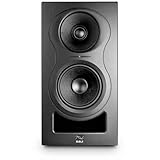
- Precision 3-Way Imaging - With its coaxial midrange and tweeter, it's a...
- Tri-Amplified Power - The 160W tri-amped system of the IN-5 5 inch studio...
- Accurate Mixing, Reliable Translation - Engineered for neutral frequency...
The Kali Audio IN-5 is a unique offering in the 5-inch studio monitor category due to its innovative 3-way design, which sets it apart from the typical 2-way monitors in this size range. Featuring a 5-inch woofer, a dedicated midrange driver, and a high-frequency tweeter, the IN-5 delivers a remarkably detailed and balanced frequency spectrum that covers lows, mids, and highs with exceptional clarity. This design allows for improved separation of frequencies and reduces distortion, making it an excellent choice for critical listening and professional music production.
One of the standout features of the IN-5 is its use of Class D amplification, which provides efficient power delivery with minimal heat generation and distortion. This built-in amplification is carefully matched to each driver, ensuring optimal performance across the entire frequency range. The monitor’s DSP-based room correction capabilities allow users to tailor the sound to their specific acoustic environment, compensating for room size and treatment limitations, which is particularly beneficial in untreated or smaller rooms.
Connectivity options include balanced XLR and 1/4-inch TRS inputs, supporting easy integration with a wide range of audio interfaces and mixers. The cabinet design incorporates rear ports, so proper placement with sufficient distance from walls is recommended to avoid bass frequency buildup. Despite its advanced features, the Kali Audio IN-5 remains compact and suitable for home studio setups, offering a great value for producers seeking a professional-grade 5-inch monitor with enhanced frequency response and flexibility.
The IN-5’s ability to reproduce a flat frequency response and maintain accuracy across the entire spectrum makes it a favorite among electronic music producers, mixing engineers, and anyone looking for a reliable and honest pair of studio monitors. Its three-way design provides a more nuanced soundstage than many previous versions of 5-inch monitors, allowing users to hear subtle details and certain frequencies that might be missed on simpler designs. This makes the Kali Audio IN-5 an excellent choice for those who want their first pair of studio monitors to deliver professional results without compromise.
Adam Audio T5V 2-Way Active Nearfield Monitor

- INCLUDED - Adam Audio T5V (Pair), Power Cords, Quick Start Guide, 5-Year...
- SUPERIOR SOUND QUALITY - Experience pristine audio clarity with the T5V's...
- PRECISE FREQUENCY RESPONSE - Hear every nuance from 45Hz to 25kHz, ensuring...
The Adam Audio T5V is a highly regarded 5-inch studio monitor known for its precise top-end clarity and excellent value within its price range. Featuring a 5-inch woofer and a ribbon tweeter, the T5V delivers a detailed and balanced frequency response that is crucial for critical listening and mixing tasks. Its design emphasizes accuracy and transparency, making it a popular choice among home studio users and electronic music producers.
One of the key strengths of the T5V is its ability to reproduce high frequencies with exceptional detail thanks to its proprietary Accelerated Ribbon Technology (ART) tweeter. This feature allows for a smooth and extended high-frequency response, which helps producers and engineers identify subtle nuances in their mixes. The 5-inch woofer provides a solid bass response, suitable for smaller rooms and untreated environments where excessive low-end can cause issues.
The T5V is an active monitor, meaning it has built-in amplification specifically matched to its drivers, ensuring optimal power delivery and reducing the need for additional external equipment. It also includes volume control and rear-panel EQ switches that allow users to tailor the sound to their room’s acoustics, which is especially useful in home studio setups with limited acoustic treatment.
Connectivity options include balanced XLR and 1/4-inch TRS inputs, facilitating easy integration with most audio interfaces and mixers. The cabinet design features a front port, allowing for flexible placement near walls without significant bass buildup, which is a common challenge with rear-ported monitors.
Focal Alpha 50 Evo Active 2-Way Studio Monitor

- Neutral, Detailed Sound – 5" Slatefiber woofer and 1" aluminum tweeter...
- Flexible Connections – TRS, XLR, and RCA inputs let you connect up to...
- Customizable Tuning – Adjustable LF and HF shelving plus sensitivity...
The Focal Alpha 50 Evo is an excellent example of a high-quality 5-inch studio monitor designed to deliver professional-grade sound in a compact form factor. This active monitor features a 5-inch woofer combined with a 1-inch aluminum inverted dome tweeter, providing a clear and balanced frequency response that is ideal for critical listening, mixing, and music production in smaller rooms or home studios.
One of the key highlights of the Alpha 50 Evo is its ability to maintain a flat frequency response across the audible spectrum, ensuring that producers and engineers hear an accurate representation of their mix without coloration. This accuracy is essential for making informed mixing decisions, especially when working in untreated or lightly treated spaces.
The monitor includes built-in amplification tailored to the drivers, delivering sufficient power to produce detailed lows, mids, and highs with minimal distortion, even at lower volumes. This makes it a suitable choice for users who prefer mixing at lower volumes to reduce ear fatigue.
In terms of connectivity, the Alpha 50 Evo offers balanced XLR and TRS inputs, facilitating seamless integration with a wide range of audio interfaces and mixers. Its rear-ported cabinet design requires proper placement away from walls to avoid bass frequency buildup, but the monitor’s compact size allows for flexible positioning on speaker stands or desks.
Additionally, the Focal Alpha 50 Evo incorporates advanced cabinet design and internal damping to reduce cabinet resonance, which enhances transient response and overall sound clarity. This level of engineering contributes to its reputation as one of the best studio monitors in the 5-inch category, providing excellent value for both beginners and seasoned professionals.
Yamaha HS5 Powered Studio Monitor

- The information below is per-pack only
- 2-Way bass-reflex bi-amplified nearfield studio monitor with 5" cone woofer...
- 54Hz-30kHz frequency response

The Yamaha HS5 is widely regarded as an honest pair of studio monitors, offering a flat frequency response that is essential for critical listening and mixing. With a 5-inch woofer and a 1-inch tweeter, the HS5 delivers clear midrange and high frequencies, making it a favorite among home studio enthusiasts and professional studios alike. Its design emphasizes accuracy over coloration, ensuring that what you hear is a true representation of your mix.
One of the standout features of the HS5 is its suitability for smaller rooms and untreated spaces. Its size and bass response are optimized to avoid overwhelming small rooms with excessive low frequencies, which can cause muddiness and inaccurate mixes. This makes the HS5 an excellent choice for those who want reliable studio monitor speakers without the need for extensive acoustic treatment.
The HS5 also offers convenient connectivity options, including balanced XLR and TRS inputs, allowing seamless integration with most audio interfaces. Its build quality is robust, and the monitor features rear ports that necessitate careful placement away from walls to maintain optimal bass response.
For electronic music producers and guitar players alike, the Yamaha HS5 provides a precise and detailed soundstage that helps in making informed mixing decisions. While it may not deliver the deepest bass compared to larger monitors, pairing the HS5 with a subwoofer can extend its low-frequency capabilities for more demanding production needs.
Conclusion
5-inch studio monitors strike a balance between size, performance, and affordability, making them a fantastic value for those seeking accurate sound reproduction without the complexity or expense of larger monitor systems. Whether you’re recording music, mixing tracks, or playing guitar through an amp modeller, these monitors provide a reliable and honest pair of speakers that can help you achieve professional-quality results in your home studio setup.
FAQ
What makes 5-inch studio monitors ideal for home studios?
5-inch studio monitors strike a perfect balance between size and performance, making them highly suitable for home studios and smaller rooms. Their compact size allows for easy placement on desks or stands without overwhelming the space, while their 5-inch woofers provide clear and accurate reproduction of low and mid frequencies. This makes them excellent for nearfield listening, giving producers a detailed and precise soundstage necessary for critical mixing and music production.
Can I use 5-inch studio monitors in larger rooms?
While 5-inch studio monitors excel in small to medium-sized spaces, they may struggle to provide sufficient bass response and volume in larger rooms. Larger speakers with bigger woofers are typically better suited for bigger rooms because they can move more air and reproduce lower frequencies more accurately. However, adding a subwoofer to a 5-inch monitor setup can help extend low-frequency response in larger spaces.
What is the difference between active and passive 5-inch studio monitors?
Active 5-inch studio monitors have built-in amplifiers matched to their drivers, offering convenience and optimal performance without the need for external amplification. They often include features like volume control and digital signal processing (DSP) to tailor sound to your room. Passive monitors, on the other hand, require separate amplifiers and are less common today. Some engineers prefer passive monitors for their pristine sound quality, but active monitors dominate modern studio setups due to their ease of use.
How should I position my 5-inch studio monitors for the best sound?
For optimal sound, place your 5-inch studio monitors in an equilateral triangle with your listening position, ensuring the tweeters are at ear level. Keep the monitors away from corners and walls, especially if they have rear ports, which require at least 25-30 cm of clearance to avoid bass buildup. Positioning monitors correctly helps maximize the sweet spot and ensures a balanced and accurate listening experience.
How do 5-inch studio monitors help in achieving a good mix?
By providing a flat frequency response and accurate sound reproduction, 5-inch studio monitors allow producers to hear their mixes without artificial enhancements. This honesty helps identify and correct issues such as frequency imbalances or excessive bass, leading to mixes that sound good on various playback systems. Their nearfield design minimizes room influence, making them a reliable tool for critical listening.