


What are Monoblock Amplifiers?
Monoblock amplifiers, often referred to as mono amps, are a specialized type of amplifier designed to power a single channel of audio. Unlike traditional stereo amps that handle two channels, monoblocks dedicate their entire power supply and circuitry to one channel, resulting in a more focused and precise sound reproduction. This singular focus allows for enhanced clarity and detail, making them a popular choice among audiophiles and enthusiasts who seek superior audio performance. The sounds produced by monoblock amplifiers are often described as clear, warm, and detailed, which are crucial qualities for audiophiles.
The design of monoblock amplifiers often leads to improved separation between audio channels, as each amplifier unit operates independently. This can result in a more expansive and immersive soundstage, where listeners can experience each instrument and vocal with greater definition and placement within the audio spectrum. Monoblocks are particularly advantageous when paired with high-end speakers that demand more power and precision to truly shine.
Furthermore, monoblock amplifiers are available in various configurations, including solid state, tube, and hybrid models. Solid state amps are known for their reliability and clean sound, while tube amps are favored for their warm, rich tones. Hybrid models, such as class AB amps, offer a blend of both technologies, aiming to deliver the best of both worlds in terms of power and sound quality.
Types of Monoblock Amplifiers
Solid State Amps
Known for their reliability and precision, solid state amps utilize transistors or other solid-state devices to amplify audio signals. These amps are celebrated for delivering clean, detailed sound with minimal distortion. They are an excellent choice for audiophiles who prioritize accuracy and clarity in their audio systems. Solid state monoblocks are often favored for their durability and consistent performance across a wide range of audio genres.
Tube Amps
Tube amps, or valve amps, are cherished for their warm, rich sound that many audio enthusiasts find appealing. These amplifiers use vacuum tubes to amplify audio signals, resulting in a distinct tonal quality that adds character and depth to the music. The sounds produced by tube amps are often described as warm and rich, making them a favorite among audiophiles. Tube monoblocks are ideal for those who appreciate a vintage or classic sound, offering a unique listening experience that highlights the nuances of vocals and instruments.
Class AB Amps
Combining the best of both solid state and tube technologies, class AB amps provide a balanced approach to power and sound quality. These hybrid amplifiers aim to deliver the clean, detailed sound of solid state amps while incorporating the warmth and musicality of tube amps. Class AB monoblocks are versatile, making them a popular choice for those seeking a well-rounded audio performance that excels across various music styles.
Digital Amps
Digital monoblock amps, also known as Class D amps, are gaining popularity for their efficiency and compact design. These amplifiers use digital processing to amplify audio signals, resulting in high power output with minimal heat generation. Class D amplifiers are being reconsidered for their sound quality and performance, as recent advancements have significantly improved their audio fidelity. Digital monoblocks are an excellent option for those looking for a powerful yet space-saving solution, particularly in modern home audio systems.
Key Features in Monoblock Amps
Build Quality
Look for amps with high-quality components and a sturdy chassis. The build quality of a monoblock amplifier is crucial as it impacts both the longevity and performance of the unit. Premium materials and a robust design not only enhance durability but also minimize vibrations and interference, leading to clearer sound reproduction. Additionally, a well-constructed chassis can provide better heat dissipation, ensuring the amplifier operates efficiently even during extended listening sessions. Monoblock amplifiers can be more expensive than stereo amplifiers due to having separate chassis for each channel, which adds to the overall cost.
Power
Consider the power output of the amp and whether it will be sufficient for your speakers. When evaluating power, it’s important to match the amplifier’s wattage with your speakers’ requirements. More power allows for better handling of dynamic range and can drive larger speakers more effectively. However, it’s also essential to ensure that the power is clean and consistent, as this will contribute to a more precise and enjoyable listening experience. Monoblock amplifiers typically require a higher budget compared to stereo amps, so it’s important to weigh the cost against the performance benefits.
Sound Quality
Look for amps with a reputation for providing high-quality sound, with good detail and nuance. Sound quality is a paramount consideration, as the primary purpose of an amplifier is to enhance audio fidelity. Seek out amplifiers known for their ability to deliver detailed soundscapes, capturing the subtle nuances in music. The sounds produced by high-quality monoblock amplifiers are often more detailed and nuanced, providing a more engaging listening experience. Pay attention to reviews and user feedback regarding tonal balance, clarity, and the amplifier’s ability to reproduce different music genres accurately. For instance, the Audio by Van Alstine DVA M225 Monoblocks are considered the ultimate giant killers by some reviewers, offering exceptional performance at a competitive price.
Input
Consider the type of input the amp has, such as RCA or XLR, and whether it will be compatible with your preamp or other equipment. The type of input connections available on a monoblock amplifier can significantly influence its integration into your existing audio system. RCA inputs are common and compatible with most consumer audio equipment, while XLR inputs are preferred for their balanced signal transmission, reducing noise and interference. Ensure that the amplifier’s inputs match your preamp and other audio sources to maintain signal integrity and achieve the best possible sound quality.
Top Monoblock Amplifiers
Pioneer 2400W Class D Mono

- 500W RMS x 1 @ 4Ω
- 800W RMS x 1 @ 2ω
- 1 200W RMS x 1 @ 1ω
The Pioneer 2400W Class D Mono amplifier is a powerhouse in the realm of monoblock amplifiers, designed to deliver impressive audio performance while maintaining efficiency and reliability. Known for its robust power output, this amplifier is capable of driving even the most demanding speakers with ease. With a peak power of 2400 watts, it ensures that your audio system can handle high volumes without distortion, making it an excellent choice for both car and home audio enthusiasts.
One of the key features of the Pioneer 2400W Class D Mono is its advanced digital amplification technology. This technology not only ensures high power output but also minimizes heat generation, allowing the amplifier to operate efficiently over extended periods. The result is a compact yet powerful unit that fits seamlessly into various audio setups, providing more power and better sound quality.
In addition to its power capabilities, the Pioneer 2400W Class D Mono amplifier is designed with sound quality in mind. It offers precise sound reproduction with excellent clarity and detail, capturing the nuances of your favorite music tracks. The amplifier also includes features such as a variable low-pass filter and a bass boost function, allowing users to customize their audio experience to suit their preferences.
Skar Audio RP-1200.1D
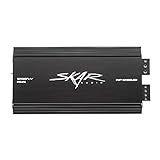
- Class D MOSFET Monoblock Power Amplifier
- Peak Power at 1 Ohm: 1,600 Watts | RMS Power at 1 Ohm: 1,200 Watts
- Frequency Response: 20Hz - 250Hz, On-board Bass EQ Switch with +6 or +12dB...
The Skar Audio RP-1200.1D is a powerful and reliable monoblock amplifier that has gained popularity among car audio enthusiasts for its robust performance and affordability. This Class D amplifier is designed to deliver high power output with exceptional efficiency, making it an excellent choice for those looking to upgrade their car audio system without breaking the bank.
One of the standout features of the Skar Audio RP-1200.1D is its impressive power handling capability. It can produce up to 1,200 watts of power at 1 ohm, ensuring that even the most demanding subwoofers receive the power they need to perform optimally. This level of power output is ideal for creating deep, impactful bass that enhances the overall listening experience.
In addition to its power, the RP-1200.1D boasts a range of features designed to enhance sound quality and performance. It includes a variable low-pass filter, allowing users to fine-tune the frequency response to match their specific audio preferences. The amplifier also features a bass boost function, providing an extra punch to the low-end frequencies for those who crave more bass.
Stinger Audio MT15001
No products found.
The Stinger Audio MT15001 is a compact Class D monoblock intended for subwoofer systems that need more output than a modest single-sub upgrade. Within this shortlist, it occupies a higher-output position without moving into extreme competition-amplifier territory.
Published ratings commonly specify 1,500 watts RMS into 1 ohm, 1,000 watts into 2 ohms, and 600 watts into 4 ohms. Confirm those figures against the documentation supplied with the exact unit, including the stated electrical conditions.
That spread makes the amplifier useful across several configurations. A system targeting approximately 1,000 watts can use a supported 2-ohm load rather than automatically pursuing the lowest available impedance.
Its compact format helps with placement, but physical size should not be confused with modest electrical demand. Delivering this much output still requires substantial current, suitable power distribution, and installation space that permits cooling.
Adjustable filtering and remote bass-level control support everyday setup and operation. Nevertheless, a remote control is not a substitute for correctly setting gain, and bass boost should not be used to compensate for an unsuitable enclosure.
The main drawback is the supporting installation expense. Wiring, signal integration, mounting, and potential electrical-system improvements can narrow the apparent value gap between amplifiers.
It makes the most sense for drivers who already know their subwoofers’ combined RMS handling and final wired impedance. Buying this much amplifier before choosing the enclosure and drivers reverses the sensible planning order.
Verdict: A strong higher-output candidate when installation quality receives the same attention as amplifier wattage.
Sundown Audio SFB-2000D

- High-Output Mono Power: 2000W RMS at 1 Ohm (up to 2,350W at 14.4V), 1500W...
- Full-Bridge Class D Design: Signature SFB-series full-bridge topology with...
- Dialed-In Bass Tuning: 12 dB/Octave variable low-pass filter plus 0-12dB...
The Sundown Audio SFB-2000D targets enthusiasts building a substantially more demanding subwoofer installation. Its advertised 2,000-watt RMS category places it above the everyday-upgrade end of this shortlist.
The critical compatibility point is its 1-ohm minimum supported load. Do not borrow specifications from a similarly named SFB revision or assume that output figures from another Sundown series apply. Confirm the exact model designation and its power-rating conditions before matching drivers.
This amplifier suits buyers who understand that high output depends on the entire installation. Battery condition, charging capacity, wiring resistance, grounding, and enclosure design can all affect whether the system performs reliably.
Its compact Class D construction can simplify mounting compared with a physically larger amplifier. However, compactness does not reduce the current required to produce a given amount of audio power.
Filtering controls help tailor the signal to the subwoofer system. For a ported enclosure, the protective high-pass or subsonic setting should reflect enclosure tuning rather than a generic setting copied from another vehicle.
The principal limitation is that this is not a casual replacement for an entry-level amplifier. A system designed around substantially lower power may need changes beyond the amplifier itself. Poor electrical support can cause voltage drop, protection events, or unreliable operation.
Its enthusiast positioning is most relevant when the subwoofers and enclosure can genuinely use the available output. Otherwise, the additional capacity may simply increase cost and setup demands.
Verdict: Best considered for a deliberately planned high-output system, with professional installation advisable when electrical upgrades or complex wiring are involved.
Alpine S-A60M

- 600W RMSx1 330W RMSx 1 S/N : 85 dBA
- preamp and speaker-level inputs
- variable bass boost
The Alpine S-A60M is a compact yet powerful monoblock amplifier that stands out for its exceptional performance and versatility. Designed for both car and home audio systems, this amplifier delivers a remarkable balance of power, sound quality, and reliability. With a maximum power output of 600 watts, the S-A60M is capable of driving a wide range of speakers, ensuring that your audio system delivers crisp and clear sound even at high volumes.
One of the key features of the Alpine S-A60M is its advanced Class D amplification technology. This technology allows the amplifier to operate efficiently, producing high power output with minimal heat generation. The result is a compact unit that fits seamlessly into various audio setups without compromising on performance. The amplifier’s compact size also makes it an ideal choice for installations where space is limited, such as in car audio systems.
The Alpine S-A60M is designed with sound quality in mind, offering precise sound reproduction with excellent clarity and detail. It features a variable low-pass filter and a bass boost function, allowing users to customize their audio experience to suit their preferences. These features enable the amplifier to deliver deep, impactful bass and a well-balanced soundstage, enhancing the overall listening experience.
Taramps HD 2000

- Class-D Technology
- Monoblock Car Amplifier
- Class-D amplifier
The Taramps HD 2000 is a high-performance monoblock amplifier that has become a favorite among audio enthusiasts for its exceptional power output and efficiency. Known for its robust design and impressive capabilities, this amplifier is engineered to deliver superior audio quality, making it an excellent choice for both car and home audio systems.
One of the standout features of the Taramps HD 2000 is its remarkable power handling capacity. With a maximum power output of 2000 watts, this amplifier is capable of driving even the most demanding speakers and subwoofers, ensuring that your audio system produces powerful, clear sound with minimal distortion. This level of power output is ideal for those who enjoy high-energy music genres and seek an impactful listening experience.
The Taramps HD 2000 utilizes advanced Class D amplification technology, which enhances its efficiency and performance. This technology allows the amplifier to deliver high power output while minimizing heat generation, ensuring reliable operation even during extended listening sessions. The compact design of the amplifier makes it easy to integrate into various audio setups, providing a space-saving solution without compromising on performance.
Which monoblock amplifier fits your system: a full-range power amplifier for home speakers or a dedicated bass amplifier for your car? That distinction matters more than wattage, brand, or amplifier class.
The best monoblock amplifiers match your speakers’ electrical demands, your source connections, and your installation. Home listeners should start with the home-audio guidance below. Drivers can move directly to the five car-subwoofer candidates, which cover everyday bass upgrades through higher-output installations. These categories are not interchangeable.
Skar Audio RP-800.1D

- Class D MOSFET Monoblock Power Amplifier
- Peak Power at 1 Ohm: 1,200 Watts | RMS Power at 1 Ohm: 800 Watts
- Frequency Response: 20Hz - 250Hz, On-board Bass EQ Switch with +6 or +12dB...
The Skar Audio RP-800.1D is a Class D monoblock aimed at drivers building a straightforward aftermarket subwoofer system. Its appeal is accessible pricing combined with useful power at several common speaker loads.
Manufacturer-rated RMS output is 800 watts into 1 ohm, 600 watts into 2 ohms, and 370 watts into 4 ohms. Those differences are important: connecting a 4-ohm subwoofer does not produce the amplifier’s headline 800-watt output.
Its adjustable low-pass crossover helps keep higher frequencies out of the subwoofer. A subsonic filter offers additional tuning flexibility, particularly with a ported enclosure, while the included remote level control makes bass adjustment accessible from the driver’s seat.
This is a sensible budget-friendly candidate for an aftermarket radio with RCA outputs. Factory-radio installations need closer attention because a compatible signal interface may add cost and complexity.
The principal limitation is that its strongest output requires a 1-ohm final load. Your subwoofer’s voice-coil configuration must support that load without falling below the amplifier’s minimum rating. Wiring a convenient but incompatible combination is not a safe shortcut.
Its protection circuitry also does not eliminate the need for adequate ventilation or a reliable ground. Avoid mounting it where carpet, luggage, or trim can obstruct heat dissipation.
Verdict: A practical everyday option when your subwoofer wiring, RMS power handling, and source connections align with its specifications. Choose it for the complete system match, not because “800” appears in the model name.
Choosing the Right Monoblock Amplifier
RMS Power at the Final Speaker Load
Continuous output—often marketed as RMS power—is more useful than “peak” or “maximum” wattage. Even continuous ratings need context: speaker impedance, supply voltage, distortion, and bandwidth influence comparisons.
For cars, match amplifier output to the combined subwoofer RMS power handling at the final wired load. A “monoblock amp 1000 watt” search is only useful once you know whether your system presents 1, 2, or 4 ohms.
For home speakers, consider sensitivity, listening distance, desired volume, and impedance demands. Twice the amplifier power provides only about 3 dB more theoretical headroom, so wattage alone is a poor ranking system.
Impedance and Wiring Compatibility
Speaker impedance is an electrical load that varies with frequency. Nominal impedance is a useful category, not a guarantee that the load never drops lower.
Never wire below the amplifier’s supported minimum.
Dual-voice-coil wiring example: One subwoofer with two 4-ohm voice coils can present 2 ohms when the coils are wired in parallel, or 8 ohms when wired in series. Both coils must be connected appropriately.
Multiple speaker terminals do not necessarily mean multiple amplifier channels. Many mono amplifiers provide duplicated terminals connected internally to the same output.
Input Compatibility
Home power amplifiers usually need RCA or balanced XLR inputs from a suitable preamplifier, processor, or volume-controlled source. Balanced connections can help reject interference over longer cable runs, but connector type alone does not guarantee better sound.
Car amplifiers may accept RCA signals, speaker-level inputs, or both. A factory radio can also require signal summing, equalization correction, or a compatible interface.
Alternatives such as the Alpine S2-A60M, Kicker 46CXA800.1T, and JL Audio JD1000/1 should likewise be checked by exact model and input requirements rather than brand alone.
Installation and Total System Cost
Home stereo generally requires a pair of monoblocks, two power connections, suitable signal cables, and ventilated placement. Tube models add maintenance and replacement-tube costs.
Car installations need appropriately sized power wiring, source-side fuse protection, a sound ground, secure mounting, and sufficient electrical capacity. Follow model-specific instructions; there is no universal cable gauge or fuse recommendation.
Warranty eligibility matters too. Confirm authorized-seller requirements and installation conditions before purchasing. Professional installation is especially valuable for factory-radio integration and higher-current systems.
FAQ
What is a monoblock amplifier?
A monoblock amplifier is a power amplifier with one audio channel. Home stereo systems typically use two monoblocks, one for each speaker. Car-audio monoblocks commonly power subwoofers. “Monoblock” describes the channel configuration, not the amplifier class, frequency range, or guaranteed sound quality.
Which class amplifier is best for sound quality?
No amplifier class automatically provides the best sound quality. Class A, Class AB, and Class D can perform well when properly designed and operated. Gallium nitride, or GaN-FET, switching devices do not guarantee superiority either. Compare measured performance, noise, speaker compatibility, available output, and thermal behavior instead.
What is a 2 channel amp?
A 2 channel amp contains two independent amplification channels, typically used for left and right speakers. One monoblock provides one channel, while two monoblocks can provide stereo amplification. Some two-channel amplifiers support bridged mono operation, but bridging is safe only when the manufacturer explicitly supports the configuration and connected load.
Do monoblock amplifiers sound better than stereo amplifiers?
Monoblocks do not automatically sound better than stereo amplifiers. Separate chassis can provide independent power supplies, greater channel isolation, and flexible placement near speakers. Whether those advantages become audible depends on circuit design, listening conditions, speaker demands, and the performance of the stereo amplifier being compared.
Can I use a car monoblock amplifier in a home audio system?
A car monoblock can operate at home with a suitable regulated DC power supply, but high current demand makes this inconvenient and potentially expensive. Many car mono amplifiers are also restricted to subwoofer frequencies. For full-range home speakers, a purpose-built home power amplifier is usually simpler.
Conclusion
Choosing a monoblock amplifier starts with the application, then moves to speaker load, usable continuous power, source compatibility, and installation requirements. More wattage is not automatically better, and a low purchase cost can conceal substantial supporting expenses. Establish your speaker configuration first, verify the amplifier’s complete specifications, and budget for safe installation. That approach produces a more dependable system than choosing by headline power or amplifier class alone.